
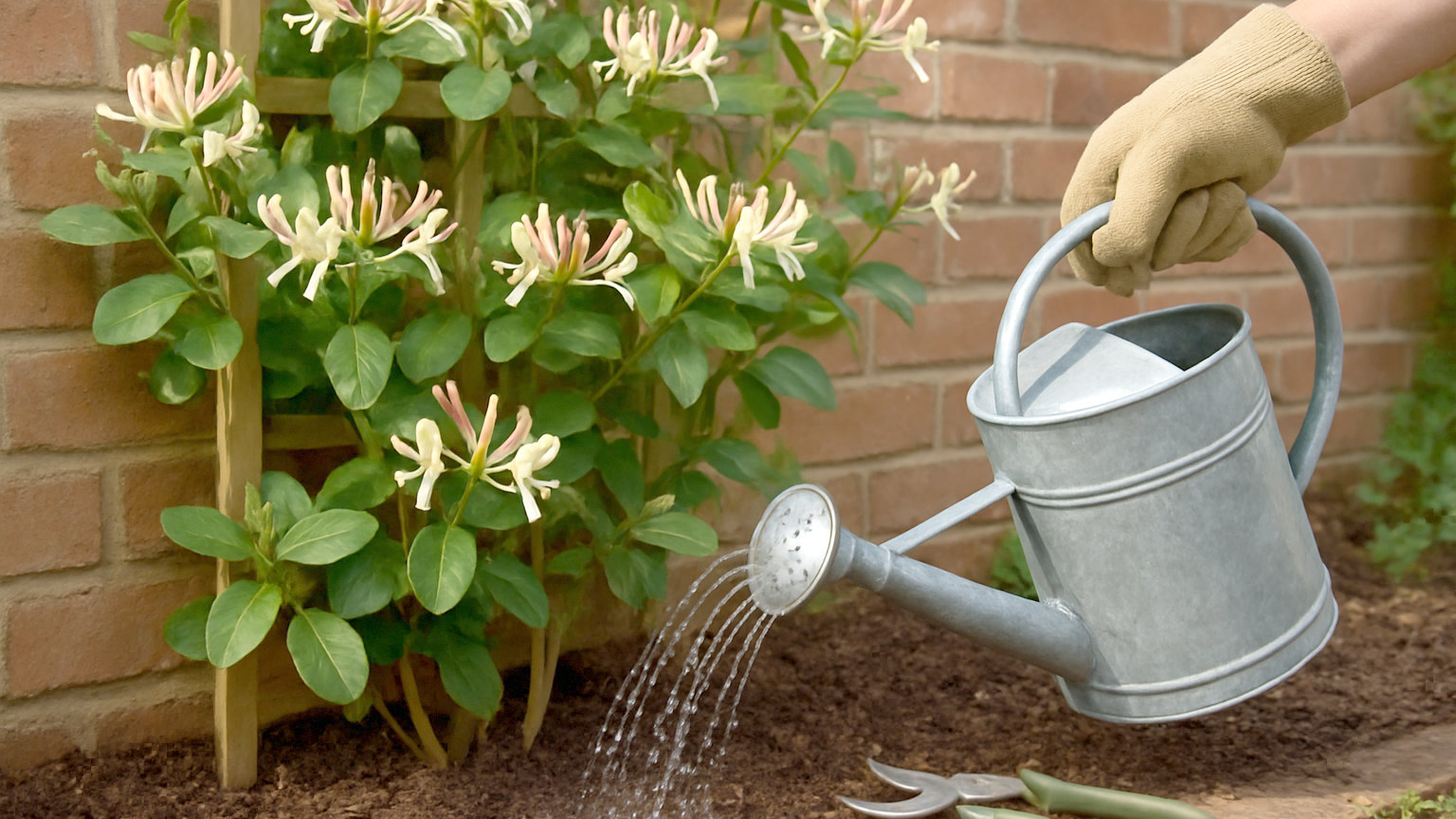
Honeysuckle is among the best-scented climbers in a British garden and among the most commonly disappointing, usually because of one thing: the roots are too dry.
Cool roots, sunny top
Honeysuckle wants its roots in cool moist shade and its top growth in sun. That combination is what produces good flowering and healthy foliage.
In the wild it grows up through hedgerows and woodland edges, with the base shaded by other plants and the flowering growth reaching the light above.
In a garden, achieve it by shading the root area with a low shrub, perennials or a slab, and mulching generously each spring. Dry roots produce sparse flowers and heavy mildew.
Add plenty of organic matter at planting and water thoroughly through the first two seasons and in every dry spell afterwards.
The main types
Lonicera periclymenum is the native woodbine, deciduous, twining, and the most strongly scented. Belgica is the early Dutch honeysuckle flowering in May and June; Serotina is the late Dutch flowering from July to September. Growing both gives a long season.
Lonicera japonica is semi-evergreen and considerably more vigorous, flowering over a very long period with a strong sweet scent. Halliana is the common form. It can become a nuisance if unchecked.
Lonicera x tellmanniana and tragophylla have showy coppery-orange flowers, tolerate shade well and have little or no scent.
Lonicera fragrantissima and x purpusii are shrubs rather than climbers, flowering in winter with excellent fragrance.
Planting
Plant at least forty-five centimetres out from a wall, since the ground immediately against one is dry and sheltered from rain by the eaves.
Provide wires, trellis or netting, since honeysuckle twines and cannot grip a flat surface. Guide the first shoots around the support by hand and afterwards it manages alone.
It also grows extremely well through a large shrub, a small tree or a hedge, which suits its natural habit and solves the support question entirely.
Pruning
Most honeysuckles flower on growth made the previous year, so prune immediately after flowering rather than in winter.
Cut the flowered shoots back by about a third, and remove some of the oldest stems at the base to keep the plant renewed.
Left unpruned, honeysuckle becomes a bare tangle of stems with a mass of growth and flowers only at the top, which is the usual state of a neglected plant.
A badly overgrown specimen can be cut back hard in late winter, to about sixty centimetres. It will regrow vigorously and lose a season's flowers.
Late-flowering Japanese honeysuckle, which flowers on the current season's growth, is pruned in early spring instead.
Mildew and aphids
Powdery mildew is the characteristic honeysuckle problem, showing as a white dusty coating from midsummer.
It is caused by dry roots combined with humid air rather than by wet conditions. Watering, mulching and improving airflow are the effective responses, and a honeysuckle in an airless corner with dry soil will mildew every year regardless of anything else.
Aphids gather heavily on the soft growing tips and flower buds. On an established plant they are a temporary nuisance and the predators catch up. Squash them or wash them off if numbers are high.
Why it might not flower
Too much shade on the top growth, since honeysuckle needs sun to flower even though the roots want shade.
Pruned at the wrong time, removing the wood that would have carried the flowers.
Too much nitrogen, producing lush growth and few flowers.
Simply too young, since a newly planted climber may take two or three years to settle.
A caution
Honeysuckle berries are toxic if eaten and appear in autumn in attractive clusters. They are worth knowing about where small children use the garden.
Birds eat them readily and the plant is a valuable wildlife climber, providing nectar for night-flying moths and dense cover for nesting birds.
Growing it in a container
Honeysuckle can be grown in a large pot with an obelisk, though it is demanding about water and the roots have nowhere cool to retreat to. Use a soil-based compost, a container of at least fifty centimetres, and shade the pot itself with other planting or by grouping containers.
Expect to water daily in summer and to repot every two or three years.


