
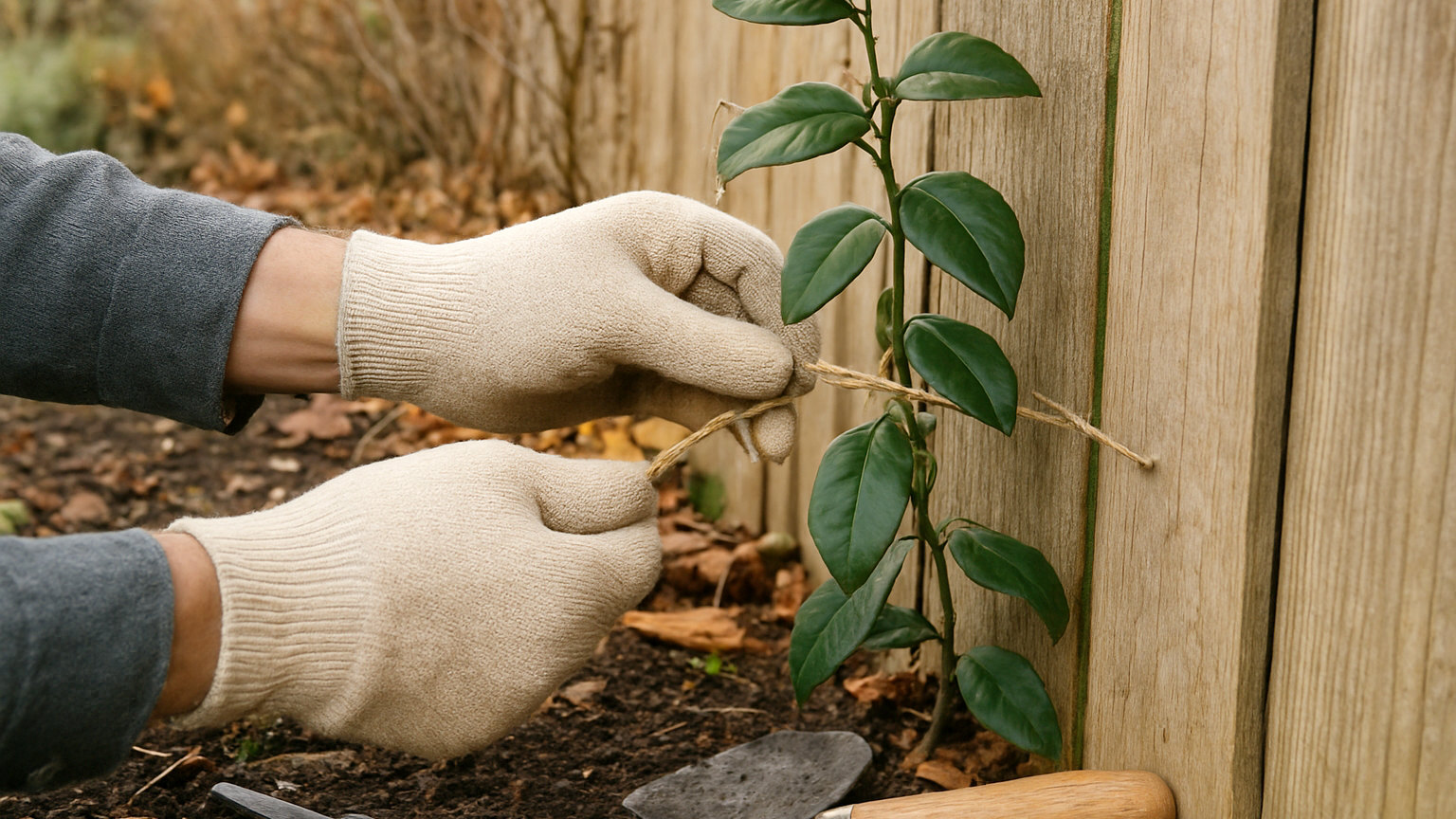
Most of the best-known climbers are deciduous, which means a wall or fence that is covered in July is bare in January. A small group hold their leaves year round, and they are what you need for screening or for a boundary that has to work in winter.
Ivy
The toughest and most tolerant, thriving in deep shade, poor soil and exposure, and requiring nothing at all.
It is self-clinging, so it needs no support, and it is the only evergreen climber that will genuinely cover a bare north-facing wall unaided.
Variegated forms brighten a dark area and need slightly more light to hold their colour. Large-leaved species such as Hedera colchica cover ground faster.
Its wildlife value is exceptional, flowering in autumn and berrying in late winter when both are scarce.
Star jasmine
Trachelospermum jasminoides is the best evergreen climber for a sunny sheltered wall: glossy dark foliage, white pinwheel flowers in midsummer, and a powerful sweet scent.
It is borderline hardy and needs the warmest position you have. In a cold exposed garden it will not survive a hard winter.
It is slow to establish, often taking three or four years before it climbs and flowers properly, and it twines so it needs wires or trellis.
Trachelospermum asiaticum is slightly hardier and worth choosing in a colder garden.
Evergreen clematis
Clematis armandii has long leathery leaves and scented white flowers in March and April. It is vigorous, reaching five metres, and needs a sheltered sunny wall since the foliage scorches in cold wind.
Clematis cirrhosa flowers through winter, from November to February, with nodding cream bells often speckled inside. Freckles and Wisley Cream are the common forms.
Both belong to pruning group one, meaning they are pruned only if necessary and only immediately after flowering.
Cirrhosa drops its leaves in summer, which is normal and looks alarming the first time.
Other options
Euonymus fortunei, usually grown as a shrub, will climb a wall by producing aerial roots if planted against one. Silver Queen and Emerald Gaiety both work, giving a modest height and reliable evergreen cover in almost any conditions.
Pileostegia viburnoides is a self-clinging evergreen relative of climbing hydrangea, shade tolerant, slow and underused.
Garrya elliptica is a wall shrub rather than a climber, evergreen with long grey catkins in winter, and it can be trained flat against a shaded wall.
Lonicera japonica is semi-evergreen, holding most of its leaves in a mild winter and losing them in a hard one.
The trade-offs
Evergreen climbers offer fewer flowers and less seasonal drama than deciduous ones. Ivy has no showy flowers at all, euonymus very little.
They are also heavier in winter, since they carry foliage through gales, so supports need to be correspondingly stronger.
An evergreen climber on a house wall keeps the wall permanently shaded and slightly damper, which is fine on sound masonry and unhelpful on anything already in poor condition.
Combining evergreen and deciduous
A common solution is to grow both on the same structure: an evergreen for winter cover, with a deciduous climber for summer flowers threading through it.
Ivy with a viticella clematis, or a evergreen backdrop with a summer-flowering climber, gives cover all year and a display in season.
Choose a clematis from group three for this, since it is cut hard in February and does not tangle permanently with its host.
Winter protection
The borderline evergreens, particularly trachelospermum and clematis armandii, benefit from a thick mulch over the root area in late autumn.
Fleece the top growth in a severe frost if the plant is small enough, and do not cut frost-damaged growth until spring, since it protects what is beneath.
Where they earn their place
Evergreen climbers are most useful on a boundary that needs to screen year round, on a wall seen from the house in winter, and anywhere a bare fence would otherwise be visible for six months.
They are less useful in a border, where deciduous climbers give more seasonal interest and let winter light through to whatever is planted beneath them.
Establishing them
Evergreens lose water through their leaves all year, so they need more attention in their first two seasons than deciduous climbers do, particularly in cold drying winds.
Plant in autumn or mid-spring rather than midwinter, water thoroughly through the first two years, and mulch generously.


