
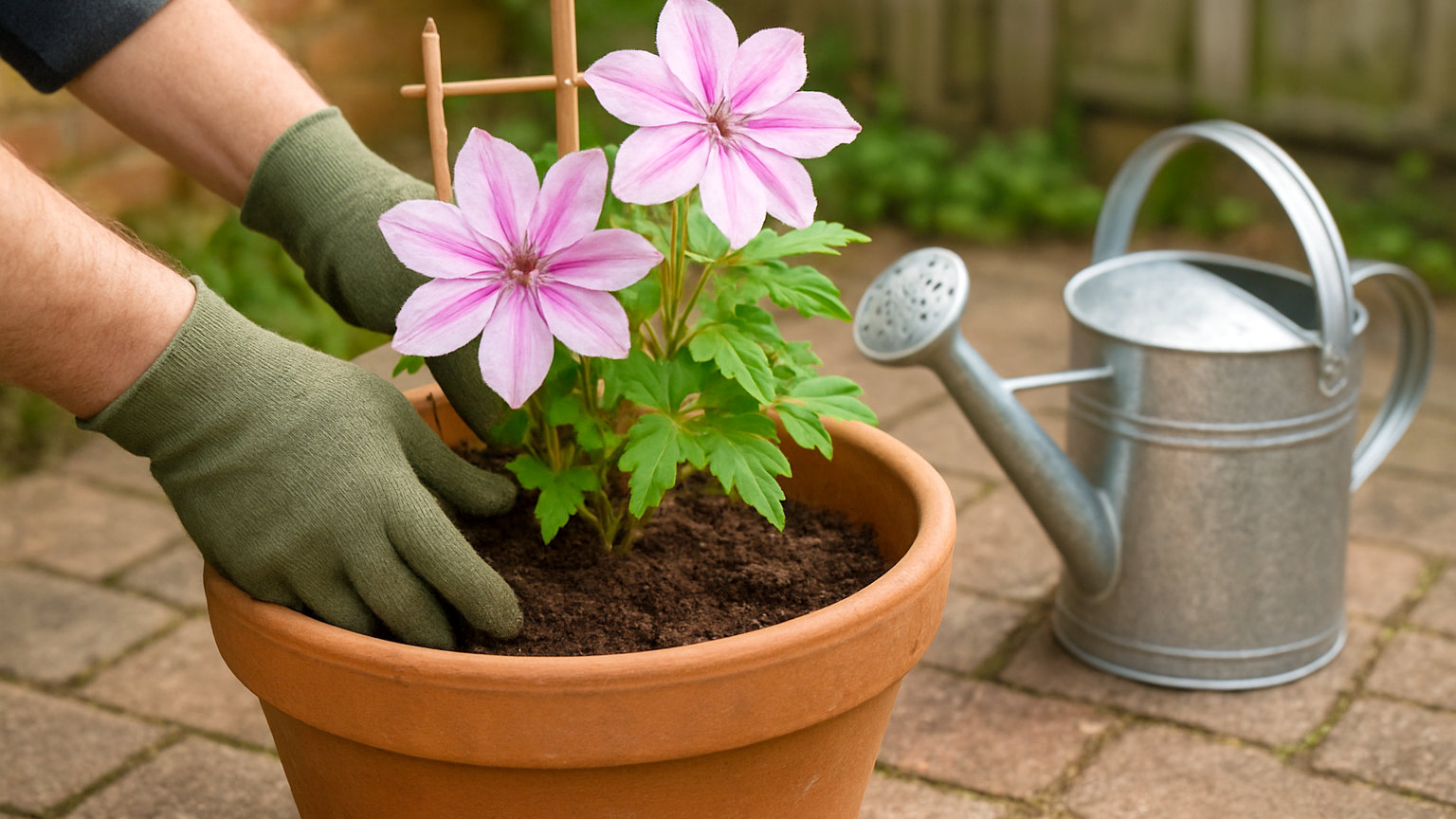
Climbers in containers make a patio, a balcony or a paved yard productive, and they let you have height where there is no soil at all. The limits are root volume and water, and both need planning rather than improvisation.
Pot size
Larger than instinct suggests. Forty-five centimetres across and deep is a realistic minimum for most climbers, and fifty or more is better for anything long-term.
Depth matters as much as width, since most climbers root deeply. A wide shallow bowl is the wrong shape.
Undersized pots dry out within hours in summer, exhaust their nutrients quickly and produce a permanently stressed plant that flowers poorly.
Weight is an advantage here, since a climber in leaf catches wind. Heavy pots blow over far less readily than light ones.
Compost
Use a soil-based compost such as John Innes No. 3 rather than multipurpose.
It holds water and nutrients far longer, does not collapse in structure over a season, and its weight stabilises a top-heavy plant. Multipurpose compost in a climber pot is exhausted and structureless within a year.
Ensure good drainage holes and stand the pot on feet so water escapes freely.
Put the support in at planting
An obelisk, a trellis panel or canes must go into the pot when you plant, not afterwards. Pushing a support into an established rootball damages the roots badly.
Choose something that fits the pot in scale and can be anchored properly. A tall obelisk in a small pot is unstable in wind.
If the container sits against a wall, wires or trellis on the wall can carry the plant instead, with the pot simply supplying the roots.
Which climbers suit pots
Clematis are the best subject, particularly the compact large-flowered varieties and the group three types that are cut to the ground each February. Plant them deep, five to eight centimetres below the compost surface, as insurance against wilt.
Annual climbers are ideal, since they occupy the pot for one season: sweet peas, morning glory, black-eyed Susan and climbing nasturtiums.
Compact climbing roses work in a large pot with reliable watering.
Trachelospermum does well and has the advantage that the pot can be given extra winter protection.
Honeysuckle can be grown in a large container, though it is demanding about water and needs its roots shaded.
Wisteria, vigorous ramblers and Virginia creeper are all unsuitable, being far too vigorous for a restricted root run.
Watering
This is where container climbers fail. Daily watering in summer is normal and twice daily in a heatwave against a hot wall.
Water thoroughly until it runs from the base rather than sprinkling the surface, and check by pushing a finger into the compost.
Mulch the compost surface with gravel, group pots together, and consider a drip system on a timer if you are away during the day. Clematis in particular resent drying out.
Feeding
Compost is exhausted within about six weeks, after which the plant depends entirely on you.
Feed weekly through the growing season with a high-potassium tomato feed once flowering begins, and stop by about mid-August so late soft growth is not caught by frost.
Top dress each spring, scraping off the top five centimetres of compost and replacing it with fresh mixed with slow-release fertiliser.
Repotting
Every two or three years, in winter while dormant, either move up a pot size or root prune and replant into the same pot with fresh compost.
A climber left in exhausted compost for five years declines steadily whatever you feed it.
Winter
Roots in a pot freeze far more readily than roots in the ground. Move containers against a house wall, wrap the pot rather than the plant, and raise it on feet so it is not standing in water.
Waterlogging over winter kills more container plants than cold does, so check drainage holes are clear and remove any saucer in autumn.
Underplanting the pot
The compost surface of a large container can carry low planting that shades the root area, which clematis in particular appreciate. Small hardy geraniums, thyme or spring bulbs all work.
Keep it modest, since anything vigorous competes with the climber for water in exactly the weeks it can least afford it.


