
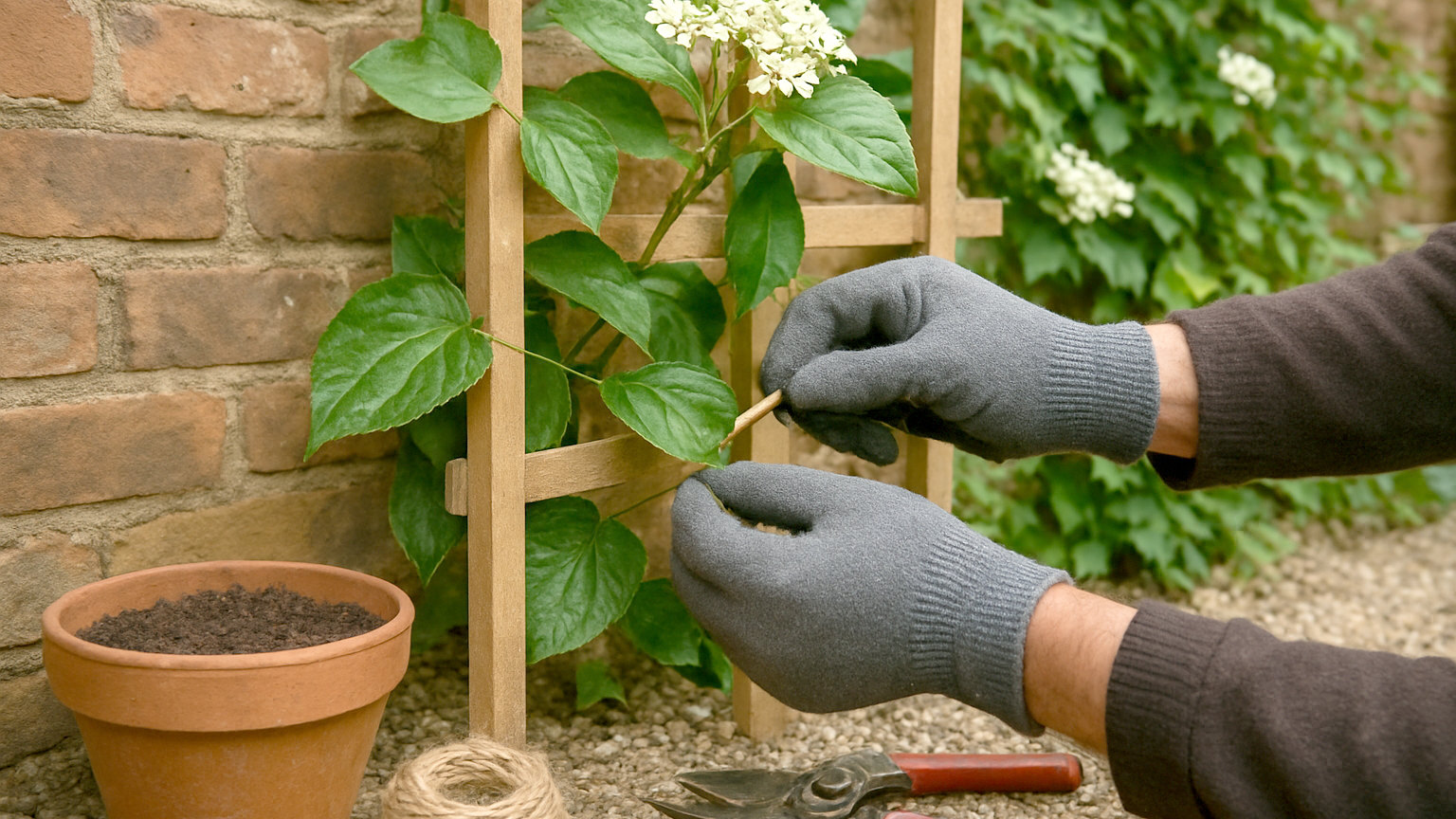
A north-facing wall is one of the more useful surfaces in a garden once you accept what will grow on it. Several excellent climbers prefer those conditions, and one of them is among the best plants available for the purpose.
Climbing hydrangea
Hydrangea anomala subsp. petiolaris is the outstanding choice for a shaded wall. It is self-clinging, needs no support at all, and produces flat lacecap flowerheads in June against handsome foliage, with good yellow autumn colour and attractive peeling bark in winter.
The one thing to know is that it is slow to start. It commonly takes three or four years to do anything much, and many people conclude it has failed and remove it in year two.
Plant it, water it, tie the first stems loosely against the wall to encourage contact, and be patient. Once established it grows steadily and eventually covers a large area.
It needs very little pruning, just the removal of anything outgrowing its space after flowering.
Schizophragma
Very similar in habit and appearance to climbing hydrangea, self-clinging and shade tolerant, with elegant flowerheads. Schizophragma hydrangeoides Moonlight has silvery foliage.
It is equally slow to establish and slightly less commonly grown, which is a matter of availability rather than quality.
Ivy
The most tolerant climber there is. Self-clinging, evergreen, thriving in deep shade, and requiring nothing.
Variegated forms brighten a dark wall considerably, though they need a little more light than the plain green species to hold their colour.
Its wildlife value is exceptional, flowering in autumn when little else does and berrying in late winter.
Clematis for shade
Several tolerate a north or east wall well.
Clematis alpina and macropetala flower in April and May, are fully hardy and cope with shade and exposure. They need almost no pruning.
Clematis montana is vigorous and flowers well in part shade, though it needs a large area.
Among the large-flowered hybrids, pale varieties actually prefer shade, since strong sun bleaches their colour. Nelly Moser is the classic example and is better on a north wall than a south one.
Honeysuckle
Lonicera x tellmanniana and Lonicera tragophylla both tolerate shade well, with showy coppery-orange flowers. Neither is scented, which is the trade.
The native woodbine will grow on a shaded wall and flowers less freely than it would in sun.
Other options
Pileostegia viburnoides is an evergreen self-clinging relative of climbing hydrangea, slow and worth knowing.
Parthenocissus, the Virginia creeper and Boston ivy, are self-clinging, tolerate shade and give spectacular autumn colour. Both are very vigorous, cover large areas quickly and are frequently planted against something far too small.
Among wall shrubs rather than true climbers, pyracantha, chaenomeles and garrya all perform on a shaded wall and can be trained flat against it with wires.
The dry soil problem
Shade is rarely the main limitation on a north wall. Dryness is.
The ground at the base of any wall is dry, because the eaves shed rain away from it and the masonry draws moisture. Combined with shade, that is what defeats most plantings.
Plant at least forty-five centimetres out from the wall, leaning the plant inwards. Improve the ground generously with compost before planting, mulch every spring, and water thoroughly for the first two years and in every dry spell afterwards.
What to expect
Everything happens more slowly in shade. Growth is less vigorous, flowering is later and lighter, and establishment takes longer.
Judge a shaded climber in its third or fourth season rather than its first. The self-clinging ones in particular reward patience and punish impatience.
Helping them start
Self-clinging climbers need contact with the surface before they will grip. Tie the young stems loosely against the wall with soft twine, or hold them there with adhesive pads, until the aerial roots take hold.
Spread the initial growth out low and wide rather than letting a single stem head for the top, or the base will be permanently bare.
East-facing walls
An east wall is a separate case from a north one. It gets morning sun, which is a problem rather than a benefit for anything whose buds may be frosted, since rapid thawing damages them.
Avoid camellias and magnolias there, and be cautious with early-flowering clematis whose buds may be caught.


