
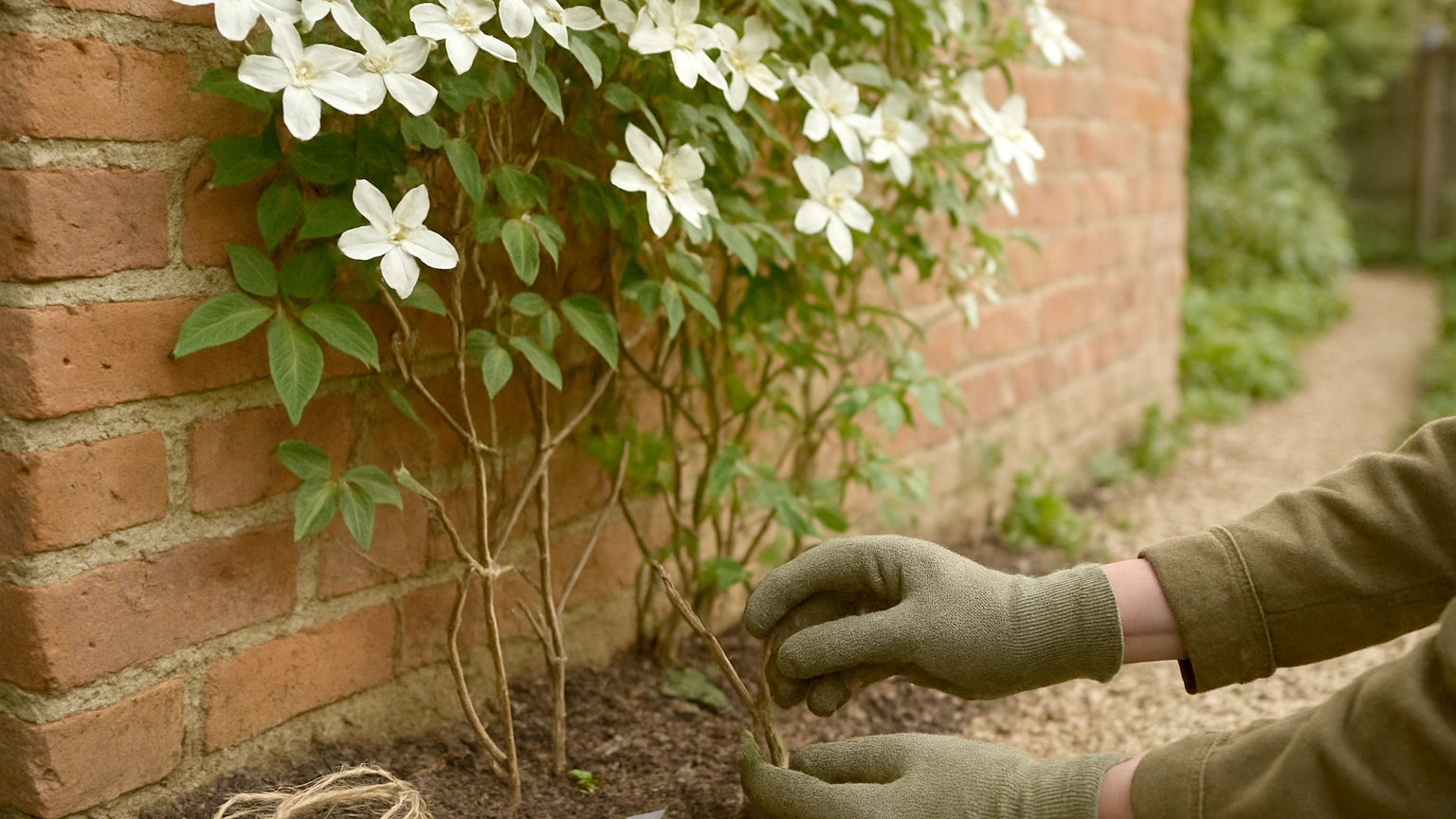
Climber problems fall into a few recognisable patterns, and each points to a specific cause. Working through them in order usually identifies what has gone wrong within a few minutes.
Flowers only at the top
The commonest complaint, and it is a training issue rather than a fault of the plant.
An upright stem flowers only at its tip, because the bud at the top suppresses those below it. A stem trained horizontally breaks that dominance and produces flowering shoots along its whole length.
The fix is to untie the main stems, lower them and retie them horizontally or arching downwards. Flowering shoots break along the length within a season.
Where the base is bare old wood with no buds left, cut one or two of the oldest stems right down to about thirty centimetres to force new growth from the base, accepting a reduced display for a year.
No flowers at all
Five likely causes, in order.
Pruned at the wrong time. Anything flowering on last year's wood, including most spring climbers, ramblers, honeysuckle and summer jasmine, loses its display entirely if cut in winter.
Too much shade. Most climbers need sun on the top growth even where they tolerate shaded roots.
Too much nitrogen. Lush dark leafy growth with no flowers usually means feeding, or a lawn fertiliser applied nearby.
Too young. Many climbers take three or four years to settle, and wisteria grown from seed may take fifteen or never flower at all.
Frost damage. Buds killed in spring on an exposed or east-facing wall remove that year's flowers without harming the plant.
It will not cling to the wall
Almost always the wrong support for the type of climber.
Twiners and tendril climbers cannot grip a flat surface or a broad trellis batten. They need wires, netting or something thin to wrap around.
Scramblers, including all climbing and rambling roses and winter jasmine, cannot attach to anything at all and must be tied in.
Self-clinging climbers do grip bare walls but are slow to start, often taking two or three years. Tie the young stems against the surface until the aerial roots take hold.
Poor growth against a wall
Dry soil is the most underestimated problem in the garden. The ground at the base of a wall is sheltered from rain by the eaves and dried by the masonry.
Plant at least forty-five centimetres out, leaning the plant inwards. Improve the ground generously before planting, mulch every spring, and water thoroughly for two years and in every dry spell afterwards.
Poor growth blamed on aspect or soil type is frequently just drought.
Clematis wilt
Sudden collapse of the top growth on a large-flowered hybrid, often just as the buds are about to open, with stems blackening near the base.
It looks fatal and usually is not. Cut affected stems back to healthy tissue or to ground level, remove the material rather than composting it, and keep the plant watered and fed.
A clematis planted five to eight centimetres deep will reshoot from buds below soil level, which is precisely why deep planting is recommended. Viticella and the small-flowered species are far more resistant.
Mildew
Common on honeysuckle, roses and clematis in still air. It is caused by dry roots combined with humid air rather than by wet conditions.
Water and mulch, hold supports clear of the wall so air circulates behind the plant, and thin congested growth.
It has outgrown the space
Usually a buying decision rather than a growing problem. Russian vine, Clematis montana, vigorous ramblers and Virginia creeper all cover far more than most gardens intend.
Prune annually and on time, or replace with something of appropriate vigour. A plant that needs cutting three times a year to stay in bounds is the wrong plant.
Wind damage
Stems torn from supports in a gale. Tie in regularly through the growing season while stems are flexible, use plenty of ties rather than a few, and check supports and fixings annually.
A mature climber in full leaf exerts considerable force in wind, and supports sized for the plant you bought will not hold the plant you have in ten years' time.
The check that answers most questions
Ask three things: is it getting enough sun, is the soil at its base actually moist, and was it pruned at the right time for its type. Those three account for the great majority of climber failures.


