
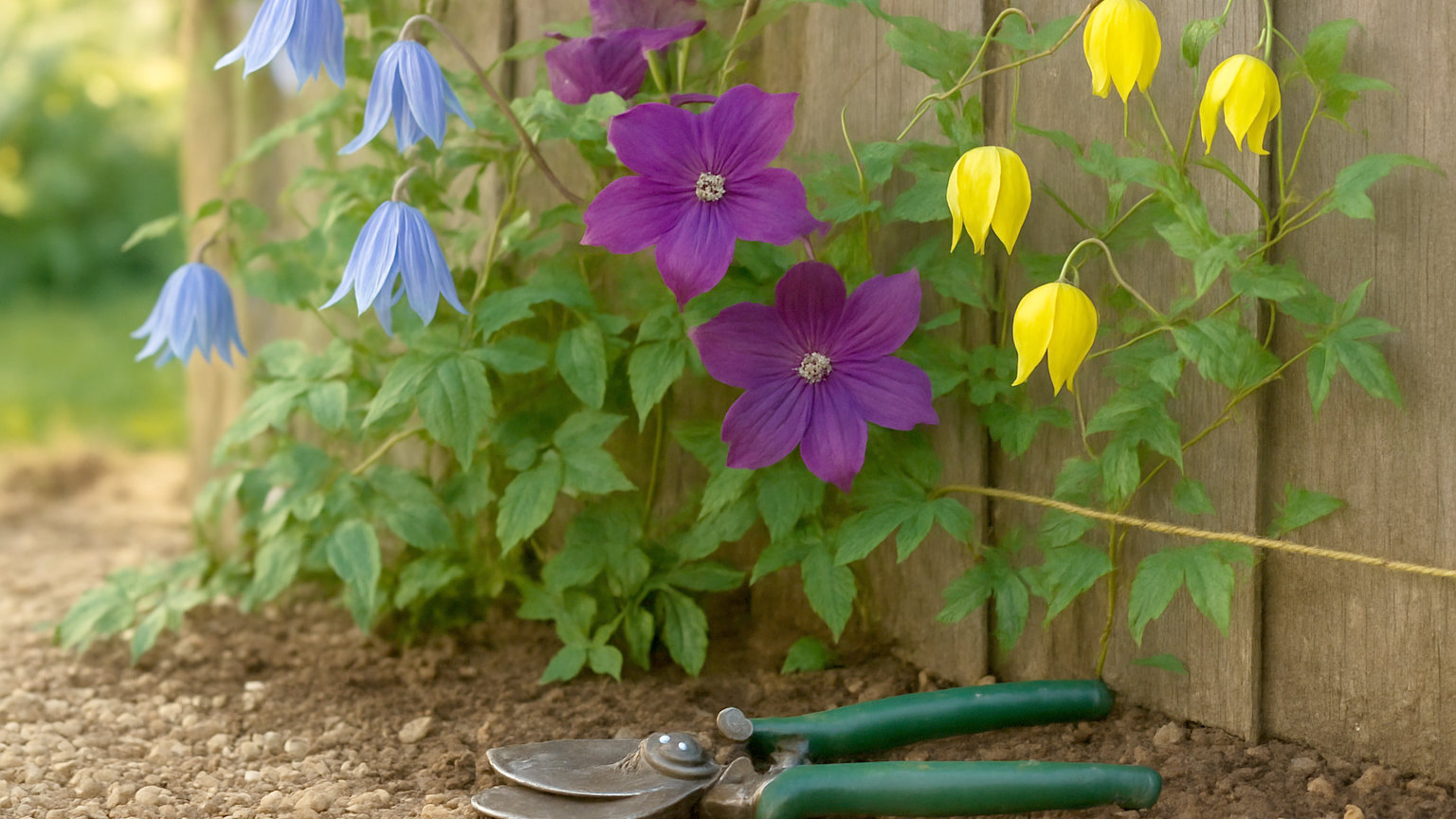
Clematis is a large enough genus that with four or five well-chosen plants a garden can have one in flower for most of the year. The types differ enormously in size, hardiness and habit as well as in season.
Winter
Clematis cirrhosa flowers from November to February with nodding cream bells, often freckled maroon inside. Freckles, Wisley Cream and Jingle Bells are the common forms.
It is evergreen, needs a sheltered sunny wall, and reaches three or four metres. It drops its leaves in summer, which is normal and alarming the first time.
Being pruning group one, it needs cutting only to keep it in bounds, immediately after flowering.
Early spring
Clematis armandii flowers in March and April with clusters of scented white flowers against long leathery evergreen leaves. Vigorous at five metres, and needing shelter since the foliage scorches in cold wind.
Clematis alpina and macropetala flower in April and May with nodding bell-shaped flowers in blue, pink or white. Both are fully hardy, tolerate shade and exposure, stay at two or three metres and need almost no pruning.
These two are among the most useful clematis for a difficult position and are underplanted compared with the large-flowered hybrids.
Late spring
Clematis montana flowers in May with masses of small flowers in white or pink, sometimes scented.
It is extremely vigorous, reaching eight to ten metres, and is frequently planted against something far too small. Given a large wall, an outbuilding or a mature tree it is spectacular.
Pruning group one, trimmed after flowering if needed. It tolerates hard renovation and takes a couple of years to recover.
Early summer
The large-flowered hybrids, with dinner-plate blooms in May and June and often a lighter second flush later. Nelly Moser, The President, Niobe and dozens more.
These are pruning group two, needing only a light prune in February down to the first strong pair of buds.
Pale varieties such as Nelly Moser are better on a north or east wall, since strong sun bleaches the colour.
Late summer
Viticella clematis are the most useful group for a mixed border: masses of small to medium flowers from July to September, excellent disease resistance, and pruning group three so they are cut to thirty centimetres each February.
That hard annual cut means they never outgrow their space and never become a tangle, which makes them ideal for growing through shrubs and roses.
Étoile Violette, Polish Spirit and Madame Julia Correvon are all reliable.
Texensis and herbaceous types also flower late and are cut hard in the same way.
Autumn
Clematis tangutica and tibetana produce yellow lantern flowers from August, followed by silvery silky seedheads that persist well into winter and are arguably better than the flowers.
Vigorous, hardy and pruning group three, cut hard each February.
Clematis flammula gives clouds of small scented white flowers in late summer.
Combining them
Two clematis on one support doubles the season from a single planting position.
An early group one or two variety with a late group three works well, since the group three plant is cut to the ground in February and does not tangle permanently with its partner.
Growing a viticella through a shrub or a climbing rose is one of the most effective combinations in a garden, extending the host's season by two months at no cost in ground space.
What they all want
Heads in sun, roots cool and moist. Plant five to eight centimetres deeper than the plant was in its pot, as insurance against clematis wilt, and shade the root area with a slab, a low shrub or a mulch.
Feed in spring with a rose or general fertiliser and mulch generously. A sparse, poorly flowering clematis is frequently just underfed rather than wrongly pruned.
Knowing the pruning group
Everything above depends on knowing which of the three pruning groups a plant belongs to, and the label usually states it. If you have lost it, the flowering time tells you: early spring is group one, early summer group two, and midsummer onwards group three.
If genuinely unsure, treat it as group two and prune lightly. You may lose a few flowers that season and you will not lose the plant itself.


