
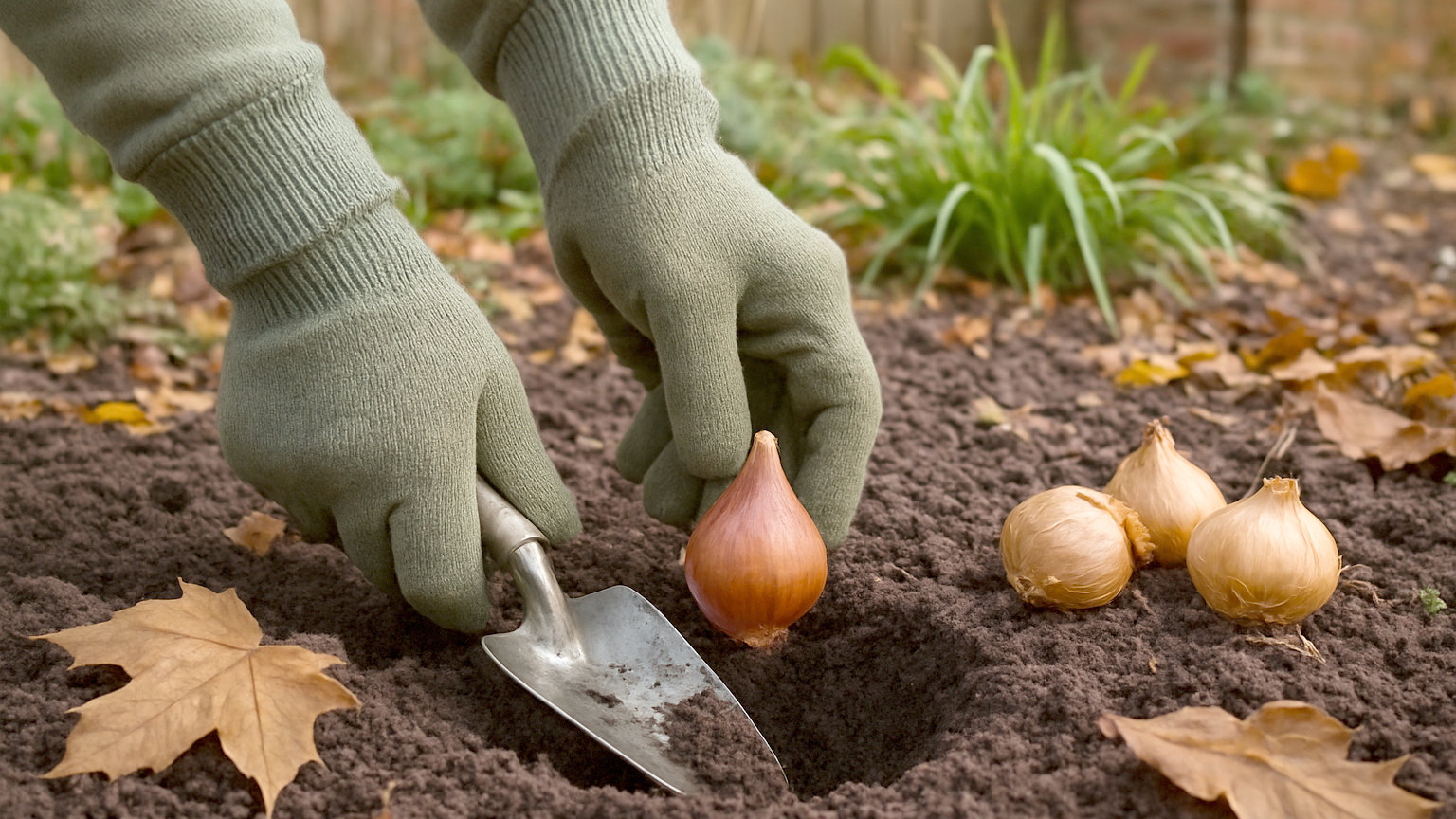
Plant daffodils and most spring bulbs from September to October, and plant tulips in November. That single difference catches people out every year, and it is the main reason tulips come back weakly or not at all. Almost everything else about bulbs comes down to planting them deep enough.
The autumn planting order
Bulbs need time to make roots before the ground gets cold, which is why most go in early. Daffodils and narcissi are first, ideally in September, and they resent being left in the bag into November. Crocus, snowdrops, alliums, muscari and hyacinths follow through October.
Tulips are the exception and want planting late, in November or even early December. Waiting until the soil has cooled reduces the risk of tulip fire, a fungal disease that thrives in warm damp ground, and it does the flowering no harm at all.
How deep to plant a bulb
The rule that works for nearly every spring bulb is to plant it at two to three times its own height, measured from the base of the bulb to the surface. A daffodil bulb five centimetres tall wants about fifteen centimetres of soil above it.
Shallow planting is the commonest mistake and it causes most of the problems people blame on the bulbs. Bulbs planted too near the surface dry out, split into many small offsets that are too weak to flower, and get pushed about by frost. Tulips in particular benefit from going deeper than feels necessary, and planting them at twenty centimetres noticeably improves the chance of a decent second year.
Point the bulb upwards if you can tell which end is which. If you genuinely cannot, plant it on its side and it will sort itself out.
Where they will be happy
Almost all spring bulbs need drainage above everything else. They evolved in places with dry summers, and a bulb sitting in wet ground through July is a bulb that rots. Heavy clay is workable if you add grit to the planting hole, but on badly drained ground pots are the more reliable answer.
Most want sun while they are in leaf, though that is easier than it sounds because they flower before deciduous trees come into leaf. Under a tree that is bare until May is a perfectly good position for daffodils and crocus.
Bulbs in pots
Pots give you drainage, portability and the option of layering. Planting in layers, sometimes called bulb lasagne, means putting the largest and latest bulbs deepest, a middle layer above them, and small early bulbs near the surface. Tulips at the bottom, daffodils in the middle, crocus or muscari on top gives eight weeks of flowering from one pot.
Use a peat-free compost with added grit, leave a couple of centimetres between bulbs so they are not touching, and stand the pot somewhere it will not sit in a saucer of water all winter.
What to do after flowering
Leave the leaves alone for six weeks after the flowers finish. This is the part that decides whether you get flowers next year. The foliage is refilling the bulb, and cutting it off early, tying it in knots or mowing over it starves the bulb for the following season. It looks untidy for about a month and there is no way round it.
Deadheading is worth doing on daffodils and tulips, because a bulb that sets seed puts energy into the seedpod rather than into itself. Snap the head off and leave the stalk.
Which come back and which do not
Daffodils, crocus, snowdrops, muscari and most alliums are reliably perennial and will spread over the years. Snowdrops establish far better planted in the green, in leaf just after flowering, than as dry bulbs.
Tulips are the difficult ones. Species tulips and the Darwin hybrids come back well, but many of the large showy varieties are effectively annual in British gardens, flowering magnificently once and then dwindling. That is not something you have done wrong. If you want tulips in the ground long term, plant them deep, choose varieties described as good for naturalising, and accept that some replanting comes with them.
If you have missed the window
Bulbs found at the back of the shed in January are still worth planting. They will flower later and possibly shorter, but a late-planted bulb almost always does better than one left in a paper bag until next autumn, by which time it will have dried out completely.


