
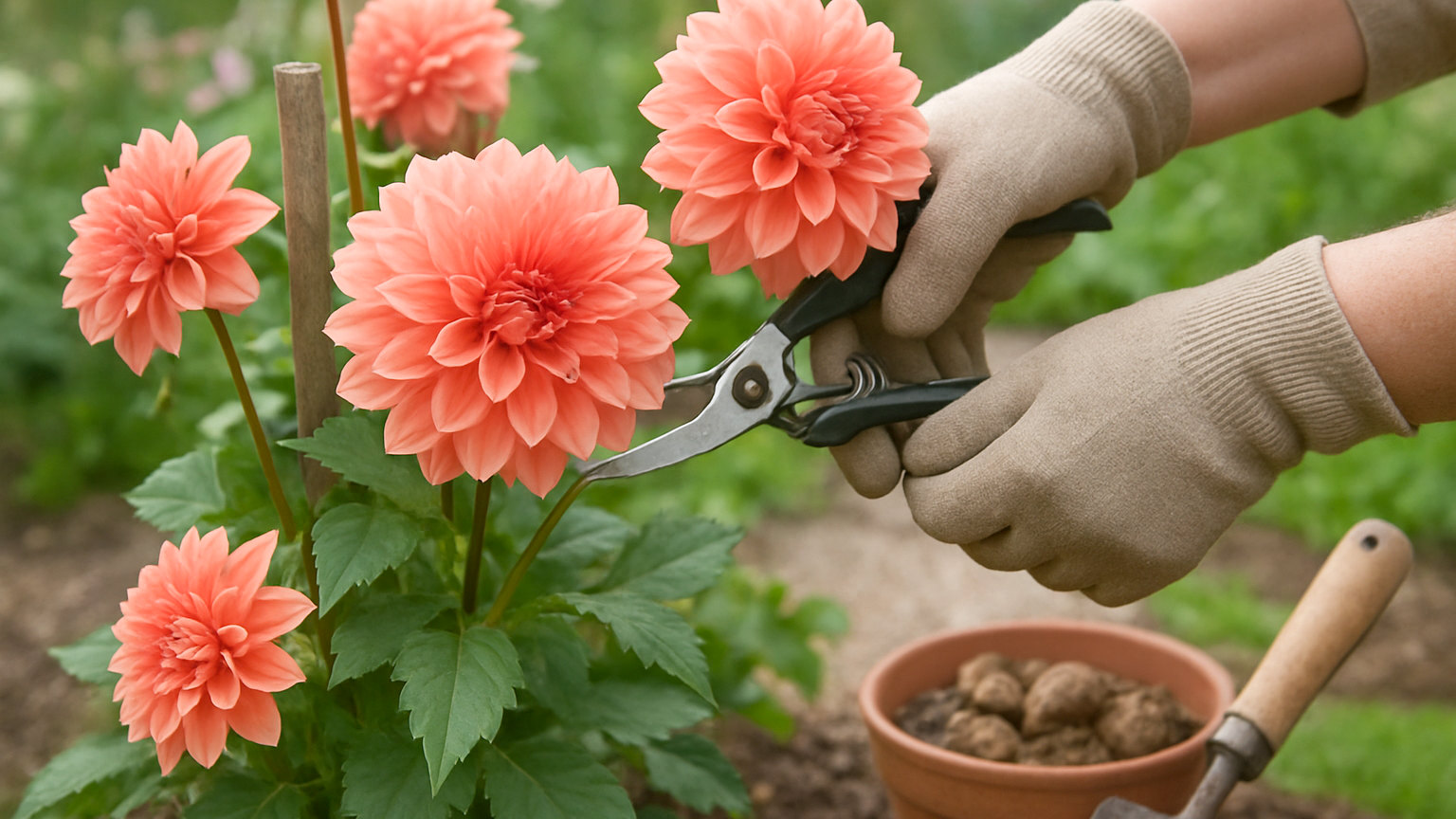
Dahlias give more flowers over a longer season than almost anything else in a border, running from July until the first frost blackens them. They ask for three things: warmth to start, support before they need it, and relentless deadheading.
Starting the tubers
Dahlia tubers are tender and cannot go outside until the frosts have finished, which in much of the country means the end of May. Planting them directly into cold soil in April achieves nothing.
The better approach is to start them under cover in April. Pot each tuber into a container just larger than itself, with the old stem base sitting just at compost level, and keep it somewhere frost-free and light. Water sparingly at first, since a tuber sitting in wet compost before it has shoots will rot, and increase watering as growth appears.
Plant out after the last frost, having hardened them off for a fortnight.
Position and soil
Full sun, at least six hours, and rich soil that holds moisture without waterlogging. Dig in plenty of compost or well-rotted manure before planting.
Space them generously, forty-five to sixty centimetres apart for most varieties and more for the large ones. Crowded dahlias develop mildew and produce fewer flowers.
Staking, done early
Put the stake in at planting, not when the plant needs it. A dahlia in full growth has brittle hollow stems and a heavy head of flowers, and driving a stake in beside an established plant spears the tuber. Set a stout cane or a stake at planting time and tie in as the plant grows.
Large-flowered varieties need substantial support, ideally three canes and string around them rather than a single tie. A dahlia snapped at the base in an August gale rarely recovers.
Pinching out
When the plant is about thirty centimetres tall with three or four pairs of leaves, pinch out the central growing tip. The plant then produces multiple side shoots instead of a single stem, giving a bushier plant and far more flowers.
It delays the first bloom by a week or two and roughly doubles the total. For exhibition-sized single blooms you would do the opposite and disbud, removing the two side buds beside each main bud.
Deadheading, which decides the season length
Dahlias stop flowering if allowed to set seed, so deadhead every few days. The difficulty is that spent dahlia flowers and unopened buds look similar at a glance.
The reliable test is shape. An unopened bud is round and firm. A spent flower going over is pointed and conical, and feels soft. Cut the whole stem back to a pair of leaves rather than snapping off the head, which leaves an ugly stub.
Slugs, and the first six weeks
Slugs and snails are the main threat, and they concentrate on new shoots at ground level in May and June. A dahlia can be eaten to nothing overnight at that stage.
Protect young plants until they are established and growing strongly. After that, some leaf damage is cosmetic and not worth treating. Earwigs eat holes in petals, and an upturned pot stuffed with straw on a cane is the traditional trap.
Lifting or leaving
Once frost blackens the foliage, cut the stems down to about fifteen centimetres. What happens next depends on where you garden.
In milder areas with free-draining soil, tubers can be left in the ground under a thick mulch of compost, bark or straw, and most will come through. On heavy wet clay or in a cold area, they are more likely to rot than freeze, and lifting is safer.
To lift, ease the tuber out with a fork a week or two after the foliage has been cut, clean off the soil, let it dry upside down for a few days, then store in a box of dry compost, sand or vermiculite somewhere frost-free, dry and dark. Check monthly and remove anything rotting.
Choosing a type
Dahlias range from compact bedding varieties under a metre to giants needing serious staking. Single-flowered and collarette forms have open centres that bees can actually use, which the tightly packed pompon and decorative types do not. If pollinators matter to you, a mix of both gives you the show and the wildlife value.
Dividing
Clumps get congested after a few years. Divide in spring once the eyes, the growth buds, are visible on the crown, cutting so each section has at least one eye and a piece of tuber. A tuber without an eye will never grow.


