
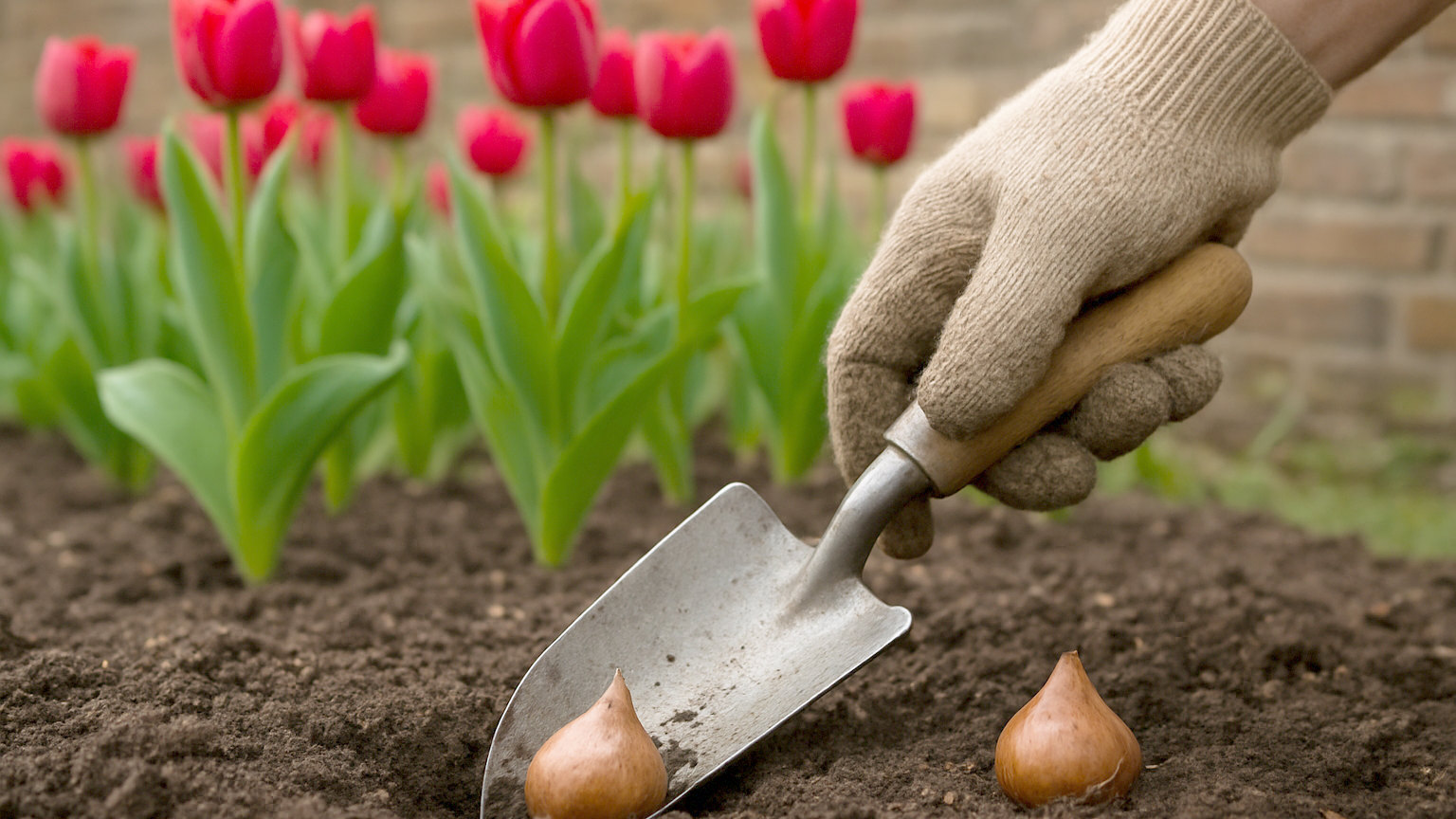
Tulips are the most spectacular spring bulb and the least reliable at returning. Two things set them apart from everything else you plant in autumn: they go in much later, and many of them should be treated as annuals rather than permanent plantings.
Plant in November
Tulips are planted in November, a good two months after daffodils. This is not a detail to skip.
Cold weather kills the spores of tulip fire, the fungal disease that disfigures and destroys them. Planting into cold soil in November substantially reduces the risk, whereas September planting into warm soil increases it.
Planting can continue into December and even January if the ground is workable. A late tulip usually flowers a little later and perfectly well.
Plant deep
Three times the height of the bulb is the standard rule, which for a large tulip means fifteen to twenty centimetres.
Most people plant them too shallowly. Deep planting improves the chances of the bulb returning, protects it from frost and from squirrels, and gives better anchorage to a tall stem.
Space them about ten centimetres apart, or closer in a container. Plant with the pointed end upwards.
They need drainage and a dry summer
Tulips come from the mountains of central Asia, where summers are hot and dry. Wet British summers are what stops them returning.
Free-draining soil in full sun is essential. On clay, add plenty of grit to the planting hole, or grow them in containers.
A position at the base of a sunny wall, where the soil bakes in summer, is the closest most gardens get to their natural conditions.
Which types come back
The large showy hybrids, particularly the Parrot, Fringed and Double types, frequently flower spectacularly in their first year and poorly or not at all afterwards. Many gardeners treat these as annuals, lifting and discarding them after flowering.
Darwin hybrids are the most reliable of the large tulips and often return for several years.
Species tulips are entirely different. Tulipa sylvestris, tarda, turkestanica, clusiana and the various dwarf kaufmanniana and greigii types are genuinely perennial, increase over time, and naturalise in a sunny well-drained spot. They are smaller and considerably better value over a decade.
Lifting or leaving
Leaving them in the ground works on light soil in a sunny position, and is the simplest approach.
To lift, wait until the foliage has yellowed six weeks after flowering, lift the bulbs, dry them off, discard anything soft or diseased, and store the sound ones somewhere cool, dry and airy until November.
Expect a proportion to be too small to flower the following year, which is normal.
Tulip fire
Distorted, twisted growth in spring, with brown scorched patches on leaves and petals and small black resting bodies on the bulbs.
There is no cure. Remove and bin every affected plant and bulb, and do not compost them. Do not plant tulips in that ground for at least three years.
Prevention is planting late, buying firm healthy bulbs, spacing generously for airflow, and avoiding overhead watering.
In containers
Tulips are excellent in pots and it is the easiest way to get a reliable display. Plant closely, almost touching, in a deep container with free-draining compost.
Layer them beneath winter bedding, or plant two varieties at different depths for a longer display.
Discard container tulips after flowering, or plant them out in a spare corner where they may recover over a couple of years.
After flowering
Deadhead as soon as the petals drop, cutting the stem below the developing seed pod, so the plant puts its energy into the bulb rather than into seed.
Leave the foliage for at least six weeks until it yellows naturally. Never tie or knot it, which reduces the leaf area available to feed the bulb.
A high-potassium feed after flowering supports next year's display, and a mulch of compost does much the same more slowly.
Buying
Buy firm, heavy bulbs with intact papery skins and no soft patches, mould or damage. Size matters directly: a larger bulb of a given variety produces a larger flower.
Store them somewhere cool and dry until November rather than in a warm shed, where they dry out and start into growth early.


