
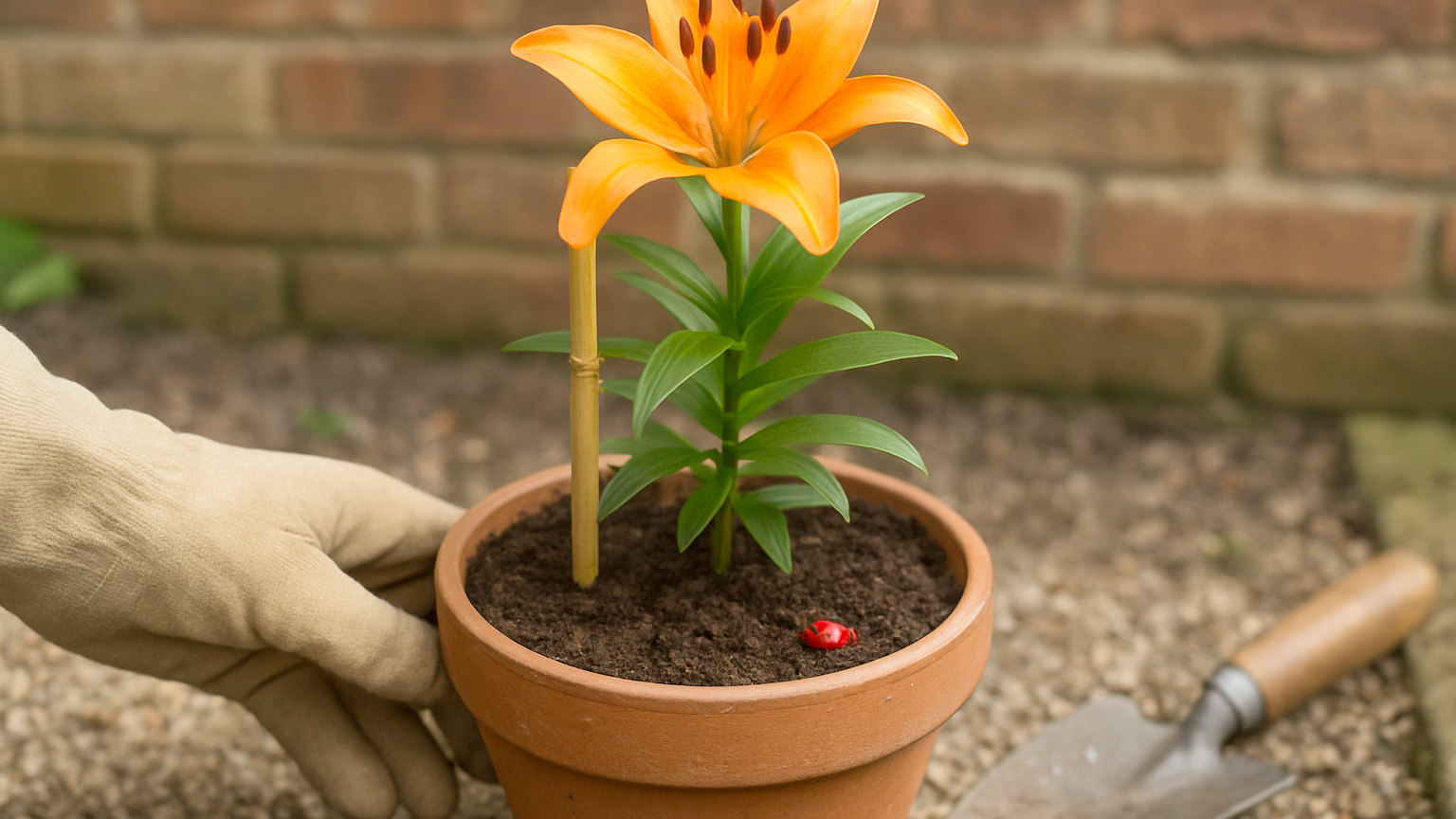
Lilies give the most dramatic flowers of any bulb and, in the Oriental types, the strongest scent in the garden. They are straightforward to grow given drainage and depth, and they have one pest that will destroy them if ignored.
The three main groups
Asiatic lilies flower first, in June and July, in strong upward-facing colours. They have little or no scent, are the toughest and most reliable, and reach around a metre.
Oriental lilies flower later, in August, with large outward-facing flowers and a powerful scent. They need acid or neutral soil and are best in containers of ericaceous compost on chalky ground.
Trumpet lilies, including the regal lily, flower in July with long trumpet flowers and strong scent, often reaching two metres.
Martagon lilies are worth knowing separately: small turk's-cap flowers, tolerant of shade and alkaline soil, and slow to establish but long lived once settled.
Planting
Plant in autumn or early spring, as soon as the bulbs are available. Lily bulbs have no protective tunic and dry out quickly, so plant them promptly rather than storing them.
Plant deep, at about three times the height of the bulb, which usually means fifteen to twenty centimetres. Most lilies are stem-rooting, producing roots from the stem above the bulb as well as below it, and deep planting allows for that.
Madonna lily is the exception and is planted shallowly, with the top of the bulb barely covered.
Drainage above everything
Lilies rot in wet soil far more readily than they suffer from cold.
Add a generous handful of grit to the base of each planting hole and mix more through the surrounding soil. On clay, grow them in containers rather than fighting the ground.
They want their heads in sun and their roots cool and shaded, so planting among low perennials that shade the base suits them well.
Lily beetle
The bright scarlet beetle, about eight millimetres long with a black head and legs, is unmistakable and it will strip a lily completely.
Both adults and larvae eat leaves, buds and flowers. The larvae are orange grubs that cover themselves in their own excrement, appearing as wet black blobs under the leaves.
Hand picking is the effective control. Check plants from March onwards, several times a week through the season.
The beetles drop off when disturbed and land on their backs, where the black undersides make them nearly invisible against soil. Hold a piece of card or your hand beneath the plant before touching it.
Wipe the larvae off leaf undersides with a gloved hand. Vigilance in March and April prevents the larvae in May.
Growing in pots
Lilies are excellent in containers, which solves the drainage problem and lets you move them into view when flowering and out of the way afterwards.
Use a deep pot with a soil-based compost and added grit, planting three to five bulbs per container at fifteen centimetres deep. Use ericaceous compost for Oriental lilies.
Water consistently through the growing season, feed with a high-potassium feed once buds form, and check daily for lily beetle, which finds container lilies as readily as any others.
Staking and aftercare
Tall varieties need support, particularly the Trumpet and Oriental types carrying heavy flowers. Put a cane in at planting rather than later, since driving one in beside an established bulb spears it.
Deadhead as flowers fade, removing the developing seed pod. Leave the stem and foliage until it yellows in autumn, then cut it to the ground.
Feed with a high-potassium feed after flowering to build the bulb for next year, and mulch the surface in autumn.
Cutting lilies
Lilies are superb cut flowers. Take no more than a third of the stem so the remainder can feed the bulb, and remove the anthers as the flowers open, since the pollen stains fabric permanently and cannot be washed out.
A caution about cats
All parts of true lilies, including the pollen, are extremely toxic to cats and can cause fatal kidney failure. A cat brushing past and later grooming pollen from its coat is enough.
If you have cats, or neighbours who do, consider growing something else, and never bring cut lilies into a house with a cat.
Day lilies, hemerocallis, are a different genus but are also toxic to cats. Alstroemeria, sometimes sold as Peruvian lily, is not a true lily and does not carry the same risk.


