
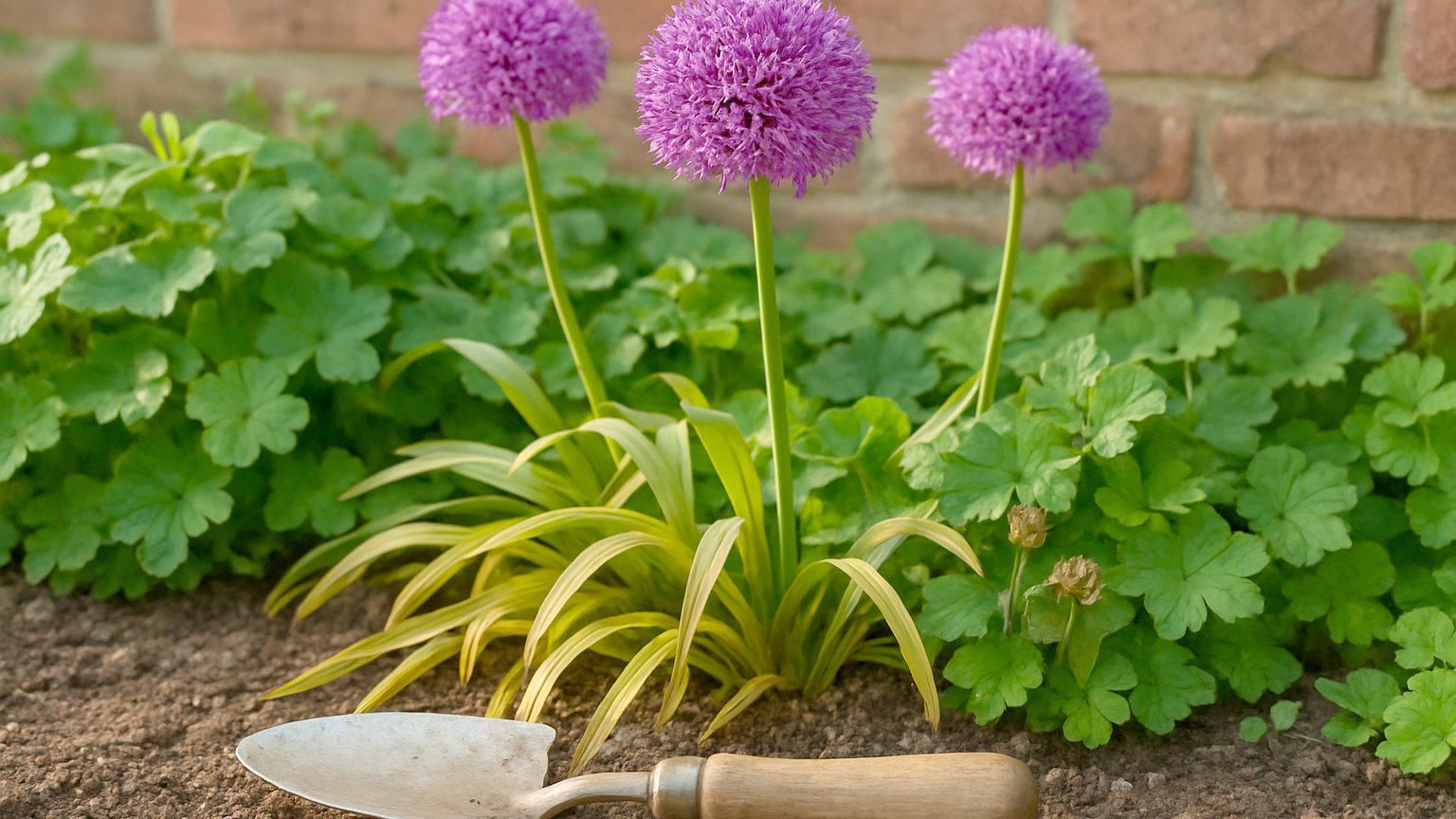
Alliums bridge the gap between the last tulips and the first summer perennials, and their seedheads carry on long after the flowers have gone. They have one quirk that has to be planned around: the leaves die before the flowers open.
The foliage problem
Allium leaves yellow and collapse just as the flower heads reach their best. This is normal and cannot be prevented, since the plant is drawing everything back into the bulb.
The answer is placement. Plant alliums among perennials or through low shrubs whose growth comes up in May and hides the dying foliage, leaving the flower stems rising above.
Hardy geraniums, nepeta, alchemilla and low grasses all do this well. Alliums planted in bare soil or at the front of a border show every yellowing leaf.
Planting
Plant in autumn, from September to November, at three to four times the height of the bulb. For a large allium such as Globemaster that means fifteen to twenty centimetres.
Space them fifteen to twenty centimetres apart for the large varieties and closer for the small ones. Plant in groups of five, seven or more, since a single allium looks lost.
Sun and sharp drainage
Alliums want full sun and free-draining soil, and they rot in wet ground over winter.
On clay, add plenty of grit to the planting hole or grow them in raised beds. They are among the bulbs most likely to disappear over a wet winter on heavy soil.
They tolerate poor soil well and need no feeding on reasonable ground.
Varieties worth knowing
- Purple Sensation - the standard, reliable, deep violet globes at about ninety centimetres in May
- Christophii - enormous open spangled heads on short stems, and the best seedheads of all
- Globemaster and Gladiator - very large heads, expensive, and long lasting
- Sphaerocephalon - the drumstick allium, small egg-shaped maroon heads in July, cheap and excellent for weaving through a border
- Nectaroscordum siculum - loose pendant bells, self-seeding freely
- Moly and oreophilum - dwarf types for the front of a border or a container
Leave the seedheads
Allium seedheads are as good as the flowers and last for months. Christophii and Schubertii in particular hold their form until autumn and look superb under frost.
Leave them standing rather than deadheading. They also dry well for indoor arrangements, cut when the seed has set but before the head shatters.
The trade is self-seeding, which for Purple Sensation and nectaroscordum can be substantial. If you do not want seedlings, deadhead before the seed ripens.
Increasing
Established clumps produce offsets and increase steadily. Lift and divide congested clumps in summer once the foliage has died down, replanting the largest bulbs at the proper depth.
Alliums also come readily from seed, though they take three or four years to reach flowering size.
Problems
Allium leaf miner and allium white rot both affect ornamental alliums as well as onions and leeks.
White rot shows as yellowing collapsing foliage with white fluffy mould at the base of the bulb. It persists in soil for many years and there is no treatment, so remove affected plants and avoid growing any allium in that ground.
Do not plant ornamental alliums where onions or leeks have suffered from it.
Downy mildew and rust can appear in wet seasons and are reduced by generous spacing and airflow.
Alliums for pollinators
All the ornamental alliums are worked heavily by bees, and the drumstick allium in July fills a gap when many spring flowers have finished. The open structure of the heads makes the nectar easily accessible, which is why they are so consistently busy.
In containers
The smaller varieties suit pots well, and the large ones work in a deep container with gritty compost.
The foliage problem is harder to disguise in a pot, so either accept it, underplant with something low and spreading, or move the container out of sight while the leaves die back.
Cutting them
Alliums cut well and last a week or more in water, though the stems of some varieties smell distinctly of onion when first cut. Changing the water after a day largely deals with it.
Cut when about half the individual florets in the head have opened, and the rest will open in the vase.


