
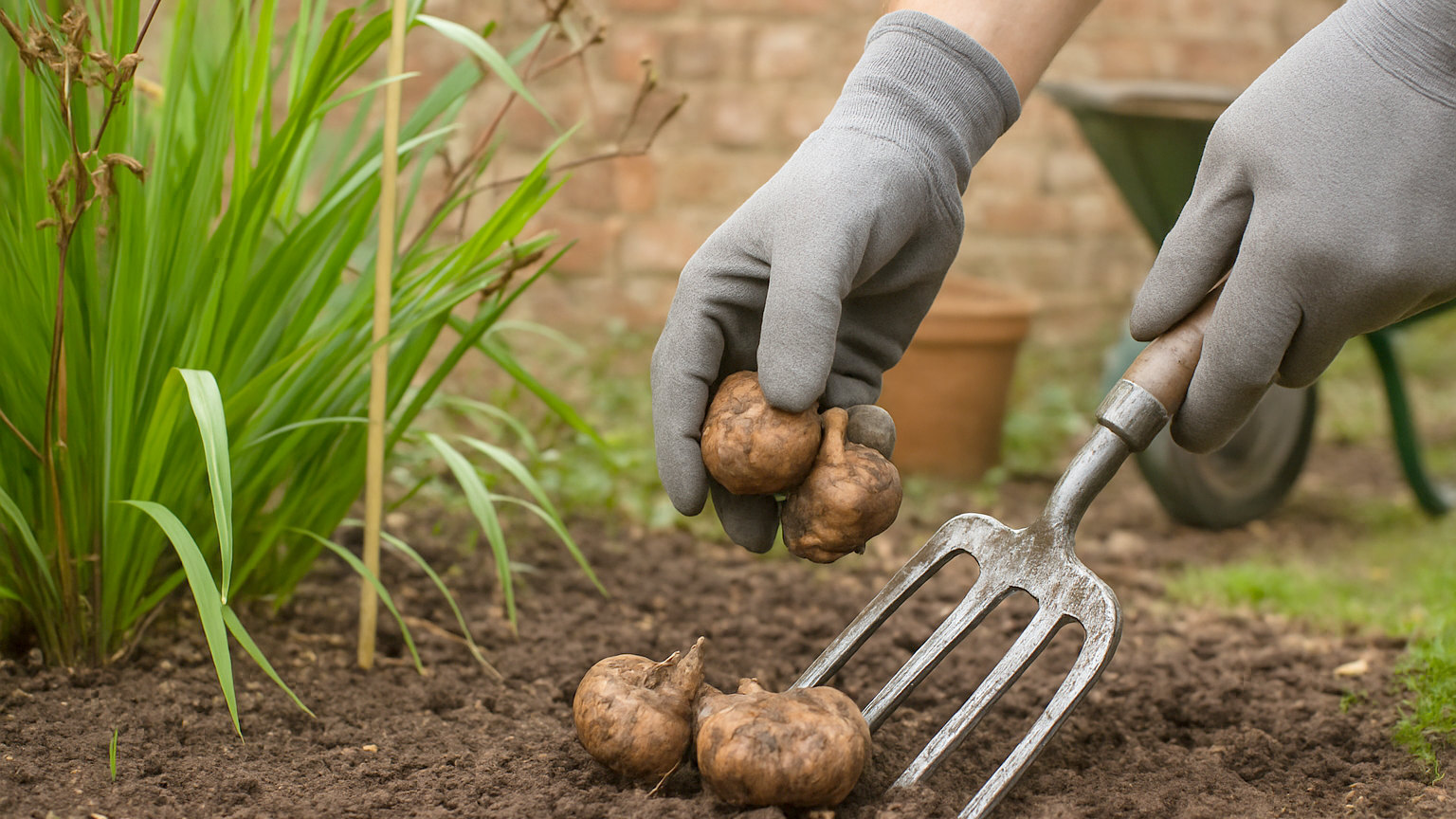
These are both summer-flowering corms and they behave in completely opposite ways. Gladioli are tender, planted each spring and lifted each autumn. Crocosmia is hardy, planted once and inclined to spread further than you intended.
Gladioli
Plant corms from late March to mid-May, once the soil has warmed, at about ten to fifteen centimetres deep and fifteen centimetres apart.
They want full sun, free-draining soil and shelter from wind. On heavy ground add grit to the planting hole, since they rot in cold wet soil.
Plant successionally every two weeks through spring, which spreads flowering from July into September rather than producing everything in one fortnight.
Staking gladioli
A gladiolus in full flower is top heavy and snaps at the base in wind.
Plant deeply, which helps considerably, and draw soil up around the stems as they grow. For the taller varieties, put a cane in at planting and tie the stem as it extends.
Growing them in a block rather than a line, or in rows through a vegetable garden with netting stretched over, gives mutual support.
Lifting and storing
Gladioli are not reliably hardy in most of Britain and are usually lifted.
Lift after the first frost blackens the foliage, or in October. Cut the stems back to a few centimetres, let the corms dry for a couple of weeks somewhere warm and airy, then remove the old shrivelled corm from the base and discard it.
Store the new corms in paper bags or trays somewhere cool, dry and frost free, and check them occasionally for rot.
In a mild area on very free-draining soil they can be left in the ground under a thick mulch, though losses are likely.
Thrips
The main gladiolus problem, causing silvery streaking and flecking on leaves and flowers, and distorted buds that fail to open.
They overwinter on stored corms, so inspect corms carefully before storing and again before planting, and discard any that look damaged. Store somewhere cool, since thrips remain active in warmth.
Crocosmia
Entirely different in habit. Hardy in most of Britain, planted once and left, forming clumps that increase steadily.
Plant corms in spring, eight to ten centimetres deep and about fifteen centimetres apart, in sun or light shade. They tolerate a range of soils and are far less fussy about drainage than gladioli.
The arching sprays of orange, red or yellow flowers appear from July to September above upright sword-shaped foliage, and the seedheads that follow are good into autumn.
Keeping crocosmia in bounds
Some varieties spread vigorously by corms, forming dense congested clumps that push outwards year on year.
The older montbretia in particular, Crocosmia x crocosmiiflora, can become a nuisance and is naturalised in the wild in parts of Britain.
Lift and divide clumps every three or four years in spring, replanting a portion and discarding the rest. Dispose of surplus corms responsibly rather than tipping them over a hedge, since they establish readily.
Named varieties such as Lucifer and Emily McKenzie are better behaved and worth choosing over the older species for a garden border.
Lucifer is the tallest and most striking, reaching a metre and a quarter with intense scarlet flowers, and it is reliably hardy across most of the country.
Aftercare for both
Water both in dry spells while flowering, and feed with a high-potassium feed to support the corms.
Deadhead gladioli as the lower flowers fade to keep the spike looking well, and cut spent gladiolus stems for the vase, where they last well.
Leave crocosmia foliage until it dies back naturally, then cut it down in late winter, or leave the seedheads standing for winter interest and cut in February.
Choosing between them
Gladioli give the more spectacular individual spike and are excellent for cutting, at the cost of an annual lift and store.
Crocosmia gives a longer season in the border with no annual work, and is the better choice for anyone who wants summer colour without an annual routine.
Other summer bulbs
Several others follow similar rules. Dahlias are lifted or heavily mulched like gladioli. Cannas and tuberous begonias are tender and lifted. Lilies, alliums and camassia are hardy and left in place.
The distinction is simply whether the plant originates somewhere with cold wet winters, and it is worth checking the label before planting anything expensive.


