
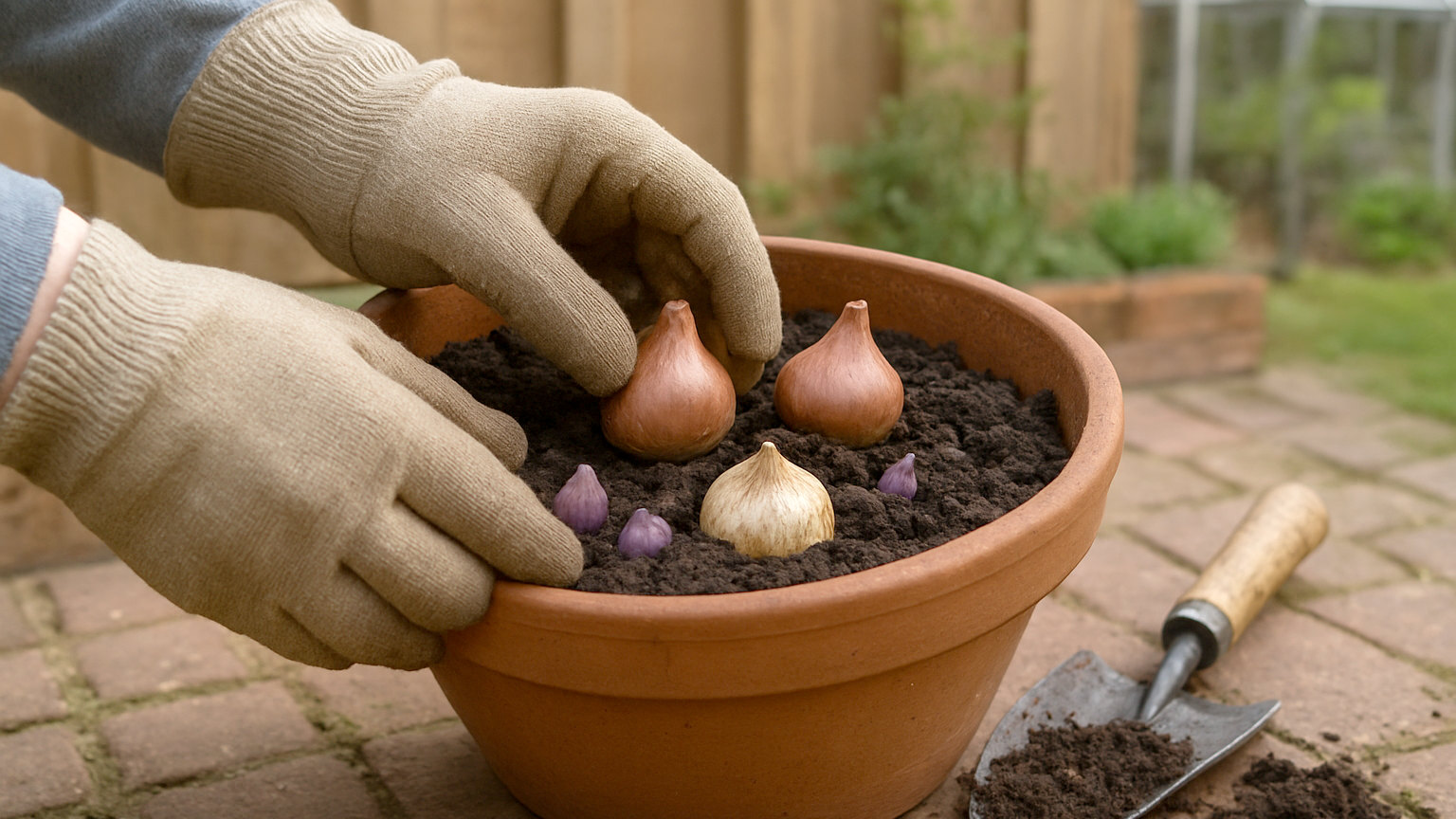
Bulbs in containers give the most controllable spring display there is, and layering several species at different depths turns one pot into three successive shows running from February to May.
The lasagne method
Bulbs push up through whatever is above them, so they can be planted in layers without interfering with one another.
Start with a layer of compost in the base of a deep pot. Place the largest, latest-flowering bulbs first, typically tulips or large daffodils, at around twenty centimetres deep.
Cover with compost, then add a middle layer of medium bulbs such as smaller narcissi or hyacinths at about twelve centimetres.
Cover again and finish with small early bulbs at five to eight centimetres: crocus, muscari, iris reticulata or scilla.
Top with compost and, if you like, plant winter bedding such as violas on the surface.
Offset each layer slightly rather than stacking bulbs directly on top of one another, though in practice the shoots find their way round any obstruction.
Choosing the pot
Depth is what matters. Thirty centimetres is the minimum for a three-layer planting, and forty is better.
Free drainage is essential, since waterlogged compost over winter rots bulbs more reliably than any frost. Ensure the drainage holes are clear and stand the pot on feet.
Frost-proof containers only, since terracotta that is merely frost resistant cracks when saturated compost freezes.
Compost
Use a soil-based compost such as John Innes No. 2, or a mix of multipurpose with added grit, at roughly one part grit to three of compost.
Soil-based mixes hold structure through winter, drain better and weigh more, which stops a tall pot of tulips blowing over.
Do not add fertiliser at planting. The bulb already contains everything it needs for its first flowering.
Plant closely
Containers are the one place to ignore the recommended spacing. Bulbs can go almost touching, provided they are not against the side of the pot or against each other.
A pot of tulips planted at border spacing looks thin. Planted densely it looks like the pictures.
Timing
Plant daffodils, crocus and most bulbs in September and October. Plant tulips in November, and if you are layering, this means planting the pot in stages or simply doing the whole thing in late October as a compromise.
Many gardeners simply plant the whole pot in late October or November, which suits the tulips and does the daffodils and crocus no real harm.
Over winter
Bulbs need a cold period, so do not bring pots into a heated room. Leave them outside.
Stand them somewhere sheltered against a wall, raised on feet so they drain, and protect from very heavy rain if you can, since sodden compost is the main risk.
Water only if the compost is genuinely drying out, which in a wet British winter is rare.
After flowering
Deadhead as the flowers fade, removing the developing seed pod but leaving the stem and leaves.
Feed weekly with a high-potassium feed while the foliage is green, and leave it for six weeks until it yellows.
Then choose. Container bulbs can be tipped out, dried and stored for replanting, or planted out into a border where they may recover over a couple of years, or discarded.
Tulips in pots rarely perform well a second year and most gardeners treat them as annuals. Daffodils, crocus and muscari from a container are well worth planting out into grass or a border.
Forcing for indoors
Prepared hyacinths and paperwhite narcissi are sold specifically for indoor flowering. Plant in autumn, keep them in the dark and cold for about ten weeks until the shoots are several centimetres tall, then bring them into a cool room and gradually into warmth and light.
Rushing the cold period produces short stems and poor flowers, and it is the usual reason forced bulbs disappoint.
Successional pots
Rather than layering, some gardeners plant several separate pots each with a single species, and move them into position as each comes into flower.
It uses more containers and gives more control, since a pot past its best can be moved out of sight rather than sitting among the display. For a doorstep or a small courtyard it is often the better approach.


