
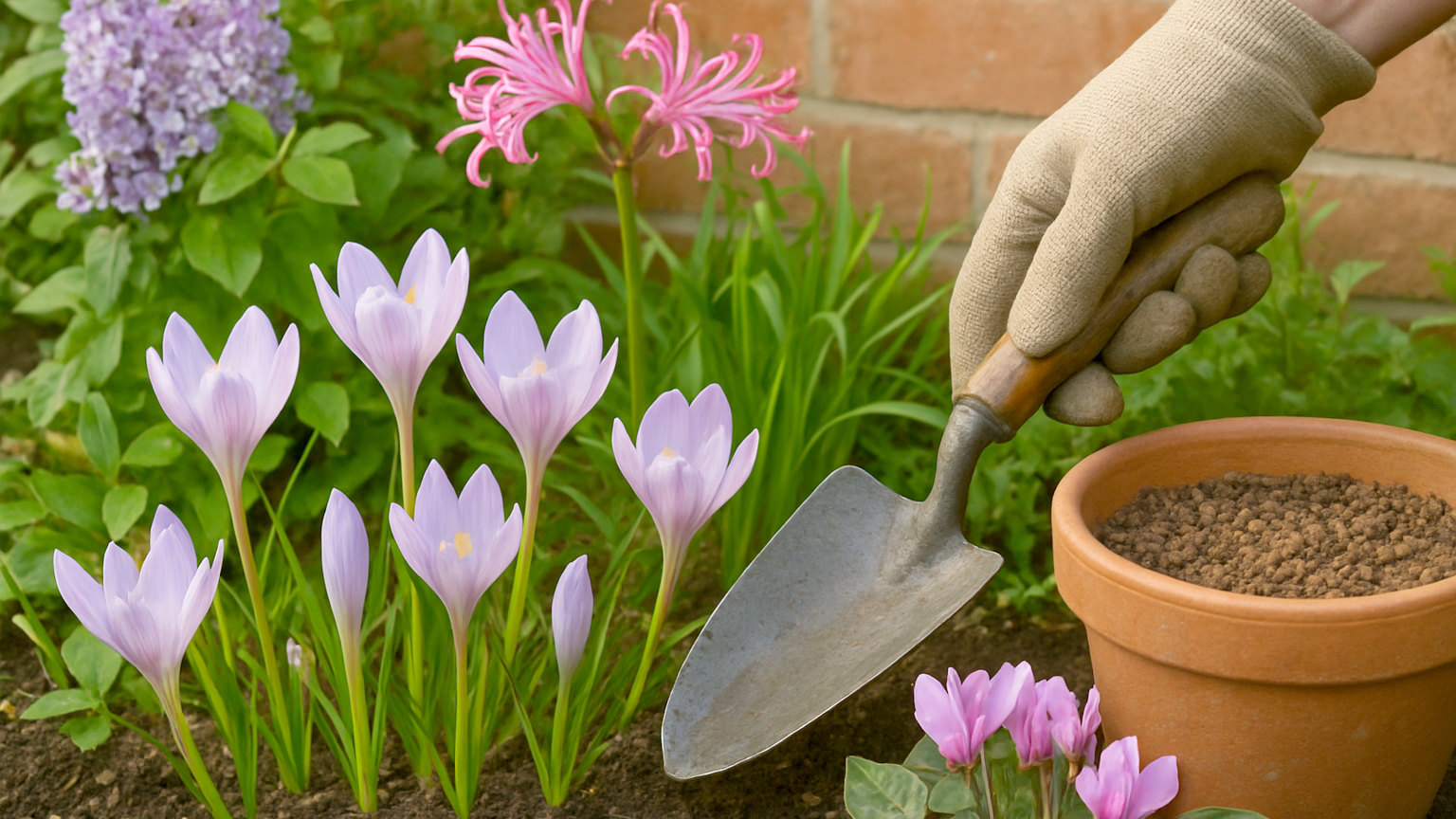
Autumn bulbs are among the most useful and least planted things in a garden. They flower in September and October when borders are going over, they need almost nothing, and most people never think to buy them because they are sold in summer rather than autumn.
Plant them in summer
This is the point that catches people out. Autumn-flowering bulbs are sold and planted in July and August, and flower within weeks of going in.
Order early, since suppliers sell out quickly and the planting window is short. Plant as soon as they arrive, because many will already have begun growing in the bag.
Colchicum
Large goblet-shaped pink or white flowers appearing from bare ground in September, with no leaves at all, which is why they are sometimes called naked ladies.
Plant in July or August, about ten centimetres deep, in sun or light shade in well-drained soil. They flower within weeks.
The large glossy leaves appear the following spring and die back by early summer. They are substantial and untidy, so plant colchicum in grass or among perennials that will hide them, rather than at the front of a border.
Colchicum is highly poisonous in all its parts. Do not plant it where children play or where livestock graze, and wear gloves when handling the corms.
Autumn crocus
True autumn crocus, Crocus speciosus and similar, are smaller and more delicate than colchicum and easily confused with it.
Plant in August, about eight centimetres deep, in a sunny well-drained position. They naturalise well in short grass and increase steadily.
Crocus sativus is the saffron crocus, flowering in October, and the stigmas can be harvested and dried. It needs a hot dry summer position and does not flower reliably in a wet British summer.
Nerine
Nerine bowdenii produces startling bright pink flowers on bare stems in October, and it is the most reliable of the autumn bulbs for a British garden.
It wants the hottest, driest, most sheltered position available, ideally at the foot of a south-facing wall. Plant with the neck of the bulb at or just above soil level, which is shallower than most bulbs.
It flowers best when congested, so resist the urge to divide. A clump left undisturbed for years performs better than one regularly lifted.
Strappy leaves appear after flowering and persist through winter, dying back in summer.
Cyclamen hederifolium
Small pink or white flowers in September and October, followed by beautifully marbled ivy-shaped leaves that persist all winter and die back in spring.
It is outstanding in dry shade under trees, where almost nothing else grows. Plant tubers shallowly, with the top just at the surface, and be aware which way up they go, since the top is usually the flatter side with old root scars.
It seeds itself generously and forms carpets over the years. Buying a few tubers and letting them spread is far cheaper than buying many.
Sternbergia
Sternbergia lutea produces bright yellow crocus-like flowers in September, needing a hot, dry, sunny position with sharp drainage. It is less commonly grown than it deserves and is worth trying at the base of a warm south-facing wall.
Aftercare
Very little is needed. Leave the foliage of all of them to die down naturally, which for colchicum means tolerating large leaves in spring.
None needs much feeding. A mulch after flowering suits the woodland types, and the sun-lovers prefer poor ground.
Most increase steadily and can be divided if they become overcrowded, though nerines are the exception and flower better when left congested.
Combining them
Plant autumn bulbs among late perennials that are still performing, so the flowers rise through something rather than out of bare soil.
Hylotelephium, asters, grasses and hardy geraniums all work, and the combination extends a border's season by a month or more.
Why they are worth it
Autumn bulbs cost little, need almost nothing and flower at the point in the year when a garden most needs something new. They also provide late nectar for insects still flying in October.
The only real obstacle is remembering to order them in June, when the garden is full and autumn seems a long way off. Setting a reminder is the practical answer.


