
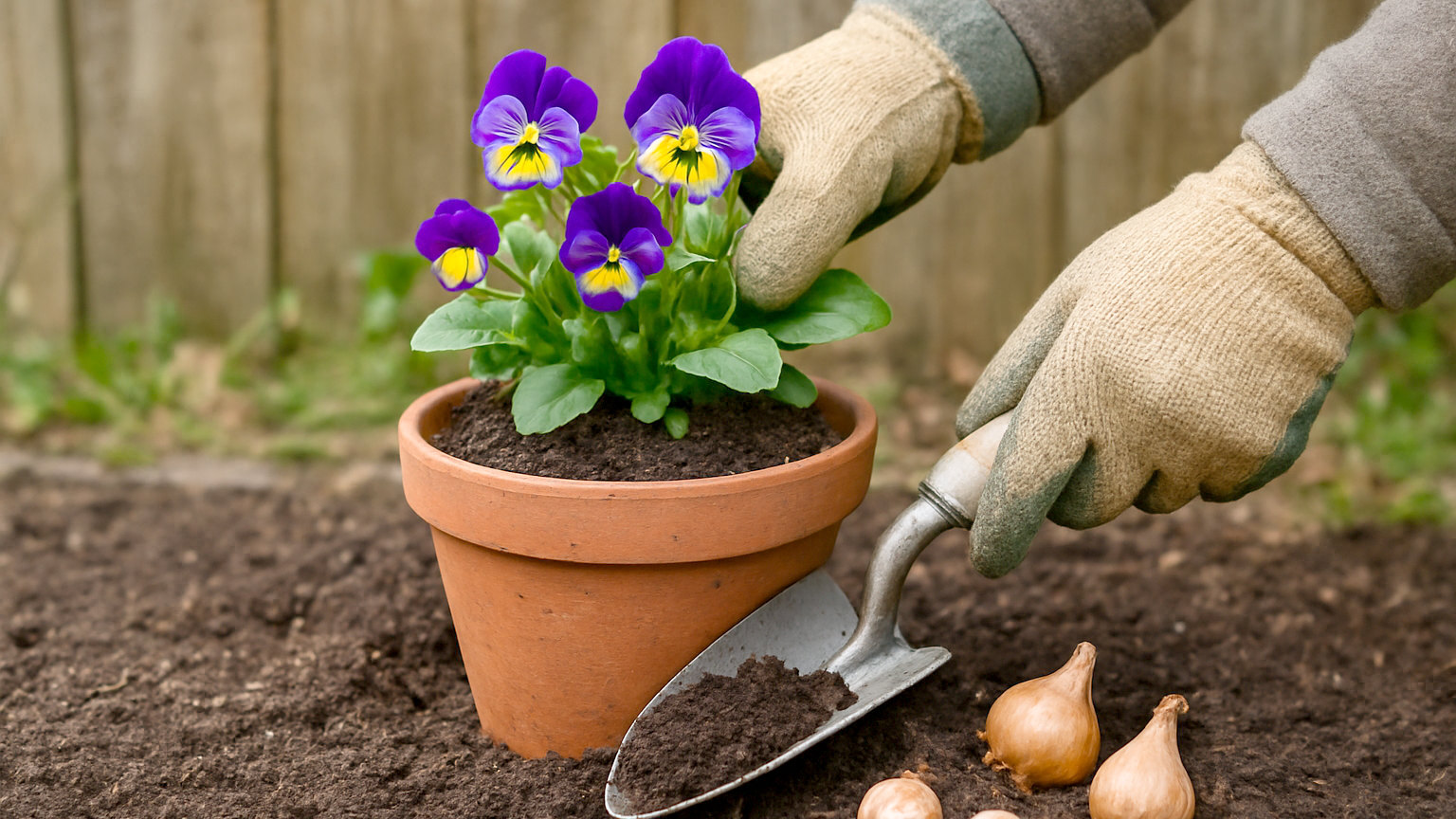
Winter bedding is planted at the point in the year when the garden looks its best and nobody is thinking about January. That timing is the whole difficulty, because plants put in after October never establish properly.
Plant in September and October
Winter bedding must root before the soil gets cold. Planted in September, it establishes and flowers through mild spells all winter. Planted in November, it sits doing nothing and often rots.
This means clearing summer bedding while it is still flowering, which feels wasteful and is the right decision. Late September to mid-October is the window.
The reliable plants
Winter pansies and violas are the backbone. They flower in mild spells from October to May, pause in the hardest weather and pick up again. Violas have smaller flowers, stand weather better and flower more freely than the large-flowered pansies.
Wallflowers are biennials planted in autumn for a spectacular scented display from April to June. Sold bare root in bundles in autumn, which is by far the cheapest way to buy them.
Bellis perennis, the double daisy, gives neat button flowers in spring and is thoroughly hardy.
Primulas and polyanthus flower from late winter, and are best in a sheltered spot or a container by a door.
Cyclamen, the hardy small-flowered types rather than the florist's ones, flower through autumn and winter in shade.
Ornamental cabbages and kales provide foliage colour that intensifies in cold weather.
Heucheras, ivy, euonymus and small evergreens provide the structure that stops a winter container looking like a collection of small flowers.
Layering bulbs underneath
The single technique that most improves winter containers. Plant bulbs beneath the bedding in autumn and they come up through it in spring, giving two displays from one pot.
Put the largest and latest bulbs deepest, typically tulips or daffodils, add compost, then a layer of smaller earlier bulbs such as crocus or muscari, more compost, and plant the bedding on top.
This lasagne planting produces a container that performs from October through to May.
Containers rather than borders
Winter bedding earns its keep most in containers by a door or under a window you use, where you see it every day.
The same plants at the bottom of the garden are barely noticed. Site winter planting where it will be looked at from indoors.
Use a container with genuinely free drainage, raise it on feet, and remove saucers. Waterlogging over winter kills far more plants than cold does.
Through the winter
Deadhead regularly, particularly pansies and violas, which stop flowering if allowed to set seed. This matters as much in winter as in summer.
Water sparingly and only when the compost is genuinely drying. Pots under an overhang may get no rain at all and still need occasional watering.
Do not feed through the coldest months, since the plants are not growing. A liquid feed in February as growth restarts gives a noticeable lift for the spring display.
Remove yellowing leaves and any grey mould promptly, since it spreads quickly in damp still conditions.
Expect a pause
Growth almost stops between late November and early February because of light rather than temperature, and flowering slows or stops entirely.
This is normal. The plants are holding rather than growing, and they resume strongly in February and March, which is when winter bedding does most of its work and earns the September planting.
Clearing in spring
Winter bedding is pulled out in May to make way for summer planting, by which time it has usually flowered itself to exhaustion.
Wallflowers are pulled after flowering in June. Bulbs planted beneath should have their foliage left to die down naturally, so lift and store them, or move them to a spare corner to finish.
Buying
Buy winter bedding early in the season while the plants are still small and green rather than late when they are in full flower. A plant already flowering hard in a small pot in October has been forced and will have little left to give.
Look for compact plants with plenty of buds and healthy roots, and avoid anything with yellowing lower leaves or any sign of grey mould, which spreads rapidly once a container is planted up.


