
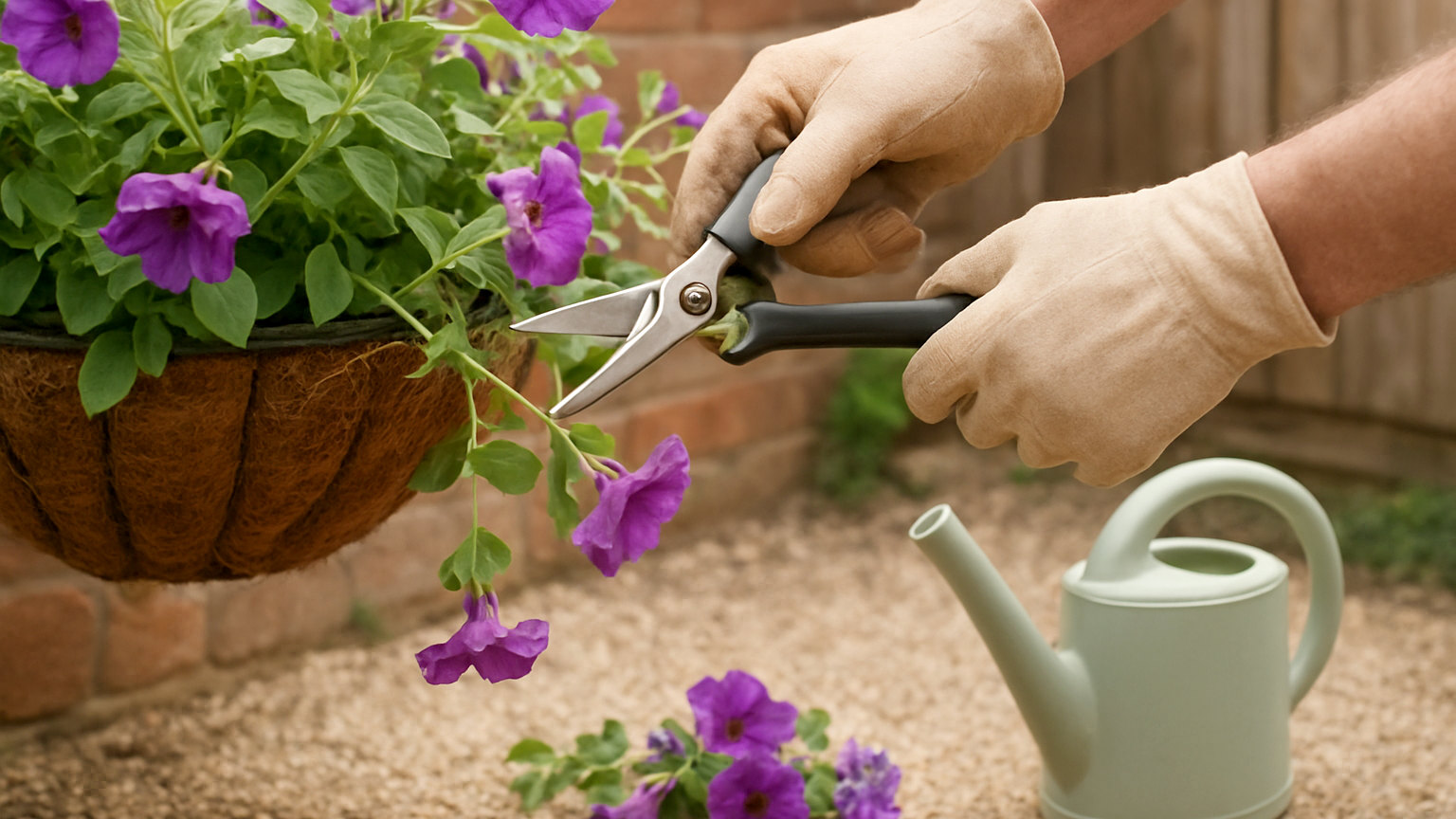
Summer bedding that looked spectacular in June and tired by early August has almost always run out of one of two things: food or the incentive to keep flowering. Both are correctable, and a container can be brought back within three weeks.
Deadhead, and keep doing it
An annual exists to set seed. Once it succeeds, it stops producing flowers, since its job is done.
Deadheading removes that signal and keeps the plant trying. It is the single most effective thing you can do.
Petunias, pansies, violas, marigolds and antirrhinum all need going over every few days. Cut or pinch back to a leaf joint rather than pulling the head off and leaving a bare stalk.
On fuchsias, remove the developing seed pods as well as the spent flowers, since the pods are what stop it flowering.
Some modern bedding is self-cleaning and needs no deadheading: many calibrachoa, bidens, bacopa and some trailing petunias. If you cannot manage regular deadheading, choose those.
Feeding is the other half
Compost contains enough nutrients for about six weeks, and after that the plant depends entirely on you. A basket planted in May is starving by early July.
Feed weekly from six weeks after planting with a high-potassium tomato feed, which promotes flowering. A balanced or high-nitrogen feed produces leaves at the expense of flowers.
Slow-release granules mixed in at planting help for the first couple of months and are not enough on their own for a full season.
Follow the dilution on the bottle. Feeding at double strength scorches roots rather than doubling growth, and always feed onto damp compost rather than a dry pot.
Water consistently
Bedding in containers needs daily watering in summer and twice daily in a heatwave. A plant that wilts repeatedly drops buds and flowers less afterwards.
Water thoroughly until it runs from the base rather than sprinkling the surface. If a pot has dried out completely, stand it in a bucket of water for half an hour to rewet the compost.
The midsummer cut back
This is the technique that rescues a tired planting, and it feels drastic.
In late July or early August, cut everything back by about a third. Trailing petunias, lobelia, bidens and verbena all respond particularly well.
Feed and water thoroughly afterwards. Within two to three weeks the plants produce fresh growth and a new flush of flowers that carries them to the frosts.
Doing this in July feels wasteful and produces a far better September than leaving a leggy plant to struggle on.
Replace what is finished
Not everything responds. Some bedding is genuinely over by August, and a single dead plant spoils a container.
Keep a few spare plants in pots as replacements, or buy a tray in July when garden centres are clearing them cheaply. Slotting a fresh plant into a gap costs very little and restores a display immediately, which is easier than nursing a failing one.
Position and problems
Sun-loving bedding in shade will never perform, however well fed. If a container has always disappointed in the same position, the plants are wrong for the place.
Check for vine weevil if a plant collapses suddenly despite adequate watering, and for aphids gathering on the soft growing tips.
Grey mould on spent flowers spreads readily to healthy tissue, so remove dead material promptly, particularly in a wet summer when it moves fastest.
Planning for a long season
Plant containers in April and grow them on under cover so they are full by the time they go out after the last frost.
Mix in some plants that flower late, and include foliage that holds the arrangement together when flowering dips. A container built only on flowers has nothing to fall back on.
The end of the season
Most bedding is killed by the first frost. Clear it promptly rather than leaving blackened plants in place, since they harbour disease over winter.
Tender perennials sold as bedding, including pelargoniums, fuchsias and osteospermum, can be overwintered under cover or propagated from late summer cuttings, which costs nothing and gives plants for next year.
Take those cuttings in August while the plants are still growing strongly, rather than waiting until the frosts have damaged them.


