
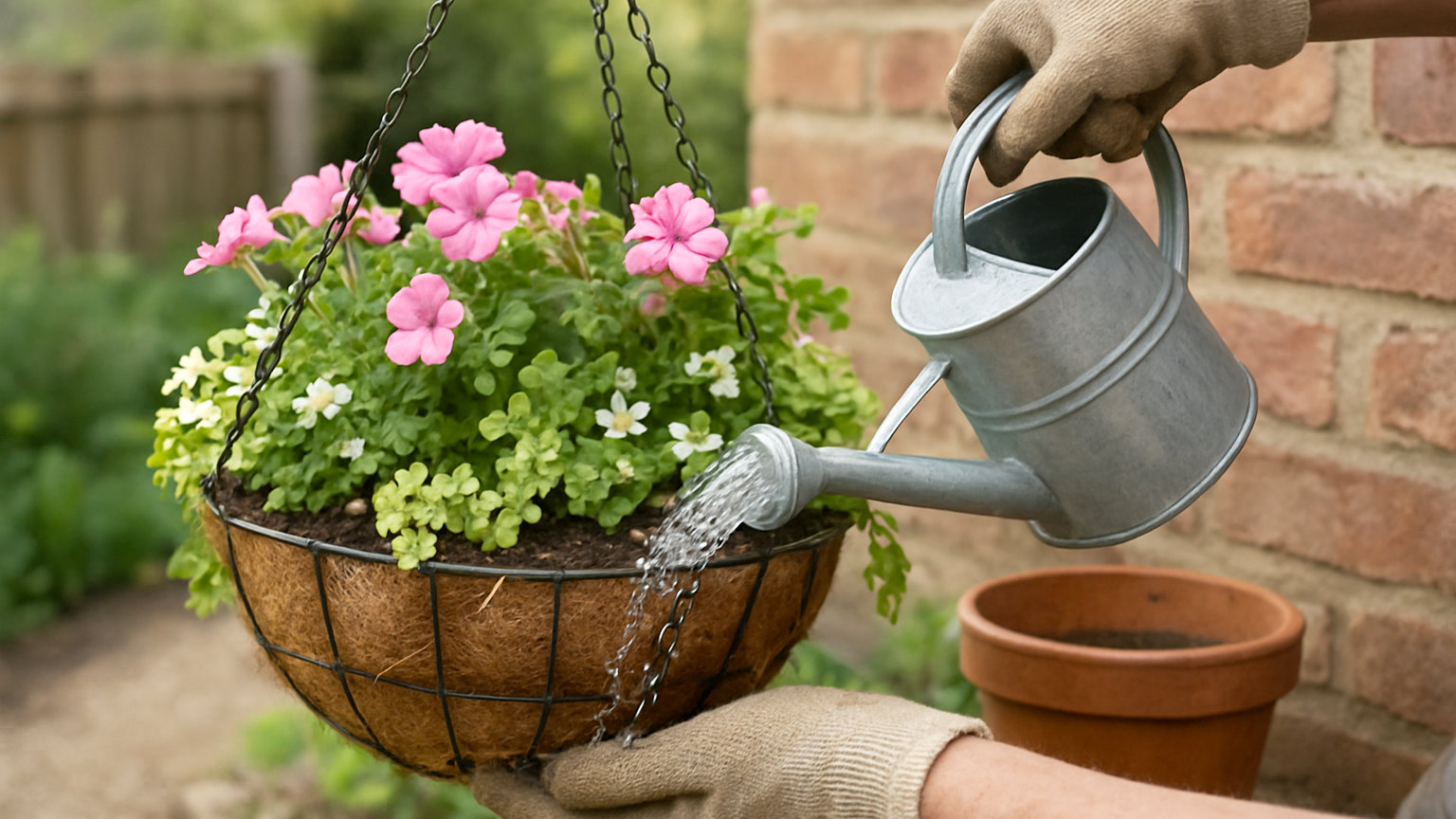
A hanging basket is the most demanding container in the garden. It is small, exposed on every side, and in full sun and wind it can dry out within a day. Everything about planting one well is aimed at that problem.
Buy the largest you can hang
A thirty-centimetre basket dries out roughly twice as fast as a forty-centimetre one. Size is the single most useful decision.
Forty centimetres or more is worth the extra, and a solid-sided basket or a plastic one with a built-in reservoir dries far more slowly than an open wire frame.
Check the bracket carefully. A watered basket is heavy, and brackets rust through where they meet the wall. Fix into masonry rather than mortar joints, and inspect annually.
Liners
Coir, wool, felt and recycled fibre liners all work. Sphagnum moss is traditional and is best avoided, since much of it is harvested from vulnerable bogs.
Whatever you use, put a circle of plastic in the base with a couple of small holes punched in it. It holds a small reservoir of water in the bottom of the basket and makes a genuine difference.
Solid liners can be slit to plant through the sides. Wire baskets with a moss or fibre liner allow planting through the sides more easily, which gives the full ball of flowers people want.
Compost and additives
Use a good peat-free multipurpose compost, and mix in water-retaining granules at the rate on the packet. Do not exceed it, since too much turns the compost to jelly.
Add slow-release fertiliser granules at planting. This does not remove the need to feed later, but it carries the basket through the first couple of months.
Adding a little soil-based compost to the mix increases water retention, at the cost of weight.
How many plants
Five or six plants in a forty-centimetre basket is about right, more if planting through the sides.
The usual arrangement is a centre plant for height, mid-height fillers around it, and trailers at the edge and through the sides.
Overplanting is tempting and produces a spectacular basket in June that runs out of water and nutrients by August. Slightly fewer plants, well fed, perform better over a season.
What to plant
For sun: trailing petunias and surfinias, calibrachoa, bidens, verbena, trailing lobelia, pelargoniums, nemesia and trailing nasturtiums.
For shade: begonias, busy lizzies, fuchsias, trailing lobelia, ivy and heuchera.
Edible baskets work well too. Tumbling tomatoes, strawberries, trailing nasturtiums and herbs all crop in a basket and keep fruit clear of slugs.
Watering
Daily in summer, and twice daily in a heatwave on a hot wall. There is no way around it.
Water in the morning if you can, thoroughly, until it runs from the base. A light splash wets only the surface.
If a basket dries out completely the compost will repel water. Lift it down and stand it in a bucket of water for half an hour to rewet it.
A pulley system that lowers the basket for watering makes a high one practical rather than an annual disappointment. Drip irrigation on a timer is the reliable answer for several baskets.
Feeding
Start liquid feeding about six weeks after planting, weekly, with a high-potassium tomato feed once flowering is under way.
A basket that looks tired in August has almost always run out of food rather than anything else, and a fortnight of weekly feeding usually restores it.
Deadheading and rescue
Deadhead regularly, since bedding stops flowering once it sets seed. Petunias in particular need going over every few days.
If a basket becomes leggy and tired by midsummer, cut everything back by about a third, feed and water well, and it will usually regrow and flower again within three weeks.
Timing
Plant baskets in April and grow them on under cover, so they are full and flowering by the time they go outside after the last frost in late May. A basket planted and hung out on the same day in June takes weeks to look like anything.
If you have no greenhouse, plant in May and keep the basket in a sheltered spot at ground level for a fortnight before hanging it, which lets the plants settle and root before facing wind.


