
Sunflowers are the annual everybody grows once and many grow badly, because the seedlings are vulnerable for a fortnight and the tall varieties are top heavy for months. Both problems are easily dealt with.
Sowing
Sow from April to May, either direct where they are to grow or in deep pots under cover for planting out.
Sow about two centimetres deep. Direct sowing produces sturdier plants with better root systems, provided you can protect them from slugs.
Starting in pots avoids the seedling losses and lets you plant out at a size that can look after itself, which for most gardens is the more reliable route. Use deep pots or root trainers, since sunflowers make long roots quickly.
Successional sowings every fortnight from April to June extend flowering from July into October.
Protecting the seedlings
Slugs and mice take more sunflower seedlings than anything else. A row sown direct can disappear entirely overnight.
Mice dig up the large seeds before they germinate. Slugs eat the seedlings at the two-leaf stage.
Protect with cut-off plastic bottles over each seedling, or start in pots and plant out at fifteen centimetres or more, by which point they are largely safe.
Position and soil
Full sun, as the name suggests, and shelter from strong wind. They are among the few plants that genuinely want as much sun as Britain can provide.
Reasonable soil with some compost worked in suits them, since unlike most annuals they are hungry and thirsty plants supporting a great deal of growth in a short season.
Space the tall varieties forty-five to sixty centimetres apart, and the branching ones about thirty.
Staking
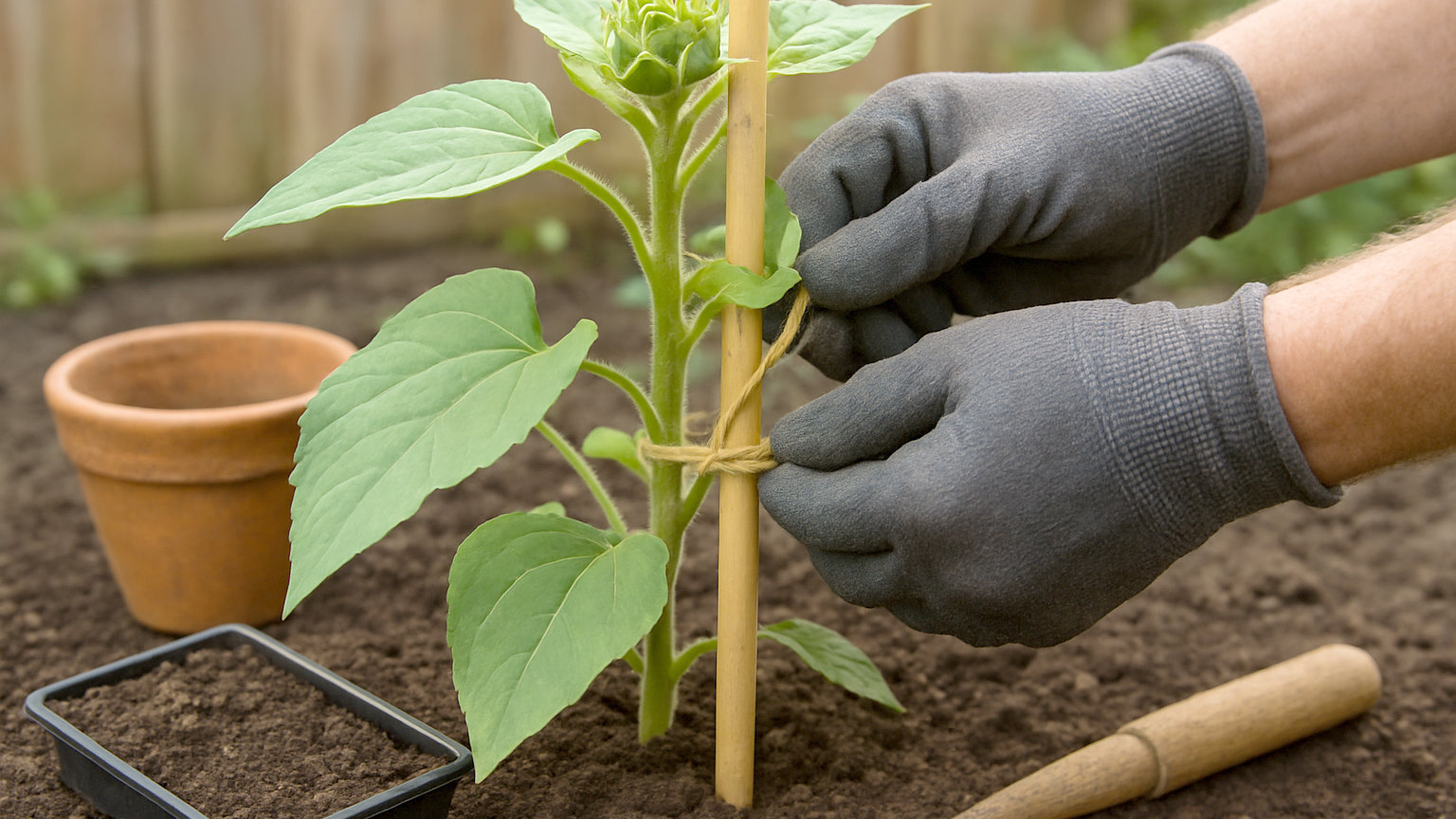
Anything over about a metre and a half needs a stake, and it should go in at planting rather than later.
Use a stout stake, not a thin cane, driven well into the ground, and tie the stem at intervals as it grows with soft twine in a figure of eight.
A three-metre sunflower carrying a heavy head catches wind like a sail, and one that snaps in August cannot be repaired.
Watering and feeding
Water generously, particularly in dry spells and while the buds are developing. Sunflowers use a great deal of water.
A high-potassium feed once buds appear improves flowering. Avoid high-nitrogen feeds, which produce enormous leaves and weak stems.
Single-stem or branching
The giant varieties everyone knows, such as Russian Giant and Titan, produce one enormous flower on a single stem and are grown for height.
Branching varieties are far more useful for a border or for cutting. Types such as Vanilla Ice, Velvet Queen and the Ring of Fire produce many smaller flowers over a long period on a plant of a manageable size.
For cutting, look for pollen-free varieties, which do not drop pollen on the table. Bear in mind that pollen-free varieties are less useful to bees, so grow some of each.
Cutting
Cut in the morning when the flower has just opened, strip the lower leaves and put the stems straight into water. They last around a week.
Picking from a branching variety encourages more flowers, exactly as with cosmos.
Seeds and birds
Leave the heads on the plant once flowering finishes and birds will strip them through autumn, which is one of the better reasons to grow them.
To save seed for yourself, cut the head when the back has turned brown and the seeds are plump, and hang it somewhere dry and airy with a paper bag over it. Rub the seeds out once fully dry.
Save seed only from open-pollinated varieties, since F1 hybrids will not come true and produce a variable and usually inferior mixture in the following generation.
Store the dried seed in a paper envelope somewhere cool and dry, labelled with the variety and year, and it stays viable for several seasons.
Afterwards
The tallest ones
Record-height sunflowers need very rich soil, constant watering, a single stem with all side shoots removed, and a stake several metres tall. That is a different and more demanding project from growing them for flowers, and it is worth knowing before promising a child a four-metre plant.
Afterwards
The stems are woody and slow to compost, so chop them up before adding them to a heap. Sunflowers take a great deal out of the soil, so mulch the area afterwards.


