
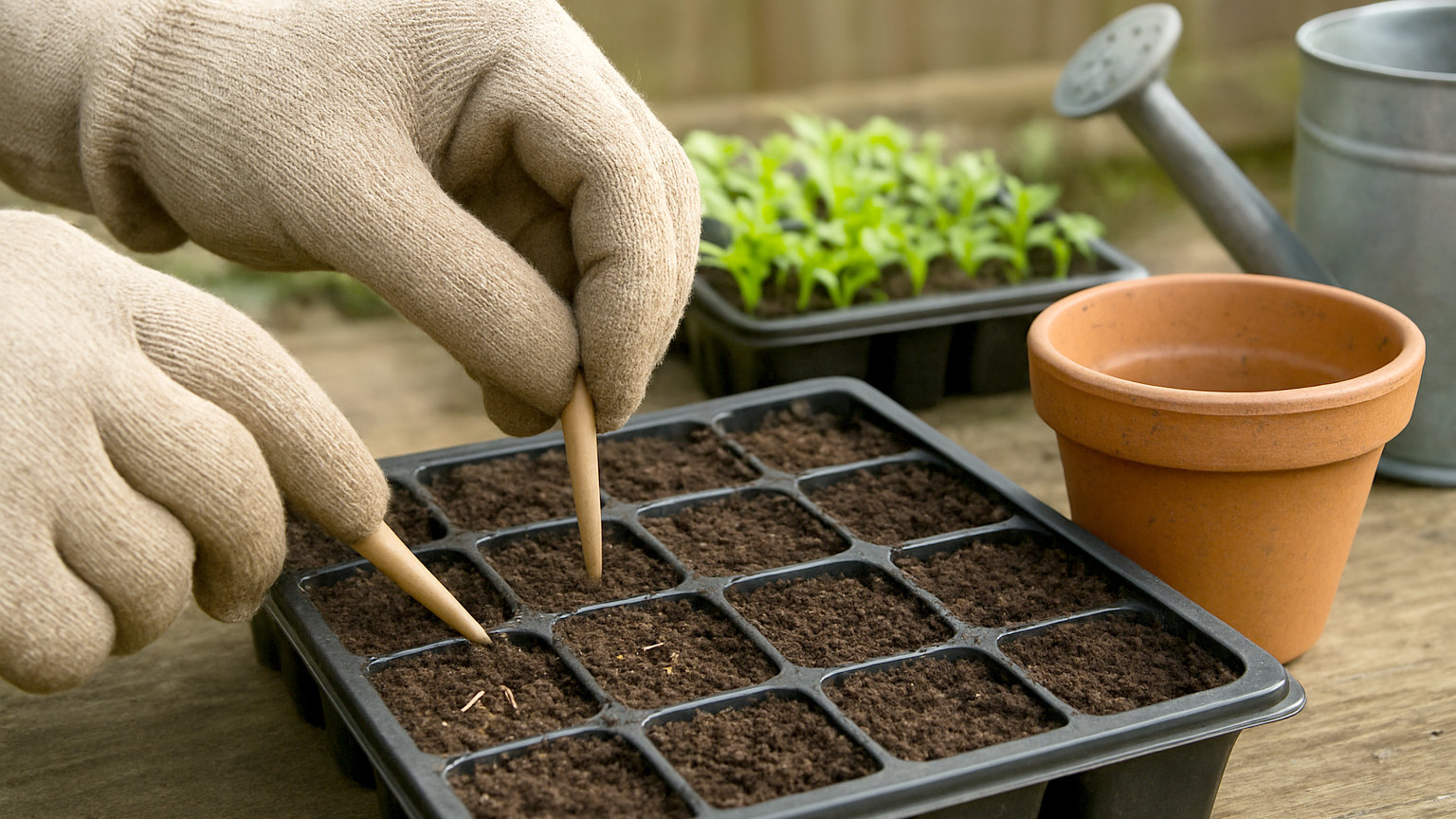
Raising bedding from seed is one of the clearest economies in gardening. A single packet costing the price of a coffee produces more plants than a tray of the same thing bought in May. The only real requirement is starting at the right time, and that depends entirely on which of two groups your plant belongs to.
Hardy or half-hardy
Hardy annuals tolerate frost and can be sown directly where they are to flower. Calendula, cornflower, nigella, poppies, larkspur and sunflowers all fall here. Sow from March to May outdoors, or in September for an earlier and stronger display the following year.
Half-hardy annuals are killed by frost and must be raised under cover, then planted out only when the risk has passed. Cosmos, zinnia, nicotiana, marigolds, petunias, lobelia and antirrhinum are in this group. Sow from February to April indoors.
The packet will say which. Getting it wrong in either direction costs you a season, since half-hardy seed sown outside in March simply rots, and hardy annuals raised on a windowsill grow soft and leggy for no reason.
Sowing half-hardy annuals under cover
Use a peat-free seed compost in modules or small pots, water before sowing, and cover the seed to roughly its own depth. Very fine seed such as lobelia and begonia is scattered on the surface and not covered at all.
Most germinate at around eighteen to twenty degrees. A propagator or a warm room works, but move the tray into the brightest place you have the moment shoots appear.
Do not sow too early. February sowings on a windowsill produce pale, stretched seedlings because there is not enough light to match the warmth. A sowing made in late March under decent light overtakes a February one and makes a better plant. If you have no supplementary lighting, wait.
Pricking out and growing on
Once seedlings have their first pair of true leaves, move them into individual pots or larger modules of multipurpose compost. Handle them by a leaf rather than the stem, since a crushed stem is fatal and a crushed leaf is not.
Grow them on somewhere bright and cool. Warmth at this stage produces soft growth; cool bright conditions produce short, sturdy plants that establish far better when they go out.
Pinch out the growing tips of cosmos, antirrhinum and petunias when they are about ten centimetres tall, which doubles the number of flowering stems.
Hardening off
This step is skipped more than any other and it is where plants are lost. Seedlings raised indoors have soft tissue and no wind tolerance, and moving them straight outside checks them severely.
Over ten to fourteen days, put them out during the day and bring them in at night, gradually extending the exposure. A cold frame makes it easy, opening the lid progressively. Only then, and only after the last frost date for your area, should they be planted out.
Direct sowing hardy annuals
For hardy annuals, rake the soil to a fine tilth, water the drill rather than the surface, and sow thinly in shallow rows or drifts. Marking out irregular patches with sand and sowing each with a different variety gives a natural look and makes it obvious which seedlings are weeds.
Thin ruthlessly once seedlings are a few centimetres tall. Crowded annuals produce spindly plants and few flowers, and the thinning distances on the packet are not optional.
An autumn sowing of hardy annuals in September gives plants that overwinter as small rosettes and flower several weeks earlier and considerably larger the following summer.
Saving your own seed
Most hardy annuals set seed freely and come true enough to be worth collecting. Let a few heads ripen on the plant, cut them on a dry day, and shake the seed into a paper envelope labelled with the variety and date. F1 hybrids will not come true, so those are worth buying fresh each year.
Planting out and keeping them going
Plant out at the spacing on the packet, which usually looks far too generous in May and is correct by July. Water in well and keep watered for the first fortnight.
Deadhead regularly. Annuals exist to set seed, and removing spent flowers before pods form keeps them producing. Cosmos, sweet peas and antirrhinum in particular will flower until the frosts if picked over consistently, and will stop within weeks if left to seed.
Feed containers weekly with a high-potassium feed. Annuals in open ground rarely need feeding on reasonable soil.


