
Annual climbers cover a fence, an obelisk or an ugly structure in a single season, cost the price of a packet of seed, and leave nothing to prune or maintain the following winter. For a new garden or a temporary screen they are hard to beat.
The ones worth growing
Morning glory, Ipomoea, gives intense blue or purple trumpets on twining stems to three metres. Each flower lasts one morning and there are dozens.
Cup and saucer vine, Cobaea scandens, is the most vigorous, reaching four or five metres in a season, with large bell flowers opening green and ageing to deep purple. Technically a tender perennial and grown as an annual here.
Black-eyed Susan, Thunbergia alata, is more modest at about two metres, with orange or yellow flowers with dark centres. Good in a container or a hanging basket.
Canary creeper, Tropaeolum peregrinum, is a nasturtium relative with fringed yellow flowers, scrambling to two and a half metres and tolerating poorer conditions.
Purple bell vine, Rhodochiton, has curious dark pendant flowers and is excellent in a container.
Spanish flag, Ipomoea lobata, produces spikes of flowers shading from red through orange to cream.
Sweet peas belong in this group too and are covered in their own right.
They need warmth to germinate
Most of these are tender and want eighteen to twenty-two degrees to germinate reliably. A cold windowsill in March produces nothing.
Sow from February to April under cover, in a propagator or a warm room. Cobaea in particular needs an early start because of the size it has to reach.
Morning glory and cobaea have hard seed coats and germinate faster if soaked in tepid water overnight, or in the case of morning glory, chipped gently with a nail file.
Sow cobaea seeds on their edge rather than flat, which reduces rotting.
Growing on
Use deep pots or root trainers, since all of these make long roots quickly and resent disturbance.
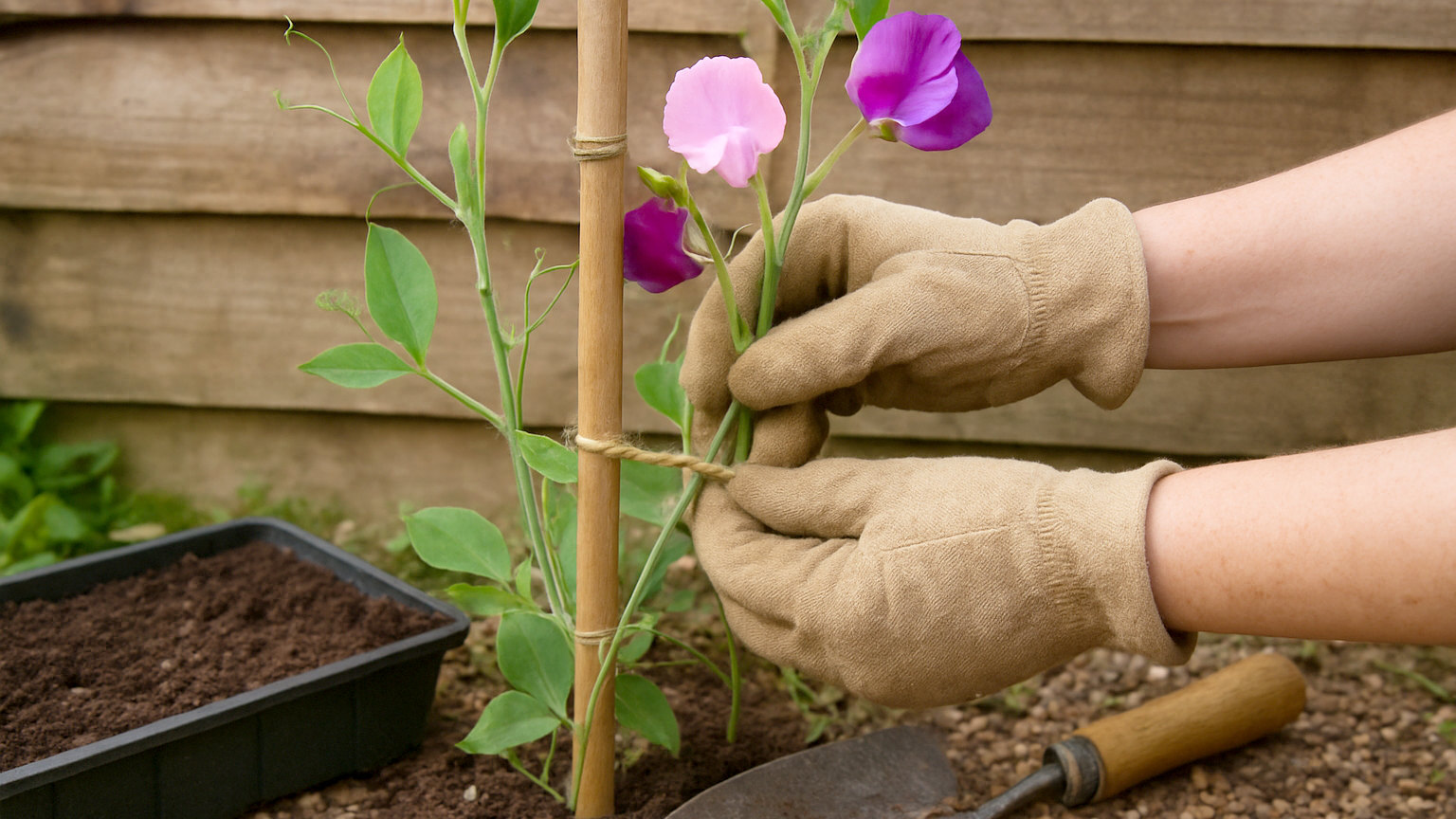
Pot on before they become pot bound, and give each plant a short cane to climb from an early stage, or they twine around each other and are impossible to separate.
Keep them growing steadily without cold checks, which set them back badly.
Planting out
All are killed by frost, so harden off over a fortnight and plant out only after the last frost, usually late May or early June.
Plant into reasonable soil in full sun with shelter from wind. They want more feeding and watering than most annuals, since they are producing several metres of growth in a few months.
Supports
Most of these twine or use tendrils and need something thin to grip: netting, trellis, wires, string or the stems of a host shrub. None will cling to a bare wall.
Get the support up before planting. Tie the young plants in for the first few weeks until they take hold, after which they climb by themselves.
Cobaea is heavy by September and needs a genuinely sturdy structure. Netting stretched between posts, or heavy-gauge wires on vine eyes, is far more reliable than light garden trellis, which distorts under the weight.
Through the season
Water generously, particularly in containers, and feed weekly with a high-potassium feed once flowering starts.
Deadhead where practical, since these are annuals and setting seed slows flowering. On morning glory the spent flowers drop themselves.
Pinch out the growing tips of young plants once to encourage branching, except on cobaea, which you want to run upwards as fast as it can.
Keep tying in the growth every week or two while it is establishing, since a shoot that has fallen away from its support is difficult to reattach without breaking it.
A caution
Ipomoea seeds are toxic if eaten and should be kept away from children. Cobaea, thunbergia and canary creeper are not edible either.
Grow them where seed pods will not be picked by small hands, and clear the plants at the end of the season.
Perennial alternatives
If you want the same effect without sowing every year, clematis, honeysuckle and climbing roses do the job permanently, at the cost of annual pruning and a slower start.
Annual climbers are at their most useful for covering something temporarily, filling a gap while a permanent climber establishes, or growing up an obelisk in a border for one season.


