
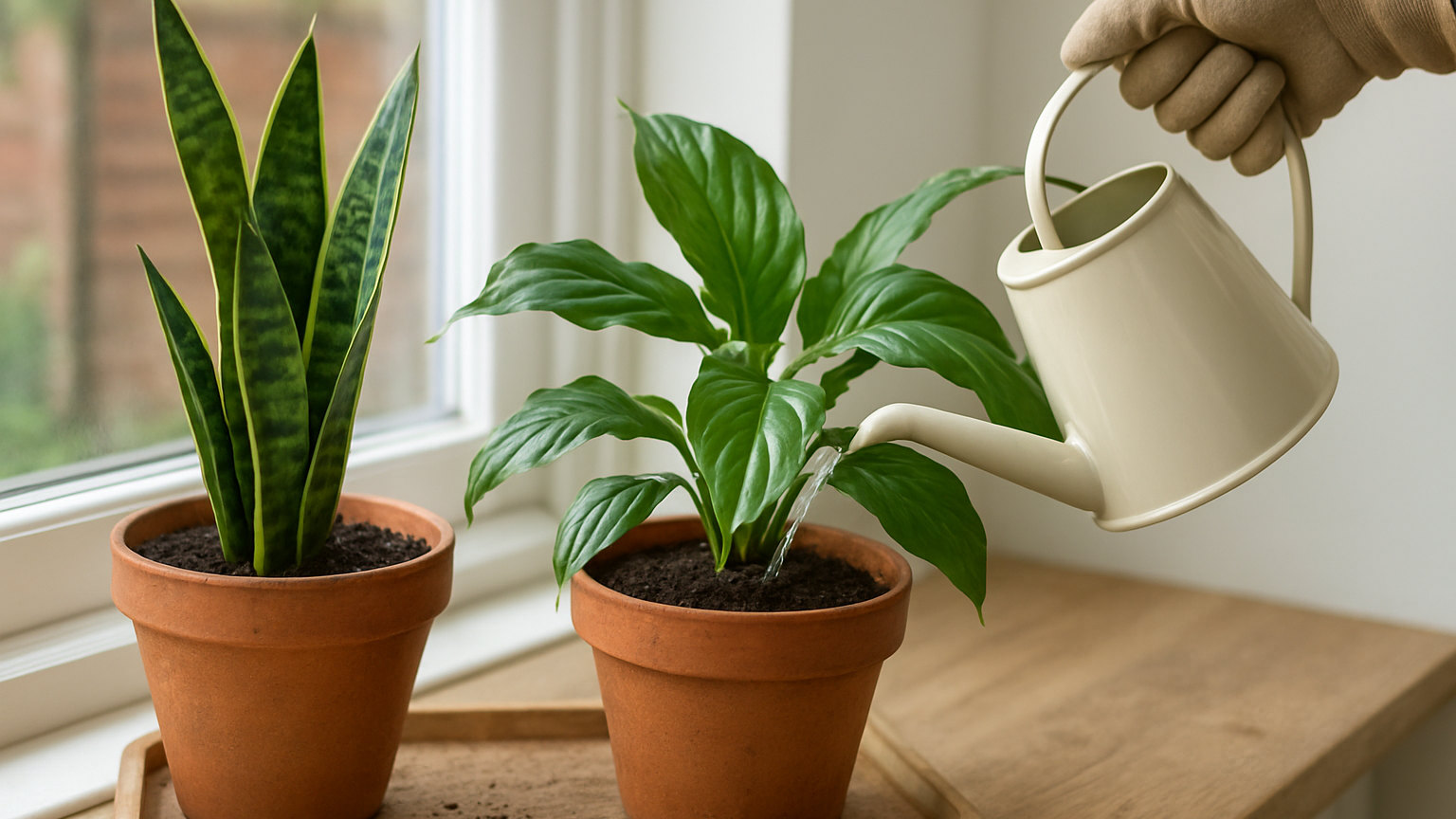
The first question before buying timers, spikes or matting is whether you need any of it. For a great many collections a fortnight requires nothing more than a good soak on the way out of the door.
Rough survival times
These assume a plant watered thoroughly immediately before you leave, moved out of direct sun, in a room at ordinary temperature.
- Cacti, succulents, sansevieria, ZZ plants: a month in summer, considerably longer in winter. These need no arrangements at all for any normal holiday.
- Pothos, philodendron, monstera, dracaena, rubber plants, aspidistra, hoya, spider plants: two to three weeks in summer, four to six in winter. A fortnight needs nothing beyond a soak.
- Peace lilies, most palms, aglaonema, syngonium: ten days to a fortnight in summer. A two-week trip is borderline and worth a measure or two.
- Calathea, maranta, alocasia, most ferns: five to ten days. Anything beyond a long weekend needs a plan.
- Maidenhair ferns, fittonia, carnivorous plants, anything in a very small pot: three to five days. These are the genuine problem cases.
What shortens the time
Season is the largest factor by some distance. The same plant may use two or three times as much water in July as in January, so a fortnight in August is a much bigger ask than a fortnight at Christmas.
Beyond that: small pots, terracotta, a pot-bound plant, direct sun, a warm room, a hanging position with air moving on all sides, and any plant that was already close to needing water when you left.
What extends it
Plastic pots, a recently repotted plant with fresh compost, a cool room, moderate light rather than bright, grouping plants together, and a top-dressing of bark or grit to slow evaporation from the surface.
The honest summary
For most collections, a long weekend requires nothing and a fortnight requires a thorough soak and moving things out of the sun.
The plants worth planning for are the short-tolerance group, anything in a very small pot, and any absence longer than about three weeks in summer. Everything else in this section is aimed at those cases.
It is also worth saying that a plant which wilts once and recovers has lost very little. The aim is not to keep every plant in perfect condition while you are away – it is to avoid anything drying out to the point of permanent damage.
Working out your own figures
The numbers above are averages across ordinary conditions, and your house is not average. The reliable way to know is to measure once: water a plant thoroughly, then note how many days pass before it genuinely needs water again. That interval, halved for safety, is how long you can leave it.
Do this in summer rather than winter, since summer is the constraint. A plant that goes twelve days in July will manage a fortnight comfortably; one that goes five will not.
The thing that shortens it most
Being pot-bound, by a wide margin. A plant that has filled its container with roots holds almost no water reserve, and it will dry out in a fraction of the time the same species would in fresh compost. If a plant needs water more than twice a week in summer, it needs repotting rather than a holiday watering system – and repotting it in spring will do more for next summer's trip than any device.


