
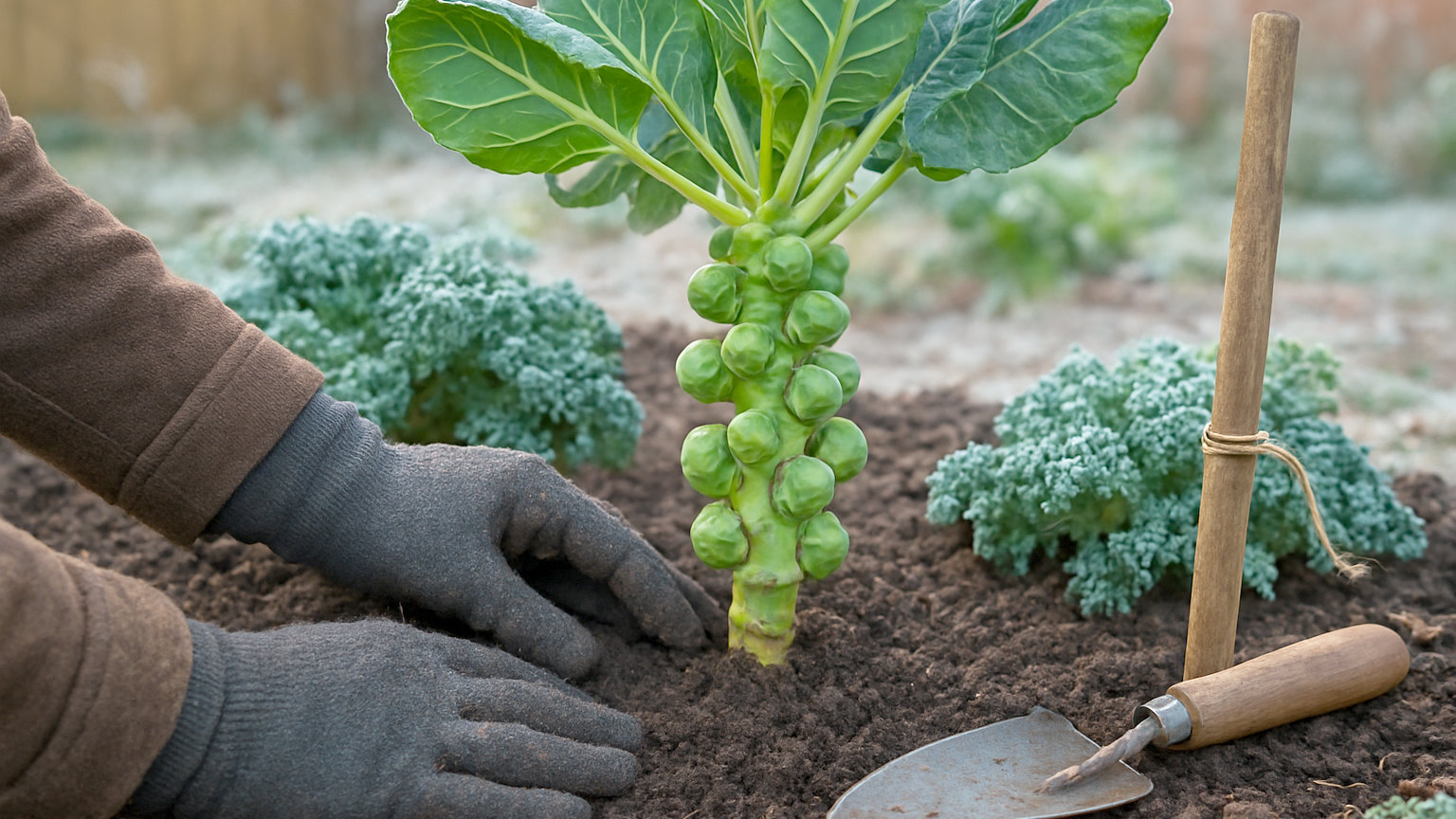
Sprouts and kale are the two crops that make a winter vegetable garden worth having. Both occupy the ground for a long time, both need firm soil and support, and both are at their best after the first frosts have sweetened them.
Sowing and planting
Sow from March to April in a seedbed or modules, about two centimetres deep. Sprouts need a long season, so early sowing matters more for them than for kale, which can be sown as late as June for a winter crop.
Transplant when the plants have four or five true leaves and are around fifteen centimetres tall, usually in May or June.
Space sprouts sixty to seventy-five centimetres apart each way, which is more than people expect and is necessary. Crowded sprouts produce poor loose buttons. Kale can go at forty-five to sixty centimetres.
Firm ground and staking
Both crops need firm soil and both need staking. A Brussels sprout plant reaching a metre tall with a full stem of buttons acts like a sail in a winter gale, and one that rocks loose in the ground produces blown sprouts and may blow over entirely.
Do not dig the bed immediately before planting. Use ground manured for a previous crop, tread it firm, and firm each plant in hard after setting it.
Put a stake in beside each sprout plant in late summer and tie the stem to it. Drawing soil up around the base of the stem, as you would earth up potatoes, gives further stability.
Netting is essential
Pigeons will strip a row of sprouts or kale to the ribs in a winter week, and it is the single most common way these crops are lost.
Net over a frame tall enough to accommodate full-grown plants, keeping the mesh clear of the foliage. Cabbage white caterpillars are the summer problem and the same netting deals with them if the mesh is fine enough.
Fit brassica collars at planting against cabbage root fly, and check leaf undersides regularly for eggs.
Watering and feeding
Water well in dry spells, particularly while the plants are establishing and through summer. A long dry period checks growth and sprouts never fully recover from it.
Feed with a general fertiliser in midsummer. Avoid high nitrogen late in the season, which produces soft growth vulnerable to frost and loose sprouts.
Why sprouts blow
Blown sprouts are open and leafy rather than tight buttons, and they are the classic disappointment.
The causes are loose soil, too much nitrogen, inadequate spacing and plants rocking in wind. All four come back to preparation rather than anything you can fix in November.
Removing the growing point at the top of the plant in early autumn, once the lowest sprouts have reached a usable size, encourages the remainder to mature more evenly. This is useful if you want them ready together, and unnecessary if you would rather pick over a long period.
Harvesting sprouts
Pick from the bottom of the stem upwards, since the lowest buttons mature first. Snap or cut them off cleanly, and remove any yellowing leaves as you go to improve airflow.
Flavour genuinely improves after a frost, as cold converts some starch to sugar. Leave them standing and pick as needed from November through to February.
The leafy top of the plant is edible and good, cooked like cabbage, and is worth taking once picking is finished.
Harvesting kale
Kale is more forgiving and more productive. Pick individual leaves from the bottom of the plant upwards, taking a few from each plant rather than stripping one.
Leave the growing point intact and the plant continues producing through winter and into spring. Young leaves are best; older ones toughen.
In spring, kale produces tender flowering shoots before it runs to seed, which are among the best things it does and are picked like sprouting broccoli.
Varieties
Curly kale is the hardiest and most productive. Cavolo nero, the dark Italian type, has better texture and is slightly less hardy. Red Russian is tender enough to use raw when young.
For sprouts, choose an early and a late variety to spread the harvest from November into February, and look for clubroot resistance if that is a problem on your ground.


