
Peas eaten within an hour of picking taste nothing like anything you can buy, which is the whole argument for growing them. They are straightforward, and the difficulties are all at the two ends: getting the seed to survive mice, and keeping the plant cropping once it starts.
The three types
Shelling peas are the traditional kind, grown for the peas inside a pod you discard. They give the smallest edible yield for the space but the best flavour.
Mangetout are picked flat before the peas develop, and the whole pod is eaten. Sugarsnap are eaten whole once the peas have swollen, giving a thicker, sweeter pod.
Mangetout and sugarsnap produce considerably more edible weight per plant, since nothing is thrown away, which makes them the better choice in a small garden.
When to sow
Main sowings run from March to June, with successional sowings every two or three weeks giving a continuous supply through summer.
Hardy round-seeded varieties can be sown in late autumn, in October or November, to overwinter and crop a few weeks earlier the following year. This suits mild areas and free-draining soil; on cold wet clay they usually rot.
Peas dislike heat, so sowings after about mid-June often struggle in a hot summer and are better made in early July for an autumn crop.
Sowing
Sow direct into a flat-bottomed drill about five centimetres deep and fifteen centimetres wide, spacing the seeds around five to seven centimetres apart in a double or triple staggered row.
Alternatively sow in lengths of guttering filled with compost and slide the whole row into a prepared drill once the seedlings are established, which is a neat trick that avoids both mice and cold soil.
Mice eat pea seed, and they are the commonest reason a row never appears. Sowing in guttering or modules under cover avoids the problem entirely. In open ground, laying prickly prunings over the row or covering with fine mesh helps.
Birds then take the young seedlings, so keep the netting on until the plants are climbing.
Supports
Even varieties described as dwarf crop far better with something to climb, and they stay clear of the ground where slugs are.
Peas climb by tendrils and need something thin to grip, so netting, twiggy hazel prunings or wire mesh all work well. A solid cane on its own is too thick for them.
Get the supports in at sowing rather than later, since pushing them in around established plants damages the shallow roots. Match the height to the variety, which may be anything from sixty centimetres to two metres.
Watering and feeding
Water thoroughly once flowering begins and while the pods are filling, which is when the crop is decided. Before that, peas need relatively little.
They fix their own nitrogen, so no nitrogen feed is needed and too much produces leaf at the expense of pods. Mulching keeps the roots cool and moist, which peas appreciate.
Picking
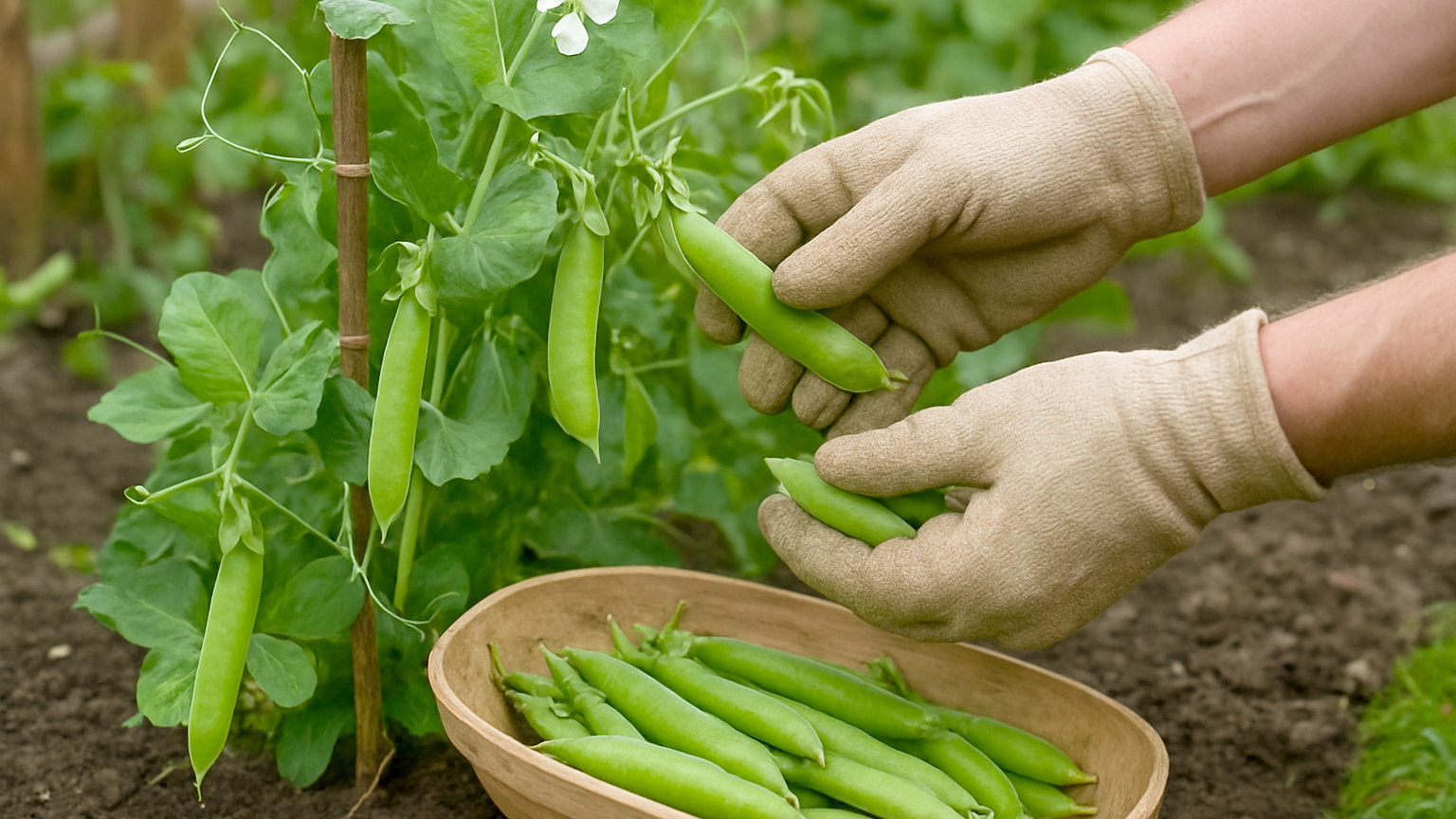
Pick every couple of days once cropping starts, and pick from the bottom of the plant upwards, as the lowest pods mature first.
As with beans, a plant that is allowed to mature its seed considers the job done and stops producing. Regular picking keeps a row cropping for several weeks rather than a fortnight.
Shelling peas are ready when the pods are well filled but still bright green and the peas inside are not yet hard. Mangetout are picked flat, before the peas show. Sugarsnap are picked when the pods are plump and still crisp.
Pea moth
Small caterpillars inside the pods are pea moth larvae, and the damage is invisible until you shell them.
The moth lays during flowering in June and July, so early and very late sowings that flower outside that window largely escape it. Covering the crop with fine insect mesh during flowering also works, though it excludes pollinators, which peas mostly do not need since they are self-fertile.
Powdery mildew
A white dusty coating on the leaves in late summer, worse on dry roots in humid conditions. Water at the base, mulch, space plants adequately and choose resistant varieties for late sowings.
Afterwards
When the plants finish, cut the tops off at ground level and leave the roots in the soil. The nitrogen-fixing nodules on them release nitrogen as they break down, which is why brassicas traditionally follow peas and beans in a rotation.


