
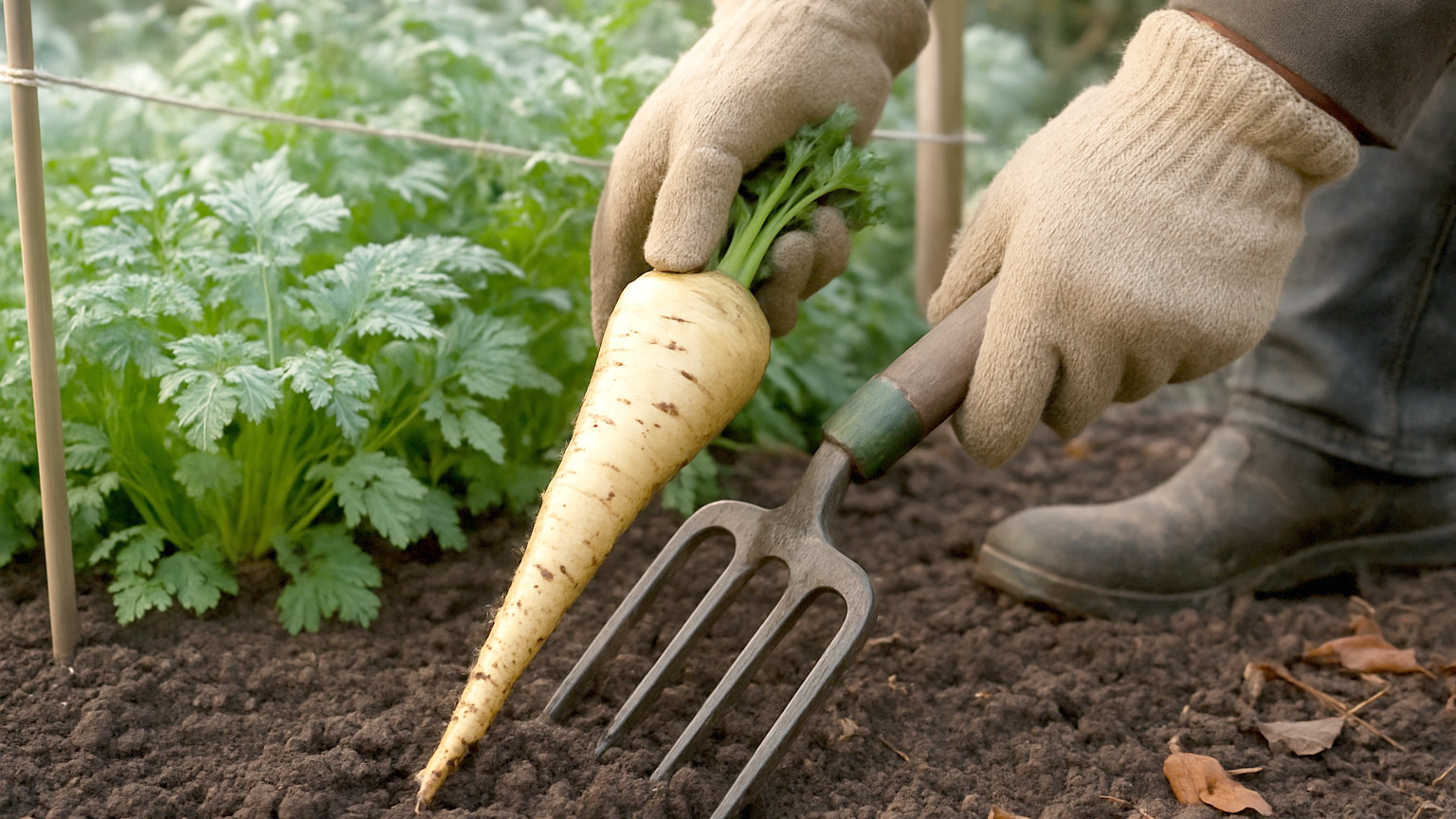
Parsnips occupy the ground for most of the year and test your patience at both ends: germination takes weeks, and the crop is not at its best until after the first frosts. They are worth it, and there are three specific things to get right.
Use fresh seed
Parsnip seed loses viability faster than almost any other vegetable seed. Seed from last year germinates poorly and seed from two years ago often not at all.
Buy a new packet every year and do not be tempted to use the remainder of an old one. This single point accounts for a great many failed rows, and gardeners frequently blame the weather or the soil for what is simply dead seed.
The soil
Like carrots, parsnips need deep, light, stone-free soil. Any obstruction causes the root to fork, and a forked parsnip is a nuisance to prepare.
Do not grow them on freshly manured ground, which also causes forking and hairy roots. Follow a crop that was manured the previous year.
On heavy or stony soil, grow a shorter-rooted variety, or make a deep hole with a crowbar, fill it with sieved compost and sow into that. Deep containers work too.
Sowing
Sow from March to May directly where the plants are to grow. Parsnips must not be transplanted, since disturbance causes forking.
Wait for the soil to warm rather than sowing at the first opportunity. Seed sown into cold wet soil in February frequently rots, and an April sowing into warm ground catches up quickly.
Sow thinly at about two centimetres deep, in drills thirty centimetres apart. Station sowing, putting two or three seeds every fifteen centimetres and thinning to the strongest, wastes less seed than sowing along the row.
Germination takes weeks
Expect anything from two to four weeks, and sometimes longer in a cold spring. This is normal and not a sign of failure.
The practical problem is that weeds germinate faster and you cannot see the row. The traditional answer is to sow a few radish seeds along the same drill, which come up within days and mark the line, letting you hoe confidently between the rows. The radishes are pulled and eaten well before the parsnips need the space.
Thinning and care
Thin to a final spacing of about fifteen centimetres. Closer spacing produces smaller roots, which some people prefer, but crowding beyond that gives nothing usable.
Keep the bed weed free while the seedlings are small. Once the foliage has developed it shades the ground reasonably well and needs little further attention.
Water in prolonged dry spells to prevent the roots splitting when rain eventually arrives. Parsnips need no feeding on reasonable ground.
Canker
Brown or black rot around the shoulders of the root, worse in wet seasons and on ground that is too rich or too acidic.
There is no treatment once it appears. Reduce the risk by improving drainage, avoiding freshly manured ground, drawing soil over the shoulders as they emerge, and choosing a canker-resistant variety, of which several good ones exist.
Harvesting after frost
Parsnips are ready from October and improve considerably after the first hard frosts. Cold converts some of the starch in the root to sugar, which is what gives a properly grown parsnip its sweetness.
Lifting them in September is possible and disappointing. Wait.
Leave them in the ground through winter and lift as needed, which is the best way to store them. On very heavy soil that becomes waterlogged, or where the ground freezes solid, lift in late autumn and store in boxes of damp sand.
Ease the roots up with a fork rather than pulling by the foliage, which will snap off and leave the root behind. A long parsnip in heavy ground takes more digging than people expect.
Saving your own seed
Parsnips are biennial, flowering in their second year, so leaving one or two roots in the ground produces tall umbels of seed the following summer. Collect it when dry and use it the same year, since it will be useless by the year after. Given how much of the crop depends on seed freshness, home-saved seed used promptly is often better than a shop packet of uncertain age.
A caution about the foliage
Parsnip leaves contain compounds that can cause a painful skin reaction in sunlight, similar to a burn. Wear long sleeves and gloves when handling the foliage in hot weather, particularly when clearing the bed.


