
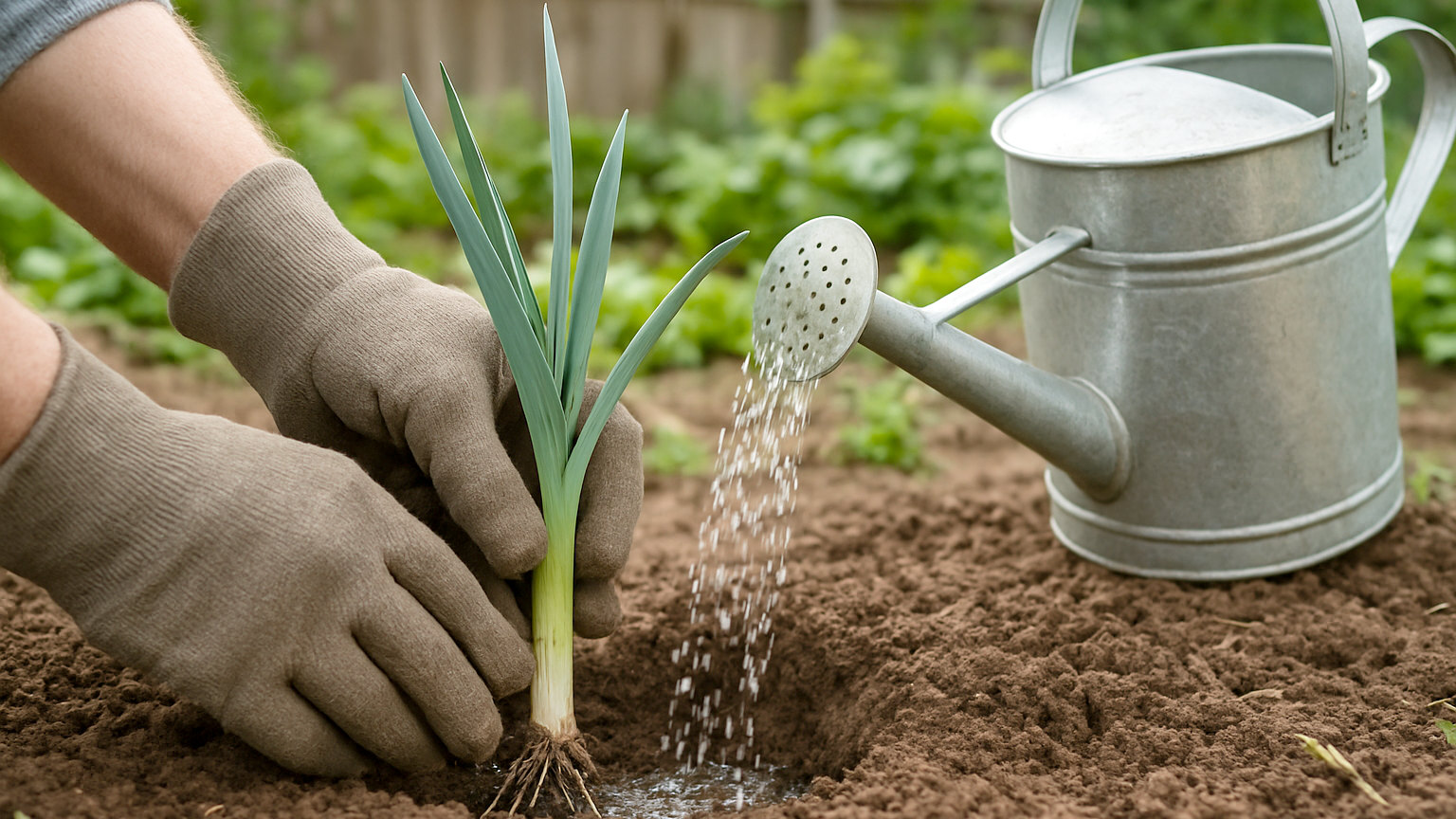
Leeks are one of the most useful crops in a vegetable garden because they stand through winter and are harvested when almost nothing else is available. The technique that makes them worthwhile is a single unusual step at transplanting, which produces the long white shank that is the point of growing them.
Sowing
Sow from February to April, either in modules under cover or in a seedbed outdoors. Module sowing gives better control and avoids root disturbance, so sow two or three seeds per cell and thin to the strongest.
Early varieties sown in February crop from late summer; late varieties sown in April stand through winter into spring. Sowing a couple of varieties spreads the harvest across six months.
Grow them on until they are about pencil thickness and roughly twenty centimetres tall, which usually takes until June.
The dibbed hole
This is the step that matters. Rather than planting leeks in a conventional hole, make a deep hole with a dibber and drop the seedling into it.
Make holes about fifteen centimetres deep and two to three centimetres wide, spaced fifteen to twenty centimetres apart with thirty centimetres between rows. Trim the roots back to about two centimetres and the leaf tips by about a third, which sounds brutal and helps the plant establish.
Drop one seedling into each hole so the leaves sit just above the surface.
Do not backfill the hole with soil. Instead, fill it with water, a process called puddling in. The water washes just enough soil around the roots to settle them, and the remaining space allows the shank to expand and stay blanched. Backfilling produces a short green leek full of grit.
Through the season
Water in dry spells, particularly through July and August when the shanks are thickening. Keep the bed weed free.
To lengthen the white shank further, draw dry soil up around the stems in stages from late summer, or slip a cardboard tube or a length of drainpipe over each plant. Take care not to let soil fall between the leaves, which leaves grit that is impossible to wash out.
A general feed in midsummer helps on poor soil, though leeks are not heavy feeders.
Leek rust
Bright orange pustules on the leaves, common in mild wet summers and worse where plants are crowded or the soil is short of potassium.
It looks alarming and rarely kills the crop. Remove badly affected leaves, improve spacing and airflow, avoid high-nitrogen feeds, and apply sulphate of potash if the soil is deficient.
Rotate so alliums do not follow alliums, and do not compost affected foliage. Some varieties have useful resistance and are worth seeking out if rust is a recurring problem.
Other problems
Allium leaf miner and leek moth have both become more common in recent years, causing tunnelling in the leaves and stems and secondary rotting. Covering the crop with insect mesh from planting is the effective control, since both are laid by adults that must reach the plant.
White rot, which shows as yellowing foliage and white fluffy mould at the base, persists in soil for many years. Remove affected plants and avoid alliums in that ground.
Harvesting
Lift leeks as you need them from autumn onwards, and continue through winter into early spring. They are extremely hardy and stand hard frost without protection, which is precisely their value.
Do not pull them by the leaves, which will simply tear. Ease each one up with a fork from the side.
Leave the remainder in the ground rather than lifting and storing, since the ground is the best store there is for leeks. Lift any still standing by March, before they begin to bolt in spring.
Cleaning them
Grit between the leaves is the usual complaint, and it comes from earthing up carelessly. Trim the roots and the darkest leaf tops, then slit the leek lengthways from the point the leaves begin and rinse under a tap, fanning the layers apart. Doing it before cooking rather than after saves considerable annoyance.
If they bolt
A leek sending up a flower stem has bolted and the centre becomes tough and woody. It is still usable if caught early, though the core will need discarding. Late-standing varieties bolt later, which is why variety choice matters for a long season.


