
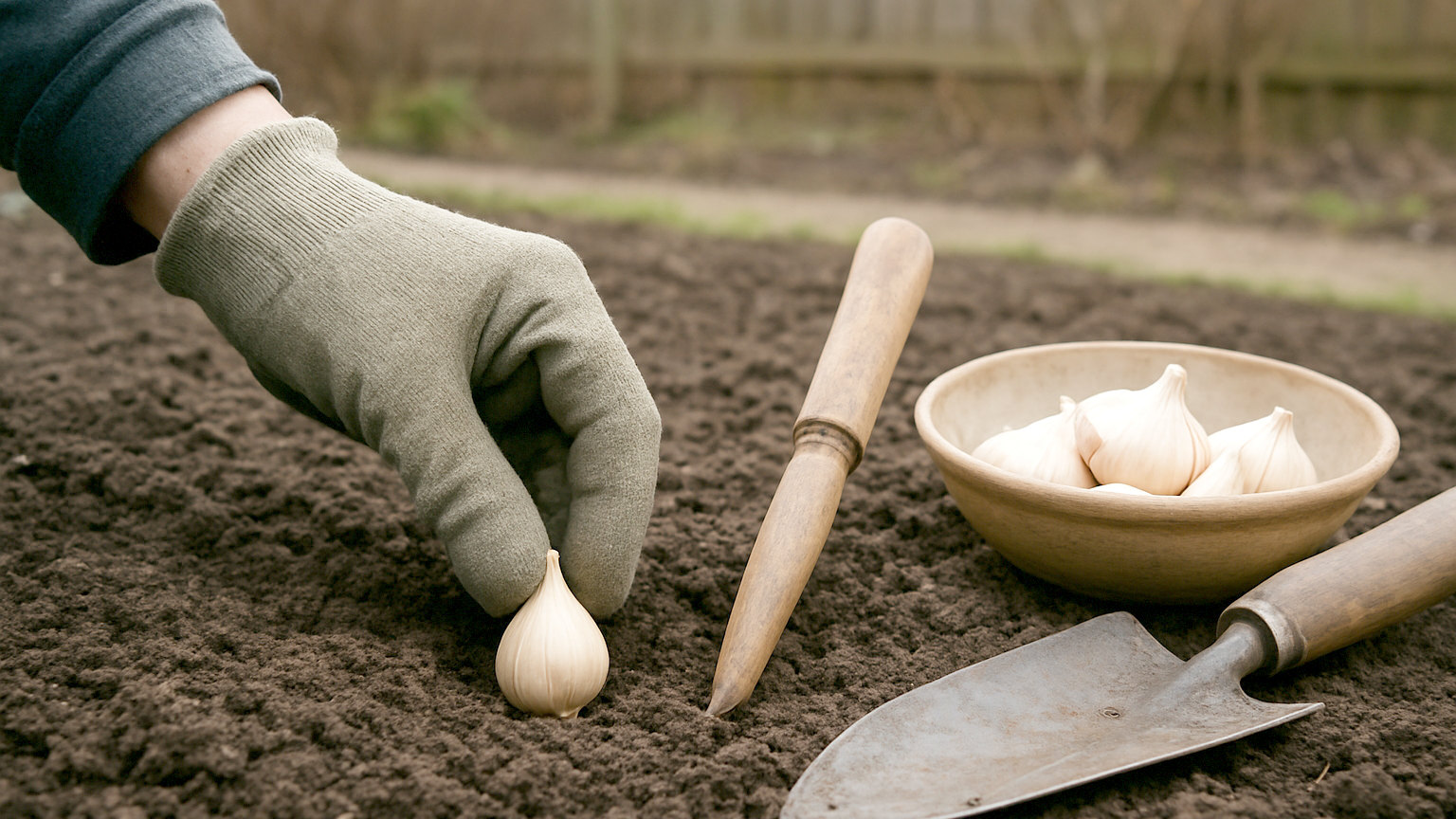
Garlic is planted in autumn rather than spring, and the reason is worth understanding: it needs a period of cold, roughly a month or more below about ten degrees, to trigger the bulb into dividing into cloves. Plant it in spring and you frequently get a single undivided bulb the size of an onion.
When to plant
October to November is ideal, giving the cloves time to root before winter and a good long cold period. Planting can continue into December and even January if the ground is workable.
Spring planting, in February or March, is possible with varieties sold specifically for it, and the bulbs are usually smaller. If you have missed the autumn, buy spring-planting stock rather than using leftover autumn cloves.
Buy proper seed garlic
Use certified seed garlic from a supplier rather than supermarket bulbs. Imported culinary garlic is often treated to suppress sprouting, is frequently a variety unsuited to the British climate, and can carry disease into your soil.
Seed garlic costs more once and pays for itself in the crop, and you can save your own best bulbs to replant in subsequent years.
Softneck or hardneck
Softneck varieties have soft flexible stems, produce more cloves per bulb, store considerably longer, often ten months or more, and are the ones that can be plaited. They are generally the better choice for a British garden.
Hardneck varieties produce a stiff central flower stalk, have fewer but larger cloves, usually a stronger flavour, and store for a shorter period, often only four to six months. They tend to be hardier in very cold areas.
Planting
Split the bulb into individual cloves just before planting, keeping the papery skin on each. Use the largest cloves and eat the small inner ones, since clove size directly determines bulb size.
Plant each clove pointed end upwards, with the tip about two to three centimetres below the surface, or deeper on light soil. Space them fifteen to eighteen centimetres apart with about thirty centimetres between rows.
Choose a sunny position with free-draining soil. Garlic will not tolerate sitting wet through winter, and on heavy clay it is far better in a raised bed or module-started under cover and planted out in spring.
Birds pull newly planted cloves up in the same way as onion sets, so net the bed until they root.
Through the season
Keep the bed weed free, since garlic competes poorly. Water in dry spells during spring when the bulbs are swelling, and stop watering once the leaves begin to yellow.
A light feed of a general fertiliser in early spring helps, but avoid high nitrogen, which produces leaf rather than bulb.
Scapes
Hardneck varieties send up a curling flower stalk in early summer, called a scape. Cut it off once it curls, which pushes the plant's energy back into the bulb and noticeably improves the size.
Scapes are edible and good, with a mild garlic flavour, so this is a free extra crop rather than a chore.
Harvesting
Lift garlic when about half the leaves have yellowed, not when they have all died down. Waiting too long is the commonest error: the bulb's protective skins break down, the cloves separate, and it will not store.
That point usually falls in June or July, earlier than most people expect. Ease the bulbs up with a fork rather than pulling by the stem, which snaps.
Drying and storing
Dry the bulbs somewhere warm, airy and out of direct sun for two to four weeks, until the skins are papery and the necks are completely dry. A greenhouse or an airy shed suits.
Then trim the roots and either cut the stems to a few centimetres or plait the softneck varieties. Store somewhere cool, dry and dark, and check occasionally.
Wet ground and module starting
On heavy clay, autumn-planted cloves frequently rot over winter. Starting them in modules in a cold frame in November and planting out in February gives the cold period the plant needs without the waterlogging, and it is the reliable route on difficult soil.
Rust
Orange pustules on the leaves are garlic rust, which is common in mild damp summers and worse in crowded, sheltered beds. It reduces bulb size rather than killing the plant.
Improve spacing and airflow, avoid overhead watering, remove badly affected leaves, and rotate so alliums do not return to the same ground for several years.


