
Carrots are among the easiest crops to sow and the easiest to disappoint yourself with. Two problems account for nearly every failure: stony or freshly manured ground, which makes the roots fork, and carrot fly, which is attracted by the smell released when you thin them.
The soil comes first
Carrots want a deep, light, stone-free soil. Every stone the root meets causes it to fork or bend, which is why carrots grown on heavy or stony ground come out looking like a handful of fingers.
Never grow carrots on freshly manured ground. Fresh organic matter causes forking and hairy roots just as effectively as stones do. Grow them on a bed manured for a previous crop, ideally following something like potatoes or beans.
On clay or stony soil, grow short, stump-rooted varieties such as Chantenay or Paris Market, or grow in a deep container or raised bed filled with sieved compost, which works very well.
Rake the surface to a fine crumbly tilth before sowing, removing every stone you find.
When to sow
Early varieties can go in from March under cloches or fleece, and main sowings run from April to July. A late June or early July sowing produces roots for autumn and winter and largely misses the first generation of carrot fly.
Carrots must be sown direct where they are to grow. They resent root disturbance and transplanted carrots fork, so do not start them in modules.
Sowing thinly
Sow into shallow drills about a centimetre deep, spacing rows fifteen to thirty centimetres apart. Water the drill before sowing rather than the surface afterwards, which stops the seed washing about.
Sow as thinly as you can manage. This is the single most useful habit, because it reduces or removes the need to thin later.
Mixing the fine seed with dry sand makes thin sowing far easier, or use seed tape if you find it fiddly. Cover lightly and firm gently.
Thinning, and why it matters
Aim for a final spacing of five to seven centimetres between plants. Crowded carrots produce a tangle of thin roots and nothing worth pulling.
The difficulty is that crushed carrot foliage releases a scent that carrot fly detects from a considerable distance. If you must thin, do it in the evening, remove every thinning from the plot rather than leaving them on the soil, and water the row afterwards to settle the disturbed soil and damp down the smell.
Carrot fly
The larvae tunnel into the roots, leaving rusty brown channels that ruin them. The damage is invisible until you lift the crop.
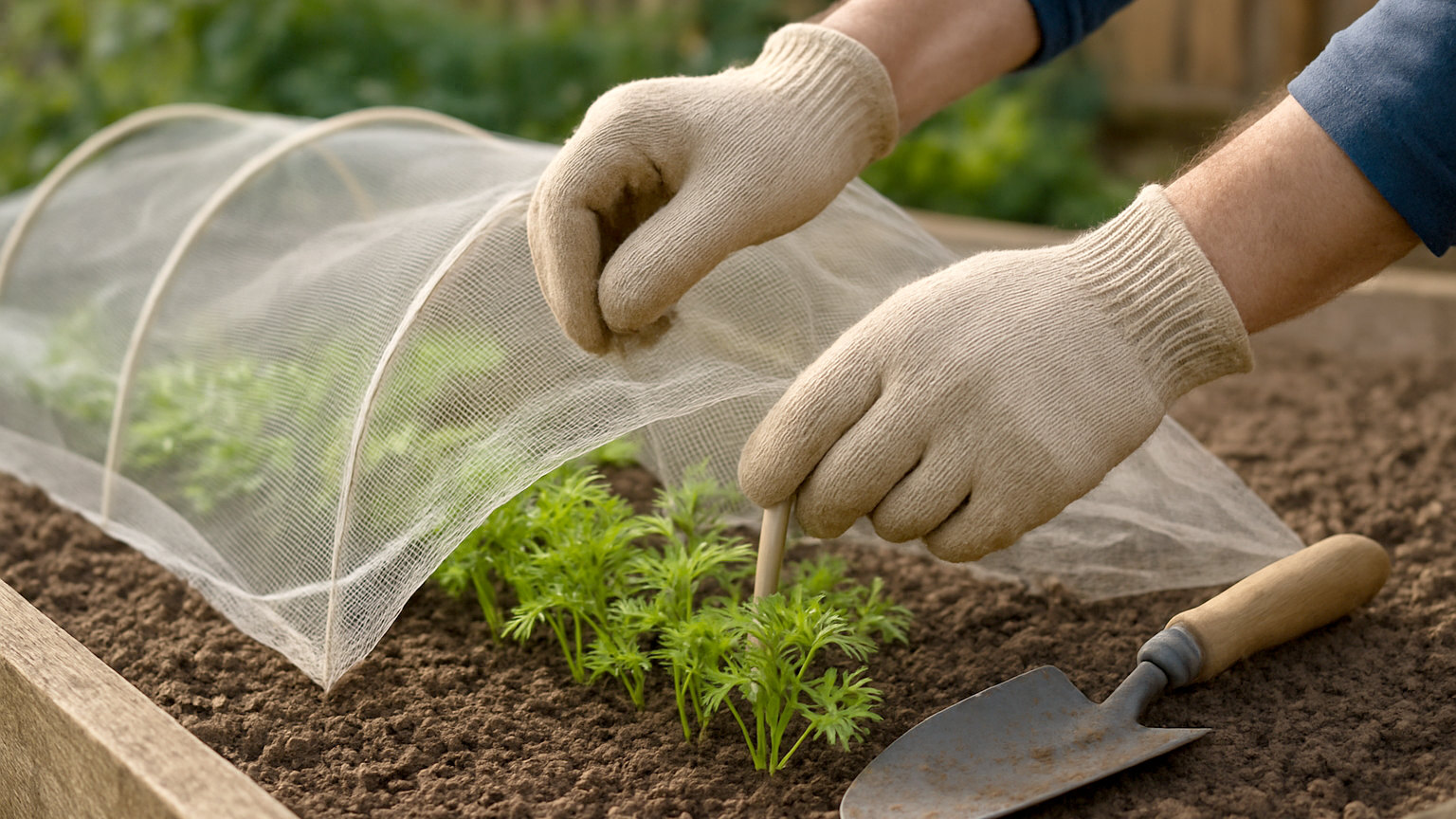
The adult fly flies low, close to the ground, and navigates by scent. The practical control is a vertical barrier of fine mesh or fleece, sixty to seventy-five centimetres high, all the way round the bed. The flies cannot easily rise above it.
Covering the crop entirely with insect mesh works too, provided the edges are buried and it goes on at sowing rather than later. Some varieties are bred for partial resistance and are worth choosing where the pest is persistent.
Watering and care
Keep the soil evenly moist. Irregular watering, particularly a heavy soak after a dry spell, causes the roots to split.
Carrots need no feeding on reasonable soil, and a nitrogen-rich feed produces lush foliage at the expense of the root.
Keep the row weed free while the seedlings are small, since carrots are slow to germinate and easily smothered. Germination can take two to three weeks, which is long enough that people assume the sowing has failed.
Harvesting
Pull earlies from around ten to twelve weeks after sowing, when the shoulders are visible and about the thickness of a thumb. Maincrops take longer and can be left in the ground.
Water the row before pulling if the ground is dry, which makes lifting much easier and reduces the number that snap.
Maincrop carrots can be left in the ground over winter in most of the country, covered with straw or fleece in cold areas, and lifted as needed. On heavy wet soil they are better lifted in autumn and stored in boxes of damp sand somewhere cool and frost free.
Green shoulders
Carrot tops exposed to light turn green. It is harmless but bitter, and easily prevented by drawing a little soil over the shoulders as they swell.


