
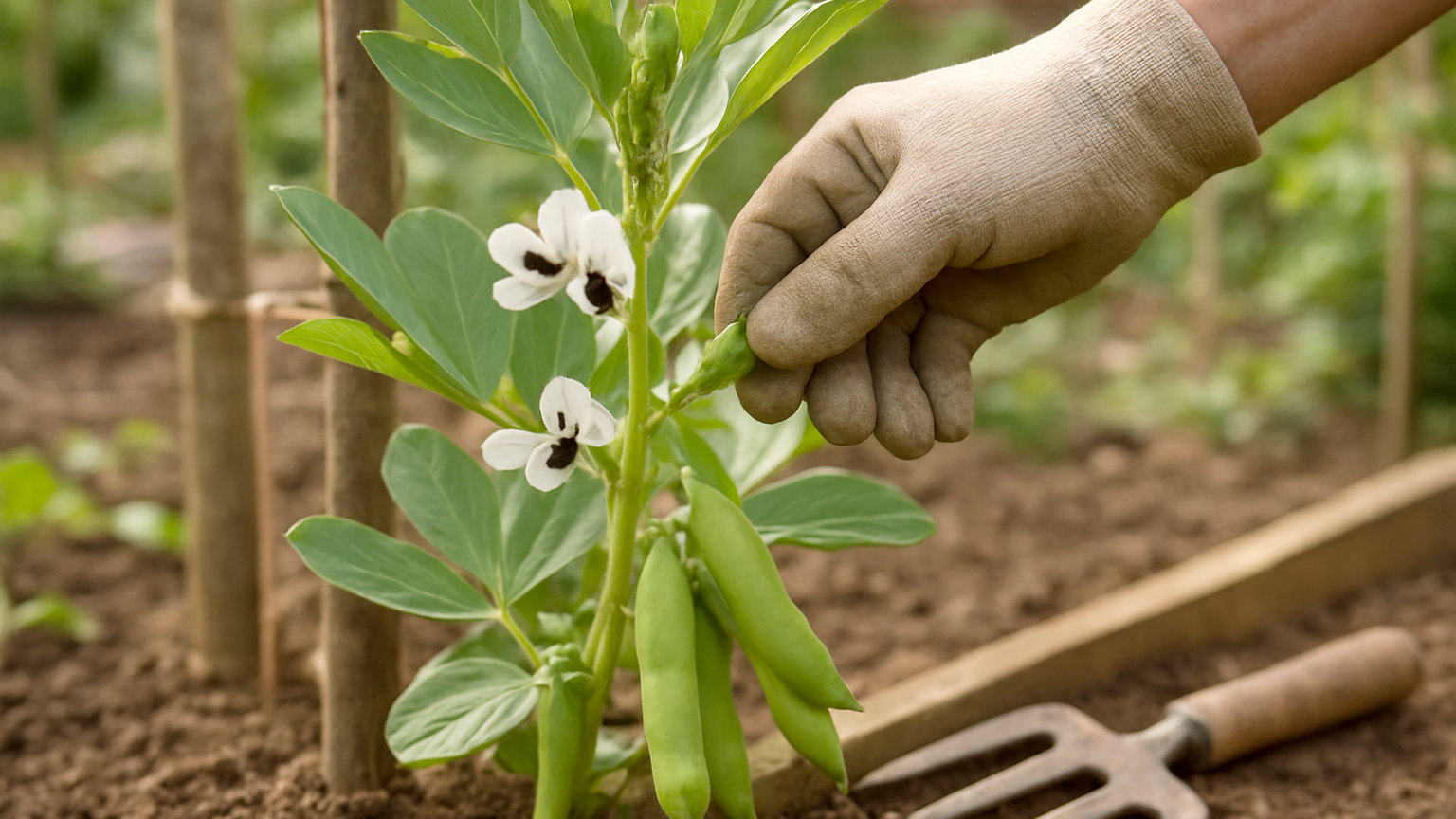
Broad beans are the hardiest thing in the vegetable garden and among the earliest to crop. They can be sown in November, sit through winter as small sturdy plants and give you the first fresh vegetable of the year in June, weeks before anything else is ready.
Autumn or spring
Autumn sowing, in October or November, produces plants that overwinter and crop from late May or June. They establish strong root systems, tolerate drought better and largely escape blackfly, which arrives after they have set their pods.
The catch is that autumn sowing needs a hardy variety, such as Aquadulce Claudia, and it suits free-draining soil. On heavy wet clay the seed frequently rots over winter.
Spring sowing, from February to April, is the straightforward alternative and crops from July. Sowing under cover in February and planting out in March gets round cold wet soil.
Sowing
Sow at about five centimetres deep, spacing seeds twenty centimetres apart in double rows about twenty-five centimetres apart, with sixty centimetres between each double row.
Broad beans germinate reliably in cool conditions but mice are extremely fond of the seed. Sowing in root trainers or deep modules under cover avoids the problem and gives sturdy plants to set out.
They want an open sunny position on reasonably fertile soil that is not waterlogged. They are not heavy feeders and, like peas, fix their own nitrogen.
Support
Broad beans grow to a metre or more and are top-heavy once podding, particularly after rain. A row that falls over is much harder to pick and the pods end up on the soil.
The usual arrangement is a stake at each corner of a double row with string run around the outside at two or three heights as the plants grow. It takes ten minutes and saves a good deal of annoyance in June.
Blackfly and pinching out
Pinch out the top ten centimetres of each plant once the lowest flowers have set pods. This is the single most useful job in growing broad beans and it does two things at once.
Blackfly congregate on the soft growing tips, so removing them takes most of the colony away before it builds. It also pushes the plant's energy into filling the pods it already has rather than producing more growth.
The pinched tips are edible and good, cooked like spinach, so nothing is wasted.
Any blackfly remaining can be squashed by hand or washed off with a jet of water. Ladybirds and hoverfly larvae usually deal with the rest within a fortnight if you leave them to it.
Chocolate spot
Brown spots on the leaves and stems, common in wet seasons and on crowded plants, particularly on overwintered crops in a mild damp winter.
It reduces the crop rather than destroying it. Improve airflow with adequate spacing, avoid overhead watering, and remove badly affected material. Good drainage and a potassium feed both help.
Picking
Pick when the pods are well filled and the beans inside are about the size of a thumbnail, which is smaller than most people wait for. Beans left to grow large develop tough skins and a mealy texture, and the black scar at the top of each bean darkens.
Pick from the bottom of the plant upwards, twisting the pods off or cutting them rather than pulling, which damages the stem.
Very young pods, under about seven centimetres, can be cooked and eaten whole.
Skinning the beans
Older beans are considerably improved by slipping the grey skins off after a brief blanching, leaving the bright green bean inside. It is fiddly and it transforms a mature crop, so it is worth knowing rather than discarding beans that got away from you.
Drying for winter
Beans left on the plant until the pods blacken and dry can be shelled and stored as dried beans. It is a useful way of dealing with a row that has got ahead of you, and the dried beans keep for a year in a jar.
Afterwards
When cropping finishes, cut the plants off at ground level and leave the roots in the soil, where the nitrogen-fixing nodules break down and feed the following crop. Brassicas are the traditional successor for exactly that reason.
The tops can be composted unless they are badly affected by chocolate spot or rust.


