
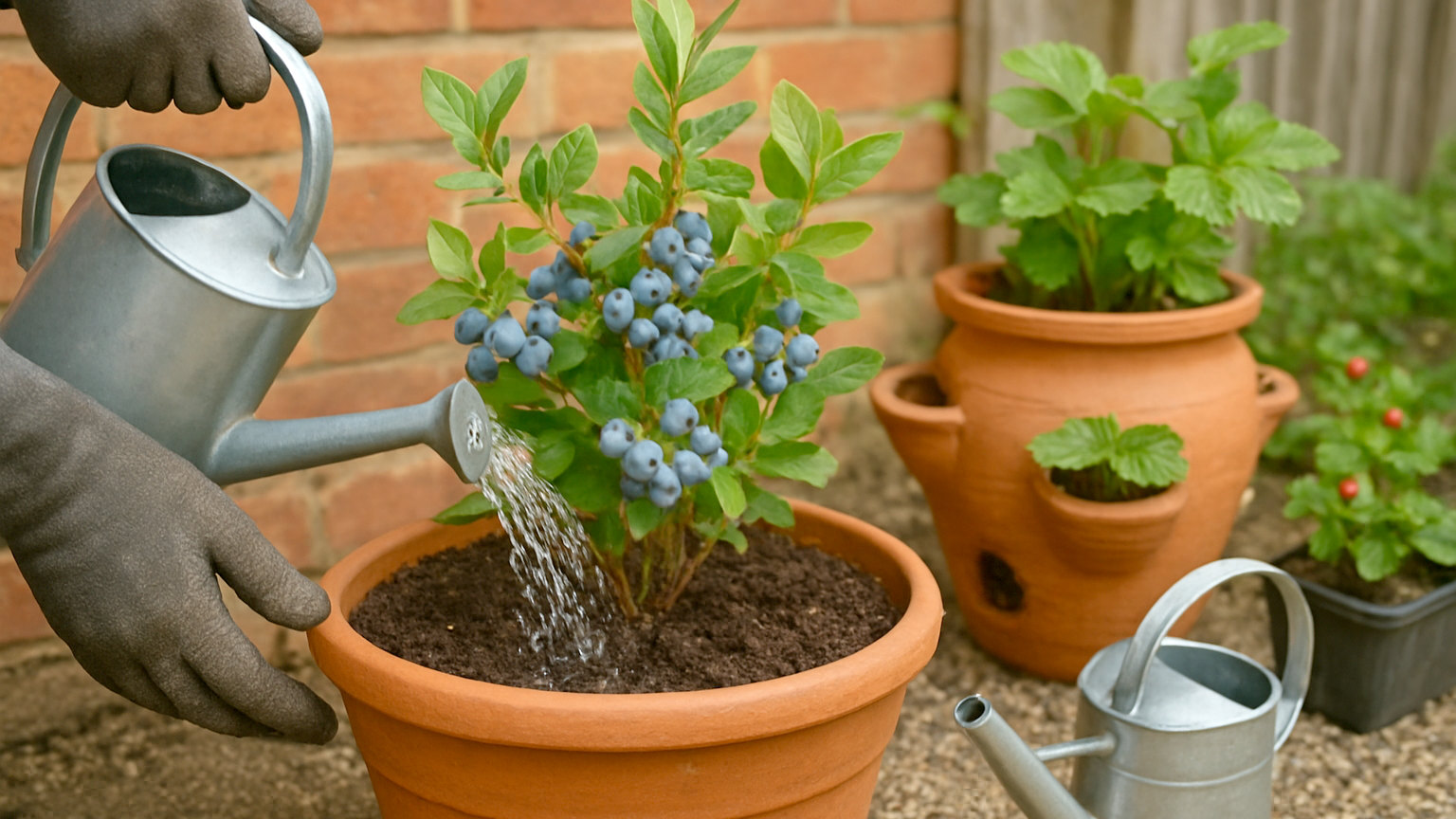
Most soft fruit grows perfectly well in containers, and blueberries generally do better in a pot than in the ground because it lets you control the soil acidity. The trade is a daily watering commitment through summer.
What suits a pot
Strawberries - ideal. Pots, troughs, hanging baskets and towers all work, and growing them off the ground largely solves slugs and muddy fruit.
Blueberries - the best case of all, since ericaceous compost in a pot removes the soil pH problem entirely.
Currants and gooseberries - crop well in a large pot, and can be grown as neat standards or cordons.
Autumn raspberries - suit containers better than summer ones, since they need no support and are simply cut to the ground each February.
Rhubarb and figs - both work in a very large container, and figs actually fruit better for the root restriction.
Blackberries and summer raspberries are the least suited, being vigorous and needing substantial support.
Pot sizes
- Strawberries - 20cm deep is enough; three plants in a 30cm pot
- Blueberries - 40 to 50cm, moving up over a few years
- Currants and gooseberries - 45cm minimum
- Autumn raspberries - 40cm, three or four canes per pot
- Rhubarb and figs - 50cm or more
Wider is better than deeper for everything except rhubarb, since a wide pot holds more compost and dries more slowly.
Compost
Use a soil-based compost such as John Innes No. 3 for anything staying in the pot for years. It holds water and nutrients far better than multipurpose, breaks down more slowly, and its weight keeps a top-heavy bush stable.
Blueberries are the exception and need ericaceous compost, and nothing else will do.
Strawberries, which are replaced every three years, are fine in a good peat-free multipurpose mix.
Watering is the commitment
Container fruit may need water daily from May to September and twice a day in a heatwave. Irregular watering causes fruit drop, small berries and splitting.
Water thoroughly until it runs from the base rather than sprinkling the surface. Check by pushing a finger into the compost rather than judging by the top.
Mulch the surface with gravel or compost, group pots together to shade the sides, and consider a drip system on a timer if you are out all day.
Blueberries need rainwater rather than tap water in hard water areas, since tap water gradually raises the pH.
Feeding
Compost is exhausted within about six weeks. Feed weekly with a high-potassium tomato feed once flowering starts, using an ericaceous feed for blueberries.
Top dress each spring by scraping off the top five centimetres and replacing it with fresh compost.
Overwintering
Roots in a pot are far more exposed to freezing than roots in the ground, since cold penetrates from every side.
Move pots against a house wall for winter, lift them onto feet so they are not standing in water, and wrap the container in bubble wrap or hessian during a hard spell. Wrap the pot, not the plant.
Do not bring hardy fruit indoors. Currants, gooseberries, raspberries and blueberries all need a cold period to break dormancy and fruit properly.
Repotting
Move up a pot size, or root prune and replace the compost, every two or three years in winter while dormant. A congested pot-bound bush crops poorly and dries out within hours of watering.
Tip the plant out to check rather than guessing. Roots circling tightly around the outside of the rootball mean it is overdue.
Netting
Wind
A bush in leaf in a pot catches wind and blows over, taking the crop with it. Use a heavy container, keep pots against a wall or grouped in a sheltered corner, and stake anything tall. A blown-over pot in July usually means a broken plant as well as a lost crop.
Replacing strawberries
Container strawberries decline after three years just as they do in the ground. Root a few runners each summer, and replace a third of your pots annually so you always have plants of mixed ages rather than a whole collection going over at once.
Netting
Birds find container fruit as readily as fruit growing in the ground, and often sooner, since a pot on a patio is at a convenient height for them. Small netted frames over individual pots are easy to make and easy to lift off for picking.


