
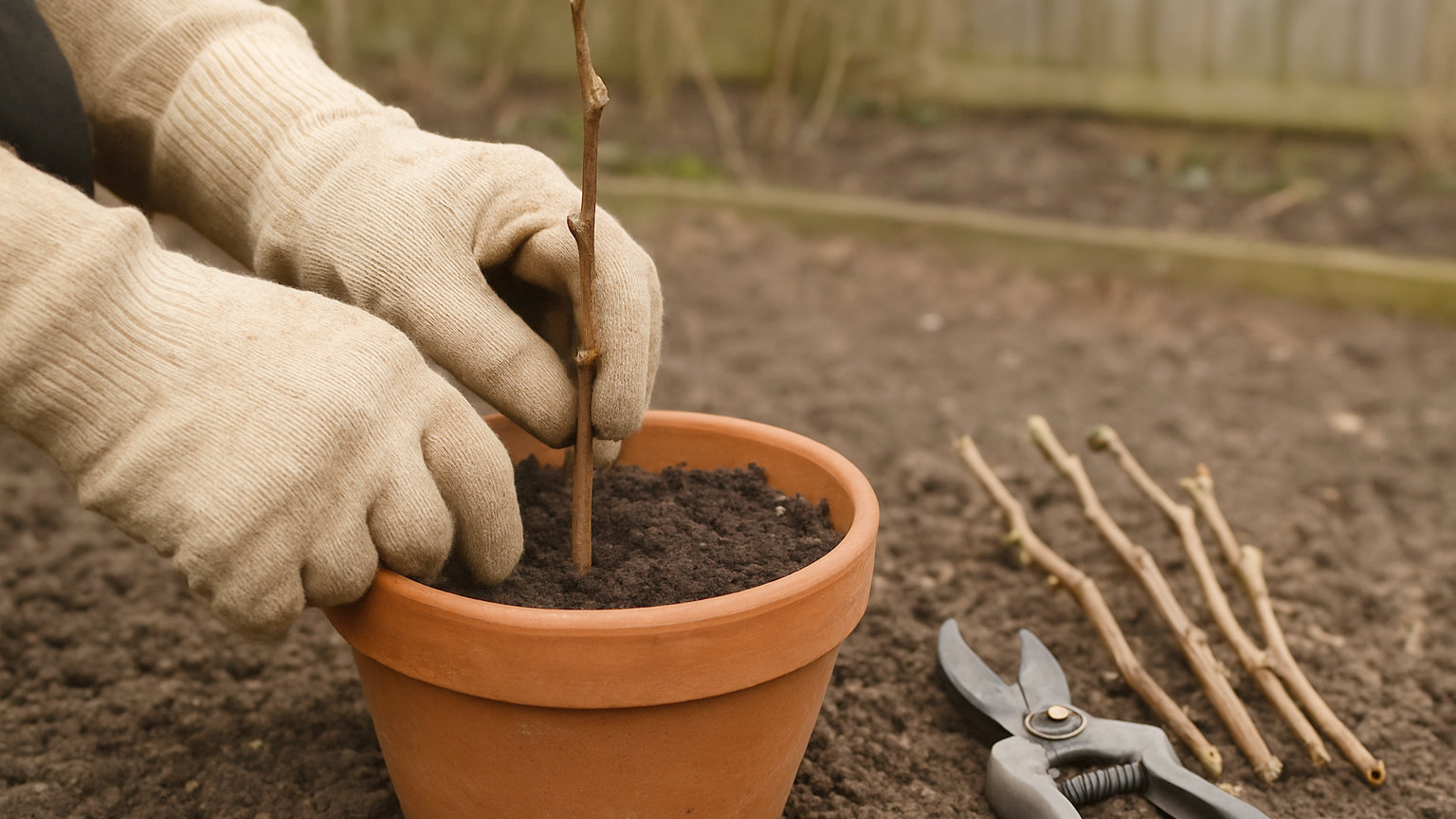
Most soft fruit propagates easily and free, and currants and gooseberries in particular root from hardwood cuttings with no propagator, no heat and almost no attention. It is among the most reliable propagation there is.
Hardwood cuttings
Suitable for blackcurrants, redcurrants, whitecurrants and gooseberries. Take them in late autumn, from October to December, once the leaves have fallen.
Select straight, healthy, pencil-thick shoots grown this season. Cut lengths of about twenty to thirty centimetres, making a straight cut just below a bud at the base and a sloping cut just above a bud at the top. The sloping cut tells you which way up it goes.
The one difference between the fruits matters. For blackcurrants, leave all the buds on, since you want a multi-stemmed stool. For redcurrants, whitecurrants and gooseberries, rub off all but the top three or four buds, since you want a bush on a clear leg.
Where to put them
Insert the cuttings into a slit trench in a sheltered corner of the garden, or into deep pots of gritty compost, with about two thirds of their length buried.
Firm them in, and firm again after frost has lifted them, which it will. Water in dry spells.
Leave them alone for a full year. They root over winter and spring and can be lifted the following autumn, by which time most will have a decent root system and some top growth.
Expect a good proportion to take. Putting in twice as many as you need costs nothing.
Strawberry runners
Strawberries send out long stems with plantlets along them, and these root readily.
Peg a plantlet down into a small pot of compost sunk beside the parent, using a bent wire or a stone, and leave it attached until it has rooted, usually four to six weeks. Then sever it and plant it out.
Take runners only from vigorous, healthy plants. Virus builds up in strawberries over the years, and propagating from a tired or mottled plant simply perpetuates it. Replace a third of the bed each year from your best plants.
Tip layering blackberries
Blackberries and hybrid berries root wherever a cane tip touches soil, which is a nuisance when unplanned and useful when deliberate.
In late summer, bend a strong new cane down and bury the tip about ten centimetres deep in soil or in a sunken pot. Peg it in place.
By the following spring it will have rooted and can be severed from the parent and moved.
Raspberry suckers
Raspberries spread by suckers, so new plants appear whether you want them or not. Lift a well-rooted sucker with a spade in autumn or winter and replant it.
The caution here is disease. Raspberry beds accumulate virus over ten years or so, and propagating from an old bed carries it into the new one. If yields have declined noticeably, buy certified virus-free stock instead.
Dividing rhubarb
Lift the crown in winter while dormant and cut it into sections with a spade, each with at least one fat bud and a good piece of root. Discard the woody centre and replant the outer sections.
Blueberries
These are the awkward ones. Softwood cuttings in early summer under a propagator are possible and less reliable than the others, and named varieties may be protected by plant breeders' rights, which restricts propagation for sale.
Layering a low branch works and is slower. Peg it down into a pot of ericaceous compost sunk beside the parent, leave it a full season, and sever it once rooted.
When to buy instead
Propagate from healthy plants, and buy in when starting a new bed, when replacing plants that have declined, or when the parent shows any sign of virus, reversion or big bud.
Certified stock costs little and starting a new bed with disease already in it wastes several years.
Timing summary
Hardwood cuttings in late autumn. Strawberry runners in summer. Tip layering in late summer. Division of rhubarb in winter. Raspberry suckers in autumn or winter.
Labelling
Label every cutting and rooted plant with the variety and the date. A row of unlabelled currant cuttings is indistinguishable a year later, and the difference between a blackcurrant and a redcurrant matters enormously once you come to prune them.


