
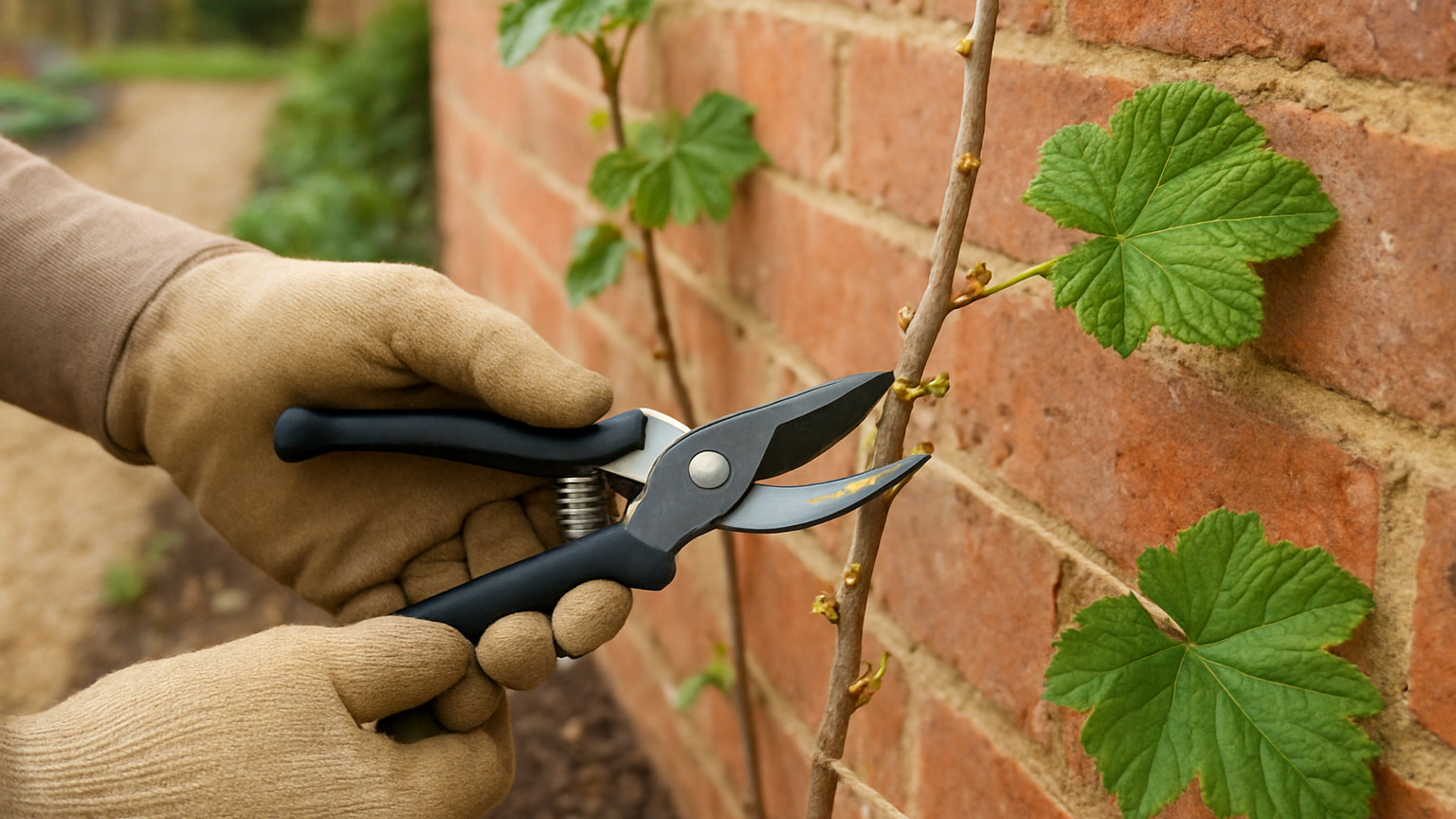
Redcurrants and whitecurrants are grown identically to each other and quite differently from blackcurrants, despite the shared name. They fruit on spurs on older wood, which changes everything about how they are planted and pruned.
Not like blackcurrants
Blackcurrants fruit on young wood, are planted deep and are pruned by removing whole stems. Red and white currants fruit on permanent spurs on a lasting framework, so they are planted at the same depth they grew and pruned by shortening side shoots.
Applying blackcurrant pruning to a redcurrant removes the framework that carries the crop, and it is the commonest reason a redcurrant bush disappoints.
Position
Full sun gives the sweetest fruit, but these are among the most shade-tolerant fruits available. A redcurrant will crop respectably on a north-facing wall or fence, which makes it one of the few genuinely productive plants for a difficult aspect.
They want well-drained soil with organic matter worked in, and dislike waterlogging. Space bushes about one and a half metres apart, or forty centimetres for cordons.
Plant bare-root between November and March, at the same depth as the soil mark on the stem.
Building the framework
The aim is an open goblet shape on a short clear stem, with eight to ten main branches radiating outwards and a clear centre.
In the first winters, shorten the main branches by about a half to an outward-facing bud to build length and encourage branching, and remove anything growing into the middle.
Spur pruning
Once the framework is established, prune twice a year.
In summer, around July, shorten the current season's side shoots to about five leaves. This lets light onto the ripening fruit and starts spur formation.
In winter, shorten those same side shoots further, back to one or two buds from the main branch, and reduce the leaders by about a quarter.
Remove any suckers from the base and keep the centre open. The result is a compact, heavily spurred bush that is easy to net and easy to pick.
Cordons
Because they spur so readily, red and white currants train beautifully as cordons: single upright stems tied to a wire, planted forty centimetres apart.
A short run of fence can carry six or eight cordons, producing a substantial crop in almost no ground area, and they are far easier to net than bushes. Double and triple cordons are also possible.
Prune cordons exactly as above, keeping the leader growing until it reaches the top wire.
Feeding and watering
Less hungry than blackcurrants. Apply sulphate of potash in late winter and mulch with compost in spring, keeping it clear of the stem.
Avoid high-nitrogen feeds, which produce soft growth and encourage mildew. Water in dry spells while the fruit is swelling.
Netting
Birds take redcurrants earlier and more thoroughly than almost any other fruit, often stripping the bush before the berries have fully coloured. Bullfinches also take the buds in late winter, which is damage done long before you are thinking about the crop.
Net with a mesh of at least two centimetres over a frame, secured at the base, and check it daily. A fruit cage is the practical answer if you grow several bushes.
Harvesting
Pick whole strigs when the berries have fully coloured and the ones at the tip have caught up. Redcurrants hold on the bush well once ripe, provided the birds are excluded.
Whitecurrants are simply a colourless form of redcurrant, slightly sweeter and less acidic, and are grown and pruned identically. Pink varieties sit between the two.
Redcurrants are high in pectin and set readily as jelly, which is the traditional use for a heavy crop and pairs particularly well with lamb and game.
Problems
Feeding on a north wall
A currant on a shaded wall competes with the wall for moisture and gets less light, so it benefits from more attention than one in the open. Mulch generously, water in dry spells, and expect the fruit to ripen a week or two later than a bush in sun.
Problems
Gooseberry sawfly attacks currants as well, stripping leaves rapidly in late spring. Check the centre of the bush from May. Currant blister aphid causes red or yellow puckering on the leaves, which looks alarming and does little real harm.


