
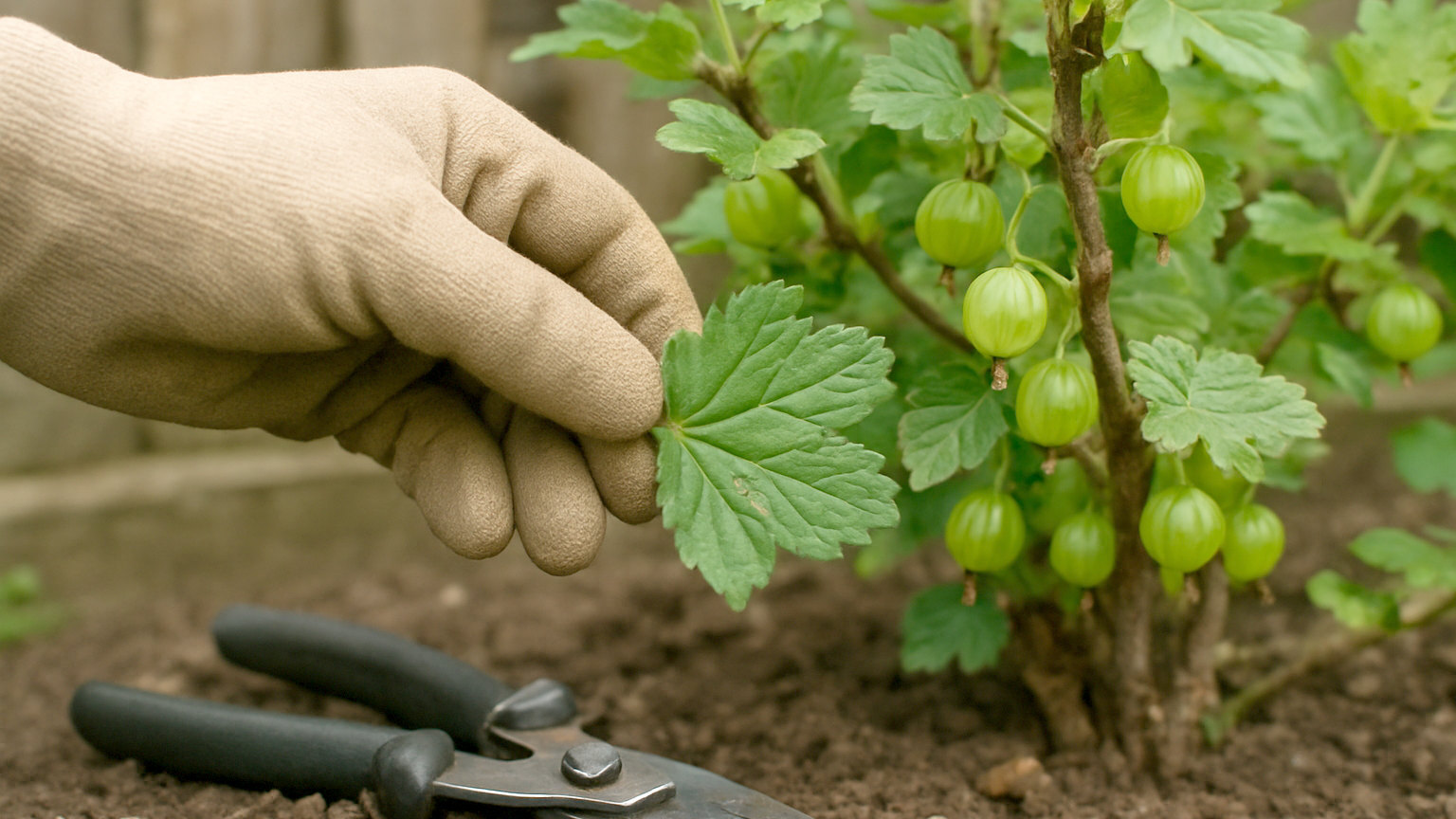
Gooseberries are tough, long-lived and crop heavily, and they have one problem that will destroy a bush faster than anything else in the fruit garden. Sawfly larvae can strip a mature bush to bare stems in less than a week, and they are easy to miss until it has happened.
Sawfly is the main job
Check inside the bush from early May, and keep checking every few days until August.
The larvae are pale green caterpillars with black spots, and they start low down in the centre of the bush where you cannot see them, working outwards. By the time damage is visible at the edges, most of the leaves have gone.
Part the branches and look at the undersides of the lower leaves in the middle. Pick the larvae off by hand, which is entirely effective if done early. There are usually two or three generations in a season, so one inspection is not enough.
A defoliated bush usually survives but produces little that year and less the next. The same sawfly attacks redcurrants and whitecurrants.
Position and planting
Gooseberries tolerate light shade and crop well in it, though full sun gives sweeter dessert fruit. They want well-drained soil and dislike waterlogging.
Space bushes one and a half metres apart, or thirty to forty centimetres for cordons. Plant bare-root between November and March, at the same depth as the soil mark.
Grow on a short clear leg of about fifteen centimetres rather than letting branches spring from ground level, which keeps fruit off the soil and makes weeding and picking easier.
Pruning
Gooseberries fruit on spurs on older wood, so they are pruned like redcurrants rather than blackcurrants.
Aim for an open goblet with eight to ten main branches and a clear centre. The open middle matters for two reasons here: airflow reduces mildew, and it lets you see the sawfly and get your hands in to pick.
In summer, shorten side shoots to about five leaves. In winter, cut those back to one or two buds and reduce the leaders by about a quarter.
Wear thick gloves and a long-sleeved jacket. Gooseberry thorns are unpleasant and gauntlets are a genuine help.
Thinning for dessert fruit
Thin the crop in late May and early June, removing about half the berries and using the thinnings for cooking. The remainder swell to a much larger size and ripen sweet enough to eat raw.
This is how dessert gooseberries are produced, and an unthinned bush gives a great many small acidic ones instead.
American gooseberry mildew
A white powdery coating on shoots, leaves and fruit, which later turns brown and felty on the berries.
It thrives in still humid air, so an open goblet shape and generous spacing are the main defence. Avoid high-nitrogen feeds, which produce the soft growth it prefers, and cut out affected shoot tips in winter.
Resistant varieties, including Invicta, Hinnonmaki Red and Greenfinch, largely solve the problem and are worth choosing when planting.
Feeding
Apply sulphate of potash in late winter and mulch with compost in spring. Gooseberries are particularly prone to potassium shortage, which shows as brown scorching around the leaf margins.
Varieties and cordons
Gooseberries are among the longest-lived soft fruit, cropping well for twenty years or more on a bush that is pruned annually and fed.
Invicta is heavy cropping and mildew resistant, best cooked. Hinnonmaki Red and Xenia are good dessert varieties. Careless is the traditional cooker.
Cordons work well, taking little space and making picking far easier among the thorns. Thornless varieties exist and generally crop a little less heavily, which is usually a fair trade in a small garden where you must reach into the bush often.
Netting and picking
Renovating an old bush
A neglected gooseberry becomes a congested thicket that is impossible to pick and full of mildew. Renovate over two winters rather than one, removing about half the oldest branches to the base in the first year and rebuilding an open framework from the remaining growth in the second.
Netting and picking
Net against birds, which take both fruit and, in late winter, the buds. Pick cooking gooseberries hard and green from late May, and dessert varieties when fully coloured and slightly soft.


