
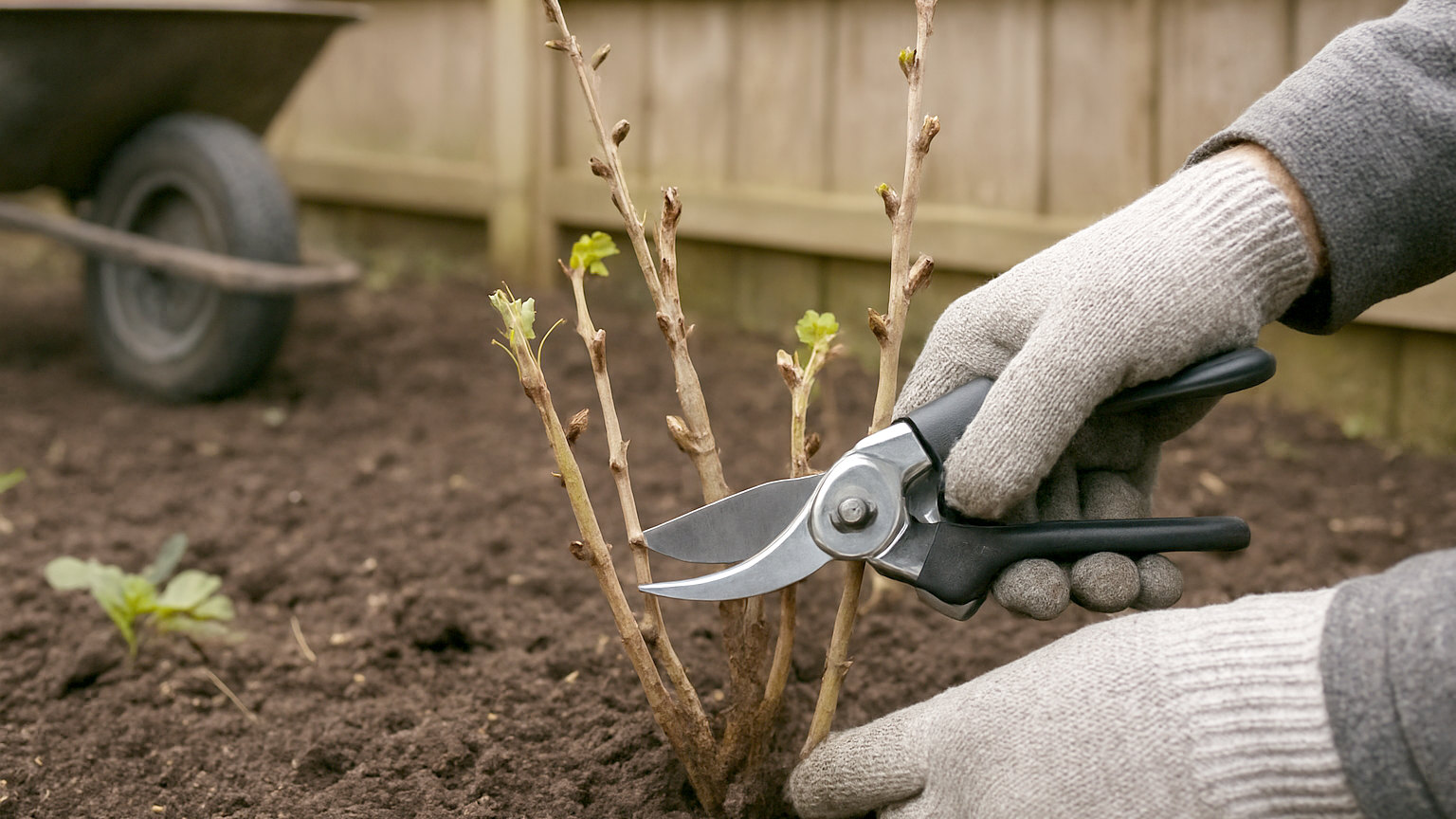
Blackcurrants are among the most productive and least demanding soft fruit, and they are grown differently from every other bush in the garden. Two things set them apart: they are planted deeper than they grew in the pot, and they are pruned by removing entire stems rather than shortening them.
Plant deep
Set a blackcurrant about five centimetres deeper than the soil mark on the stem. This is the opposite of the rule for almost everything else, and it is deliberate.
Deep planting encourages new shoots to develop from below ground, producing a multi-stemmed stool rather than a single-stemmed bush. Since blackcurrants fruit on young wood, a constant supply of new shoots from the base is exactly what you want.
After planting, cut every stem down to about two buds above soil level. It feels destructive and it produces a strong bush; a plant allowed to fruit in its first year never builds the framework properly.
Position and soil
Full sun gives the heaviest crops, though blackcurrants tolerate light shade better than most fruit. They want rich, moisture-retentive soil with plenty of organic matter dug in, and they are hungry plants.
Space bushes about one and a half metres apart. Avoid a frost pocket, since the flowers open early and are vulnerable.
Plant bare-root bushes between November and March, or container-grown at any time the ground is workable.
Pruning
Blackcurrants fruit best on wood grown the previous year, so the aim is to keep the bush young.
From the third winter onwards, cut about a third of the stems right down to ground level each year, choosing the oldest and darkest. Young wood is pale; older wood is dark, thick and often flaking.
Also remove anything weak, damaged or lying along the ground. Do not shorten the remaining stems, which is the mistake people bring across from other bushes.
Over three years this replaces the entire bush, and a well-pruned blackcurrant crops for fifteen years or more.
Feeding and watering
Blackcurrants are among the hungriest fruit. Mulch generously each spring with well-rotted manure or compost, keeping it clear of the stems, and apply sulphate of potash in late winter.
They tolerate more nitrogen than most fruit, so a spring feed of a general fertiliser is worthwhile on poor soil.
Water thoroughly in dry spells, particularly while fruit is swelling. Blackcurrants are shallow rooted, so avoid digging around the base and mulch instead.
Big bud mite and reversion
Big bud is caused by a microscopic mite living inside the buds, which swell into round, fat, unopened balls over winter, obvious against the normal slim pointed buds.
Pick off and bin affected buds in winter if there are few. A heavily affected bush is better removed.
The real problem is that the mite carries reversion virus, which is untreatable. A reverted bush produces leaves with fewer than the normal five main lobes and fewer veins, flowers that look thin and bright pink rather than dull, and progressively smaller crops.
There is no cure for reversion. Dig up and destroy affected bushes and replant with certified virus-free stock in a different part of the garden.
Netting
Birds will strip a blackcurrant bush as it ripens. Net with a mesh of at least two centimetres, held taut on a frame and secured at the bottom, and check it daily so nothing gets trapped. Remove it once picking finishes.
Harvesting
Pick whole strigs, the little strings of berries, rather than individual currants, then strip them indoors with a fork. It is far quicker.
The berries on a strig ripen unevenly, so wait until the whole strig is black and the currants at the tip have had a few days to catch up.
Varieties
Freezing the crop
Blackcurrants freeze better than almost any fruit and lose very little in the process. Open freeze them on trays before bagging so they stay loose, and they will keep a year. Since a mature bush can produce four or five kilograms, this is usually where most of the crop goes.
Varieties
The Ben series, bred in Scotland, are the reliable modern choice: Ben Connan for early heavy crops on a compact bush, Ben Sarek for small gardens, Ben Lomond for late flowering that escapes frost.


