
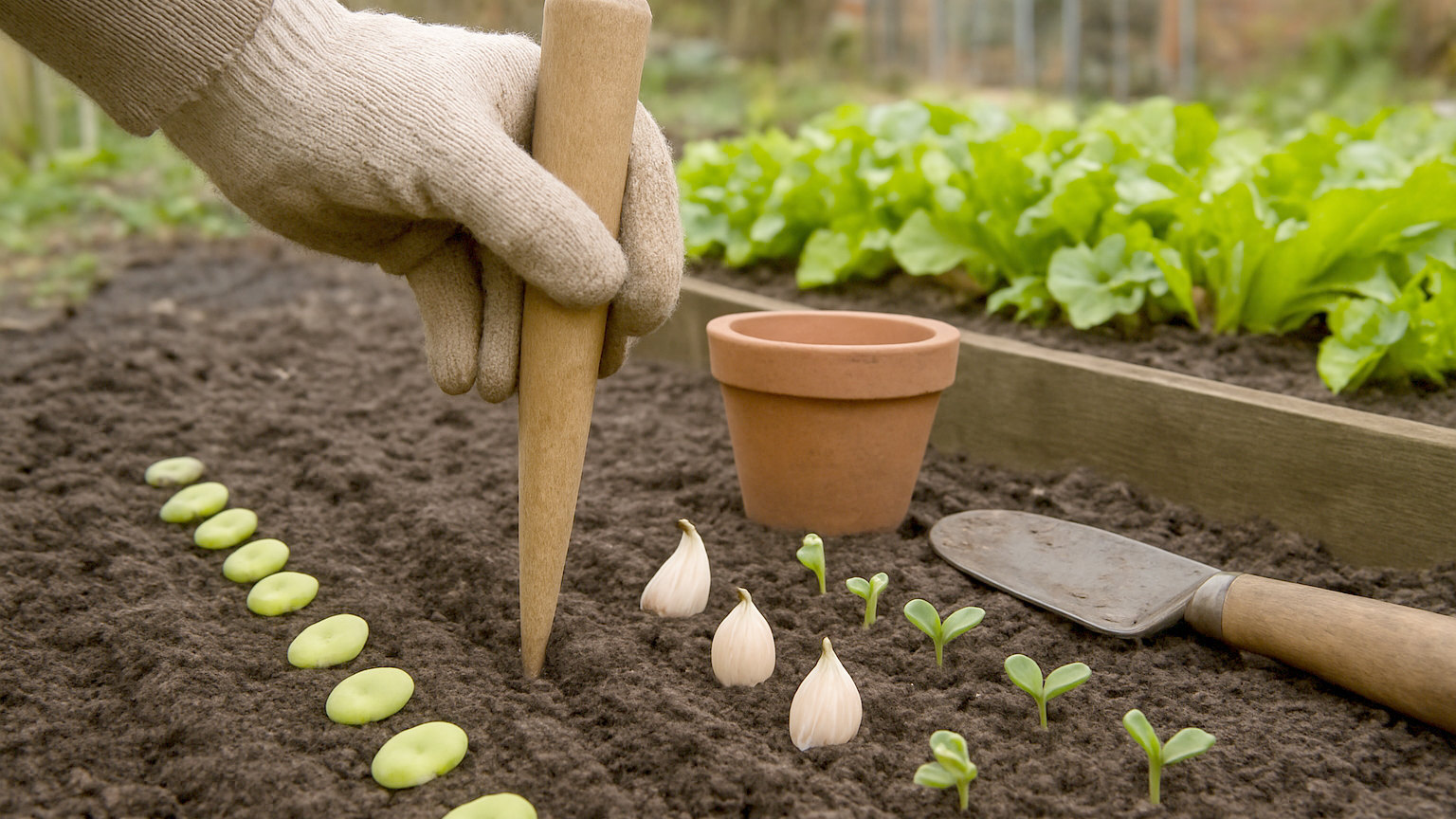
Autumn is the most underused sowing season. Plants that go in now establish roots over winter, start growing the moment conditions allow in February, and crop several weeks before anything sown in spring.
Broad beans
The classic autumn sowing. Hardy varieties such as Aquadulce Claudia sown in October or November overwinter as sturdy plants and crop from late May, weeks ahead of a spring sowing.
They also largely escape blackfly, which arrives after the pods have set, and that alone justifies it.
Mice are fond of the seed, so sowing in root trainers under cover and planting out in November is more reliable than sowing direct.
Peas
Hardy round-seeded varieties sown in late October or November overwinter and crop a fortnight or so earlier than spring sowings. Cover with cloches in a cold garden.
This suits free-draining soil. On cold wet clay the seed usually rots, and a February sowing under cover is the safer route.
Garlic and onions
Garlic must go in before winter, since it needs a cold period of a month or more to divide into cloves properly. October and November are ideal.
Autumn-planting onion sets, which are heat treated to prevent bolting, go in from September to November and crop in June rather than August. Japanese overwintering onions can also be sown from seed in August.
Hardy annuals
This is the trick that most improves a flower garden. Calendula, cornflower, nigella, larkspur, poppies and ammi sown in September overwinter as small rosettes and flower several weeks earlier and considerably larger the following summer than spring-sown plants.
The difference in size is striking, since the plants have had a whole extra season to build roots.
Sweet peas sown in October in root trainers and overwintered in a cold frame produce far stronger plants than spring sowings, with better root systems and earlier flowers. It is what exhibitors do and it costs nothing extra.
Winter salads
Sow from late August to the end of September for leaves through autumn and winter. Lamb's lettuce, land cress, winter purslane, mizuna, oriental mustards, wild rocket and hardy winter lettuce all work.
Under a cloche or in an unheated greenhouse they crop through much of the winter. Growth almost stops from late November to early February, so cut sparingly through the darkest weeks and let the plants recover.
Spring cabbage and hardy greens
Sow spring cabbage in July and August and plant out in September, for cutting as spring greens from April, which is exactly when the vegetable garden has least to offer.
Oriental greens, chard, perpetual spinach, parsley and chervil all take an August or September sowing and stand through the cold months, picking up strongly in February when little else is growing.
Green manures
Any bed that will otherwise sit bare through winter is worth sowing with a green manure. Field beans, grazing rye, winter tares and phacelia all establish in autumn.
They protect the soil surface from winter rain, prevent nutrients washing out, suppress weeds, and are dug in or cut down in spring to feed the soil. Field beans additionally fix nitrogen.
Trees, shrubs and perennials
Many hardy seeds need a cold period before they will germinate. Sowing them in pots in autumn and standing them outside over winter provides it naturally, and they germinate in spring.
This applies to a great many trees, shrubs, alpines and hardy perennials, and it is far simpler than trying to replicate the cold in a fridge.
Which soils suit it
Autumn sowing works best on free-draining ground. On heavy wet clay, seed and small plants sit in cold saturated soil for months and frequently rot.
If your soil is heavy, use raised beds, sow in modules under cover for planting out later, or concentrate on the crops that tolerate it best. Cloches and fleece make a considerable difference either way.
Protecting autumn sowings
Mice take pea and bean seed through the winter and are the commonest cause of an autumn sowing that never appears. Module sowing under cover avoids it entirely.
Pigeons take overwintering greens, so net anything standing through the cold months. Slugs remain active in mild winters and shelter under cloches, so check periodically rather than assuming cold weather has dealt with them.


