
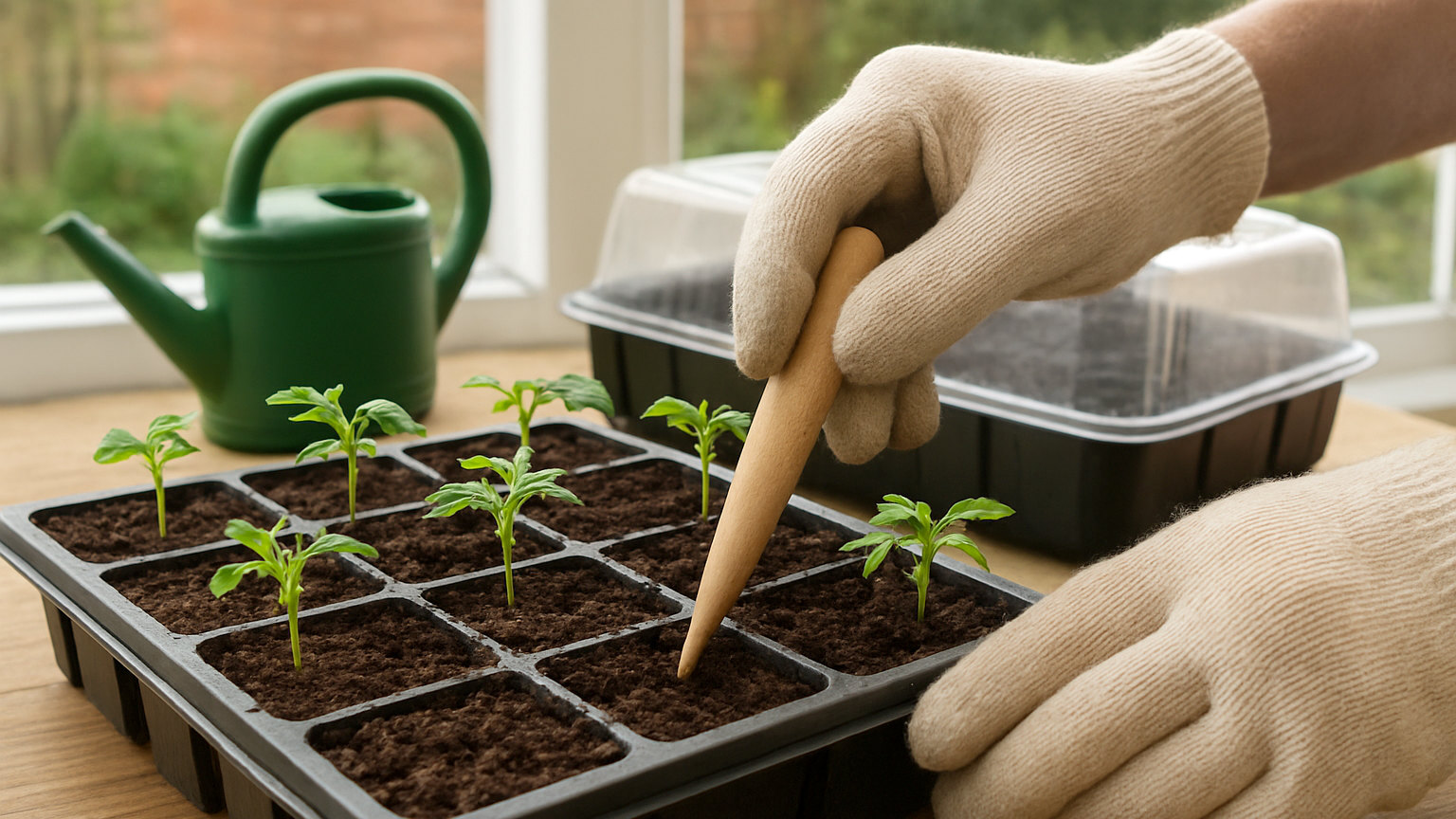
Sowing indoors buys you weeks at the start of the season and lets you grow things that would never ripen from a direct sowing. It also fails more often than it needs to, and nearly always for the same reason: seeds need warmth to germinate and light to grow, and a windowsill supplies plenty of the first and rarely enough of the second.
What to sow indoors, and when
Anything tender or long-season benefits. Tomatoes, chillies, aubergines and peppers need starting from February to early April. Courgettes, squash, cucumbers and sweetcorn are sown in April, since they grow fast and resent being pot-bound.
Half-hardy annual flowers, leeks, celery and early brassicas also do well started under cover. Root vegetables such as carrots and parsnips should always be sown direct, because they resent root disturbance and fork if transplanted.
Compost and containers
Use a peat-free seed compost, which is finer and lower in nutrients than multipurpose. Seeds carry their own food supply and too much fertiliser at this stage scorches roots.
Almost anything with drainage works as a container: modular trays, small pots, root trainers for beans and sweet peas, or clean recycled containers with holes punched in the base. Modules are worth the space, since each seedling grows undisturbed and can be planted out with its rootball intact.
Fill, tap down to settle, and level off without compressing the compost hard. Water before sowing rather than after, so the seed is not washed about.
Sowing depth
The general rule is to cover a seed to roughly its own depth. Large seeds such as beans and squash go in a couple of centimetres deep, small seeds get the lightest dusting of compost or vermiculite, and very fine seed is pressed onto the surface and not covered at all.
Sow thinly. Crowded seedlings compete, stretch and are far harder to separate later. Two seeds per module, thinned to the stronger, is more useful than a dozen.
Warmth to germinate
Most seeds want somewhere between fifteen and twenty-five degrees to germinate, and chillies and aubergines want the top of that range. A heated propagator makes a real difference, though an airing cupboard or the top of a fridge works for the germination stage.
Move seedlings into full light the moment they emerge. If they germinate in a dark airing cupboard and are left there even a day too long, they stretch into pale, weak stems that never recover. Check daily from the point you sow.
Cover trays with a propagator lid, a clear bag or a sheet of glass to hold humidity, and remove it as soon as germination happens to prevent damping off.
Light to grow
This is where windowsill sowing struggles. A seedling in February gets light from one direction only and for few hours, which produces long, leaning, spindly growth.
Turn trays daily so they grow evenly, place a sheet of white card or foil behind them to bounce light back, and sow later rather than earlier if you have no better light. A sowing made in late March under good light will overtake one made in February on a dim sill.
Pricking out
Once seedlings have their first pair of true leaves, which appear after the initial seed leaves, move them into individual pots of multipurpose compost.
Handle them by a leaf, never the stem. A crushed leaf is replaced; a crushed stem kills the plant. Ease them out from below with a dibber or pencil, make a hole in the new compost, drop the roots in and firm gently. Tomatoes can be planted deeper than they were, as they root from the buried stem, but most others should stay at the same depth.
Labelling and record keeping
Label every tray as you sow it, with the variety and the date. Seedlings of different tomatoes are indistinguishable, and by April nobody remembers what went where. A note of sowing dates also tells you next year whether you started too early, which is the most useful record a gardener can keep.
Hardening off
Plants raised indoors have soft growth and no tolerance of wind or cold. Moving them straight outside checks them badly and often kills them.
Over ten to fourteen days, put them outside in a sheltered spot during the day and bring them in at night, gradually extending the time and exposure. A cold frame makes this easy, opening the lid progressively wider. Only after that, and after the last frost for tender plants, should they be planted out.


