
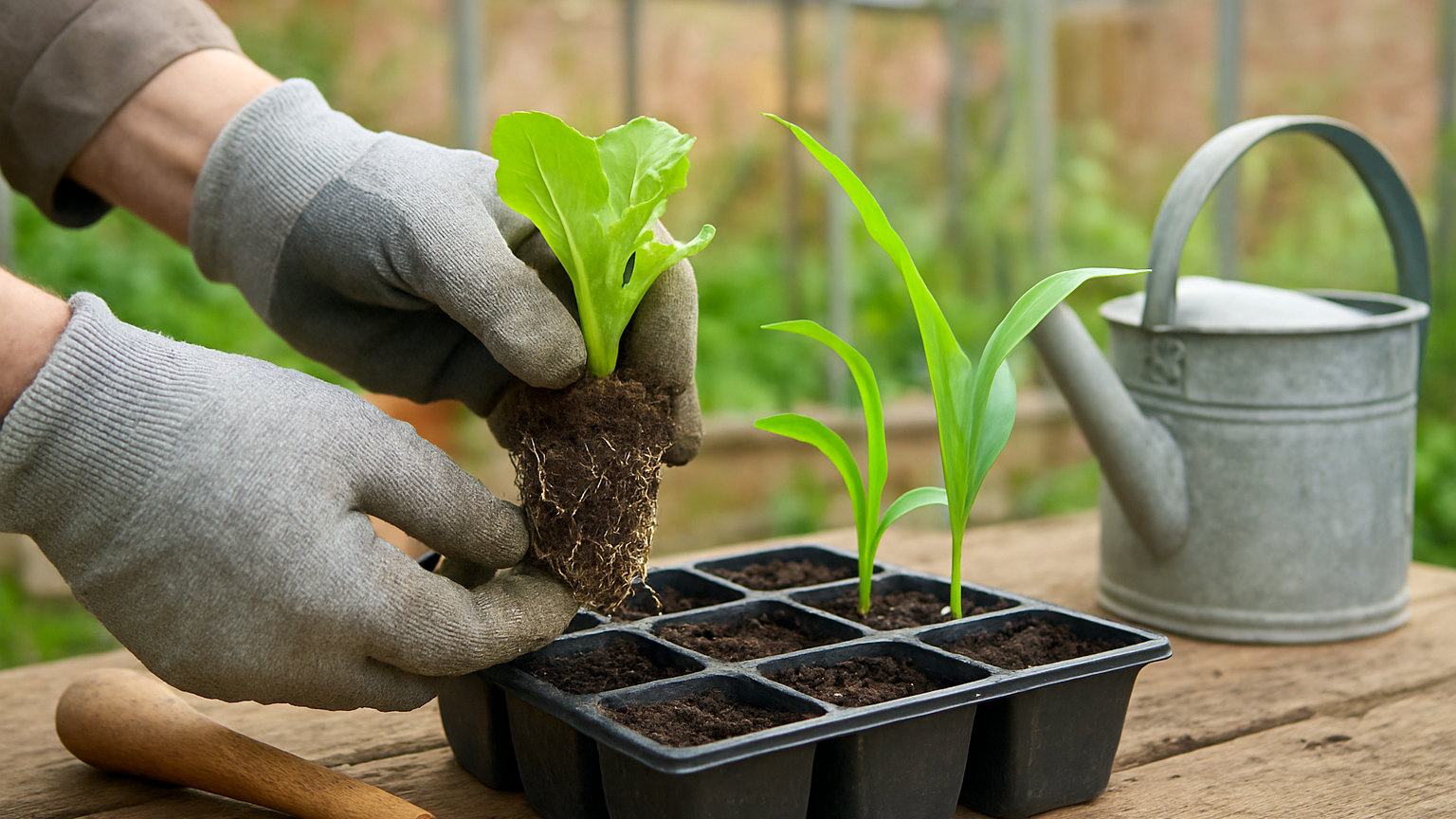
Module sowing means giving each seedling its own cell, so it grows undisturbed from germination to planting out. It uses more compost and space than an open tray and repays both, because the plant never suffers the check that pricking out and transplanting cause.
Why it works
A plant lifted bare-rooted from a seedbed loses a large proportion of its fine root hairs, and spends the following fortnight rebuilding them rather than growing.
A module-grown plant goes into the ground with its rootball intact and carries on growing from the same day. Over a season that fortnight is worth having, and for successional crops it is what allows you to drop a new plant into a gap the moment one appears.
Cell sizes
Match the cell to the plant and to how long it will sit there.
- Small cells, around 3cm - salad, brassicas, onions, quick crops moved on within weeks
- Medium cells, 5 to 7cm - most vegetables and bedding
- Large cells or small pots, 9cm - courgettes, squash, sweetcorn
- Root trainers, deep and narrow - peas, beans, sweet peas, anything with a long root
A cell that is too small dries out within hours and produces a pot-bound plant. Better slightly too large than too small, since a plant sitting in a generous cell simply waits, while one in a cramped cell is checked permanently.
Root trainers and soil blocks
Root trainers are deep narrow cells with ribbed sides that guide roots downwards rather than letting them circle, and they open like a book so the plant comes out without any handling of the roots at all.
Soil blocks are made with a blocking tool that compresses damp compost into free-standing cubes. Roots reach the edge and air-prune rather than circling, they use no plastic, and the block goes straight into the ground.
Both cost more effort and produce noticeably better plants for anything sensitive.
Sowing technique
Fill the tray, tap it to settle the compost, level it off and firm gently. Water before sowing.
Sow one or two seeds per cell at the appropriate depth, and if two germinate, snip the weaker off at compost level with scissors rather than pulling it, which disturbs the one you are keeping.
Sowing two per cell insures against poor germination and avoids pricking out altogether, at the cost of using more seed.
Which crops benefit most
Anything that resents disturbance: peas, beans, sweetcorn, cucurbits, and all the tender crops.
Anything sown successionally, since a tray of plants waiting in the cold frame turns an empty patch into a crop the same afternoon.
Anything expensive or slow, where you want to watch every seed rather than trust it to open ground and the weather.
Which do not
Root crops should be sown direct. Carrots, parsnips, beetroot and radishes all fork or bolt if their roots are disturbed, and no module is deep enough to prevent it.
Anything with a long taproot, including coriander and poppies, is better sown direct or in deep root trainers and planted out very small.
Watering
Modules dry out far faster than open trays because each cell holds so little compost. Check daily in warm weather.
Water from below where possible, standing the tray in water until the surface darkens. Overhead watering washes small seed out of the cells and wets the foliage, which encourages damping off in a crowded tray.
Knowing when to plant out
A module-grown plant is ready when the roots hold the compost together as a plug but before they circle tightly at the base.
Tip one out to check. White roots visible around the edge with compost still holding shape is right. A solid mat of coiled roots means it is overdue, and that plant will be slower to establish however well you treat it afterwards.
If planting out has to be delayed, pot the plugs on into slightly larger cells rather than leaving them to become congested.
Plant out at the same depth, water in thoroughly, and firm gently.
Hardening off still applies
A module-grown plant raised under cover needs the same fortnight of acclimatisation as anything else. The intact rootball removes the transplanting check, not the shock of moving from still warm air to wind and full light.


