
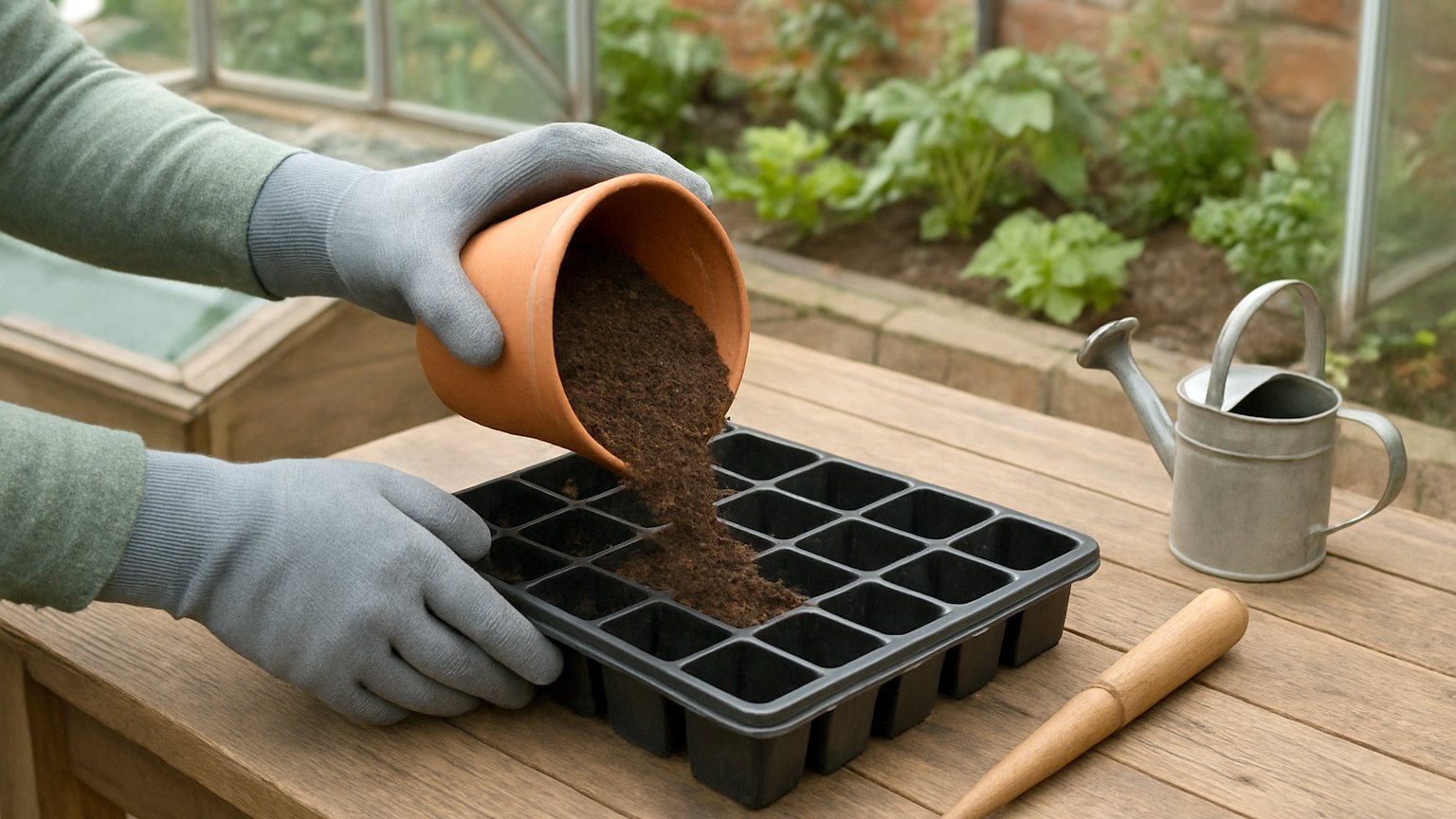
The two things a seed needs from its container are a fine, low-nutrient medium and clean surroundings. Getting either wrong accounts for a good share of the seedlings that never appear or collapse shortly after they do.
Why seed compost is different
Seed compost is finer in texture and much lower in nutrients than multipurpose.
The low nutrient content is deliberate. A seed carries its own food supply for the first stage of growth, and high fertiliser levels scorch the fine emerging roots. Multipurpose compost is formulated to feed established plants and is too strong for germination.
The fine texture matters because small seed needs close contact with the growing medium, and coarse lumpy compost leaves air pockets where roots dry out.
Peat-free seed composts vary considerably between brands, so it is worth finding one that works for you and staying with it.
Improving what you have
If you only have multipurpose, sieve it to remove the coarse material and mix it roughly half and half with vermiculite, perlite or sharp sand. That approximates a seed compost well enough for most purposes.
Vermiculite holds moisture and is good mixed in or used as a light covering over fine seed. Perlite improves drainage and aeration and is better where the risk is waterlogging.
Do not use garden soil. It compacts in a pot, drains badly, and brings weed seed, pests and disease indoors.
Choosing containers
Modules and cell trays are the most useful for most sowings. Each seedling grows undisturbed and is planted out with its rootball intact, which avoids the check that transplanting causes.
Root trainers are deep narrow cells that open like a book, suiting anything with a long root: peas, beans, sweet peas and sweetcorn.
Seed trays suit sowing a lot of small seed to be pricked out, such as bedding plants.
Small pots suit large seed sown individually, such as courgettes and squash.
Soil blocks, made with a blocking tool, avoid plastic altogether and the roots air-prune at the edges rather than circling.
Recycled containers work perfectly well provided they have drainage holes. Yoghurt pots, mushroom trays and cut-down bottles all do the job.
Cleanliness
Reused containers must be washed before sowing. Damping off, the fungal problem that collapses seedlings at soil level, survives on dirty trays and old compost from one season to the next.
Scrub pots and trays in hot soapy water, rinse and dry them. A dilute disinfectant solution is worth using for anything that held a diseased crop.
Use fresh compost each year rather than last season's leftovers, which are both exhausted and potentially contaminated.
Filling and firming
Fill the container loosely, tap it on the bench to settle the compost, and level it off with a straight edge. Firm gently with a presser or the base of another pot, to about a centimetre below the rim.
Do not compress it hard. Compacted compost drains poorly and roots struggle through it.
Watering the container
Water the filled container before sowing rather than after, which stops the seed being washed about.
Afterwards, water from below by standing the container in a tray of water until the surface darkens, then draining it. This keeps the surface from crusting and reduces damping off, since the foliage and surface stay drier.
A fine rose on a can works for larger seed but is easy to overdo. Tap water is safer than stored rainwater for seedlings, since butt water can carry the organisms that cause damping off.
Covering and labelling
Cover fine seed with a light dusting of vermiculite rather than compost, which lets light through for seed needing it and holds moisture.
Reusing compost
Old seed compost is exhausted and may carry disease, so it should not be used for sowing again. It is perfectly good spread on a border or mixed into a compost heap, so nothing is wasted, but fresh compost each season is one of the cheapest insurances against damping off.
Covering and labelling
Cover fine seed with a light dusting of vermiculite rather than compost, which lets light through for seed needing it and holds moisture.
Label every container as you sow it with variety and date. Seedlings of different varieties are indistinguishable, and by April nobody remembers.


