
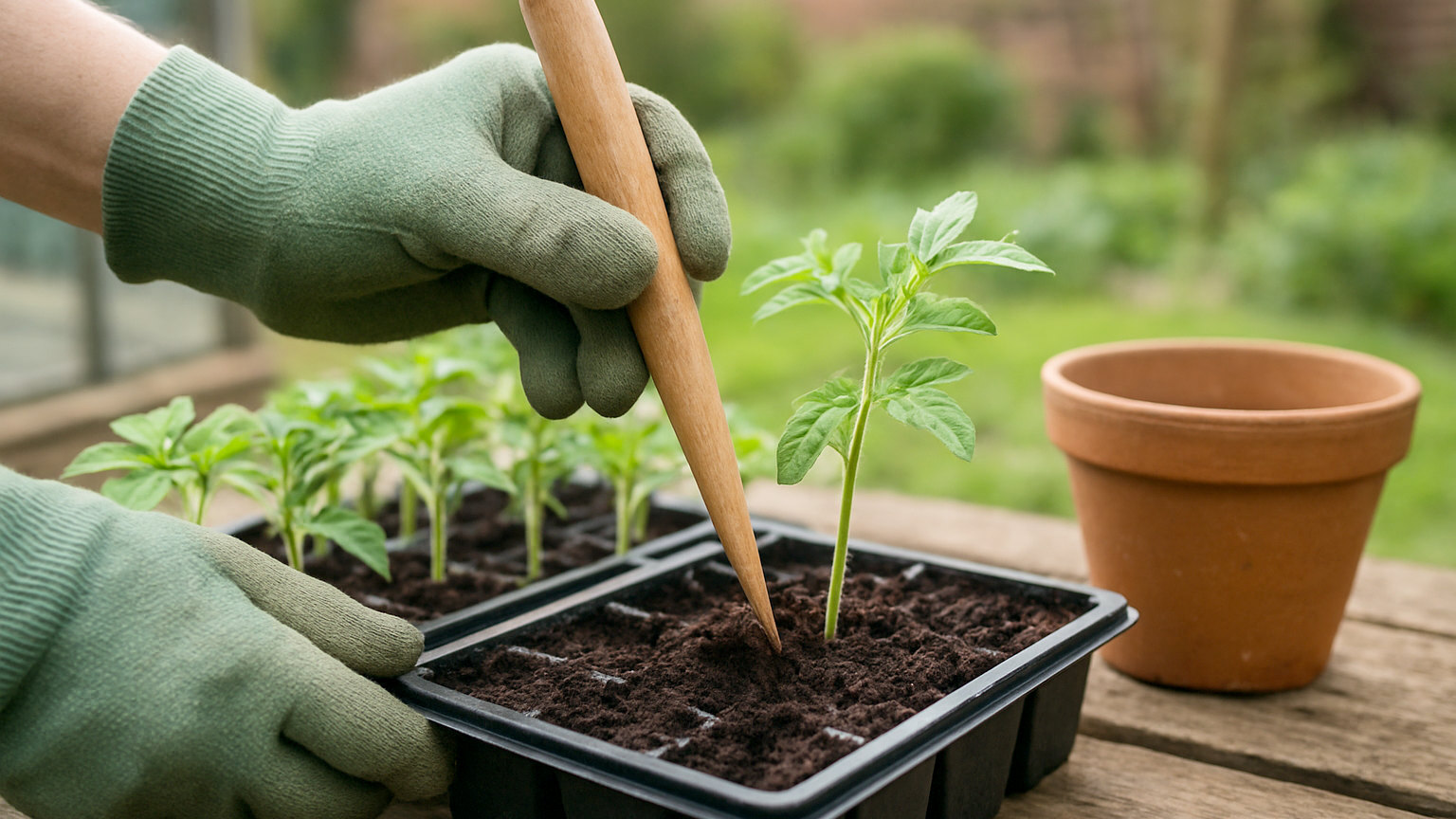
Pricking out is moving seedlings from the tray they germinated in to individual pots or wider spacing. It is a straightforward job with one rule that decides whether the seedling survives.
Handle by the leaf, never the stem
Hold a seedling by a leaf, never by the stem. A crushed leaf is replaced by the plant within days. A crushed stem severs the only route between roots and shoot, and the seedling dies.
The stem at this stage is a single fragile column, and the pressure needed to damage it is far less than you would think.
When to do it
Prick out once the first pair of true leaves has appeared. These are the leaves that look like the plant, as distinct from the seed leaves or cotyledons that emerge first and often look nothing like it.
Do it promptly. Seedlings left crowded in a tray compete for light, stretch, and their roots tangle, so separating them later causes far more damage.
Choose a dull day or work out of direct sun, and water the tray an hour beforehand so the compost holds together around the roots.
The technique
Fill the destination pots or modules with multipurpose compost, firm lightly and make a hole with a dibber, a pencil or a chopstick.
Loosen a group of seedlings from below by pushing a dibber or a plant label under the roots and lifting gently. Do not pull from above.
Separate one seedling, holding it by a leaf, and lower it into the hole so the roots hang down rather than bending back on themselves. Firm the compost gently around it.
Space them so the leaves of neighbouring seedlings will not touch for a couple of weeks.
How deep
Most seedlings go in at the same depth they were growing, with the seed leaves just above the compost surface.
Tomatoes are the useful exception and can be set considerably deeper, up to the seed leaves, because they root from the buried stem and produce a stronger plant. Tomatillos behave the same way.
Do not bury the stems of beans, peas, squash, courgettes or most flowers, which rot at the collar if planted deep.
Watering in
Water immediately after pricking out, ideally from below by standing the tray in water until the surface darkens.
This settles the compost around the roots as much as it supplies moisture. Keep the seedlings out of direct sun for a day or two while they recover, and avoid letting them wilt.
Growing on
Keep the pricked-out seedlings somewhere bright and cool rather than warm. Warmth without enough light produces soft drawn growth; cool bright conditions produce short sturdy plants that establish far better when planted out.
Turn trays daily on a windowsill so they grow evenly rather than leaning.
Begin feeding with a dilute liquid feed about a fortnight after pricking out, once the roots have taken hold and the compost's own nutrients are running down.
Potting on
Move plants up a pot size when roots appear at the drainage holes or growth slows. Go up one size at a time rather than straight into a large pot, since unused compost stays wet and sours.
Tomatoes, chillies and aubergines usually need potting on once or twice before planting out. Each move sets a plant back a few days, so going up gradually but not unnecessarily is the balance to aim for.
When not to prick out at all
Anything with a taproot resents disturbance and is better sown direct or in deep modules and planted out without ever being pricked out. Carrots, parsnips, coriander and poppies all fall here.
Aftercare
Expect a check of a few days while the seedlings recover, during which growth appears to stop. That is normal. Keep them evenly moist, out of fierce sun, and in good light, and they resume within the week.
Any seedling that has wilted badly and not recovered within two days is usually not going to, and is better removed than nursed.
Avoiding it altogether
Sowing two seeds per module and snipping off the weaker one avoids pricking out entirely for many crops, and is the easier route where you have the space to spare.
It uses more seed, which for cheap common vegetables is a reasonable trade for a job avoided.


