
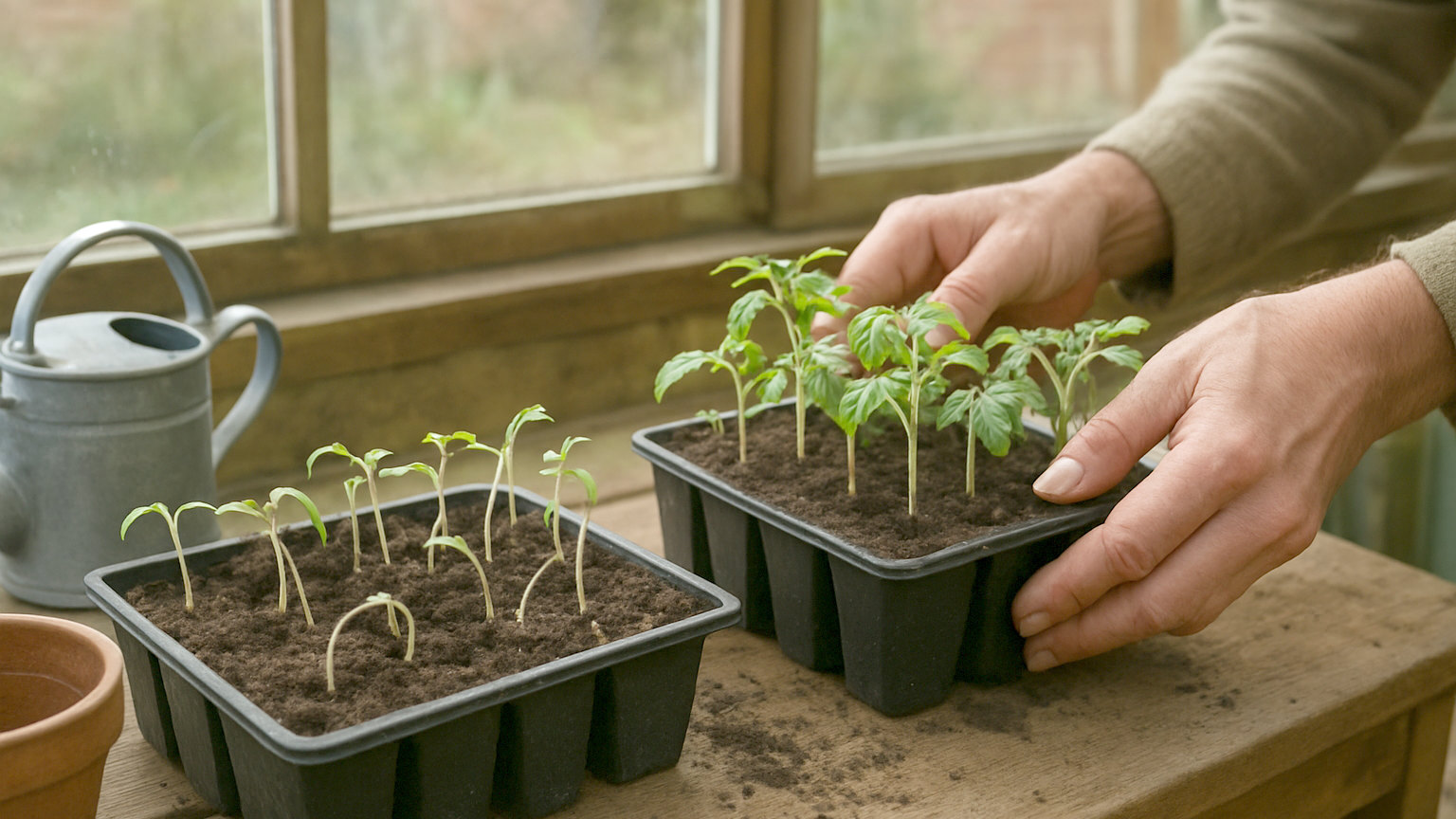
Leggy seedlings are pale, stretched and thin-stemmed, often falling over under their own weight. The plant is reaching for light it cannot find, and it is a specific and correctable problem rather than bad luck. Diagnosing which of two causes is at work tells you what to change.
The two causes
Not enough light is the usual one. A seedling that cannot photosynthesise enough elongates its stem searching for better light, putting resources into height rather than into thickness and leaves.
Too much warmth relative to light is the second, and it is more common than people expect. Heat drives fast growth, and if light does not keep pace the growth is soft and drawn. A propagator left switched on after germination, or a tray on a radiator shelf, produces exactly this.
Sowing too early makes both worse, because February light is weak and short. A great deal of legginess is really an impatience problem.
How to tell which
If the seedlings lean noticeably towards the window, it is light. If they are stretching straight up, pale and soft, in a warm room, heat is likely to be involved.
Crowded sowings produce the same symptom for a third reason, since seedlings shade one another and compete. If they emerged in a dense mat, thinning is the answer regardless of anything else.
What can be rescued
Tomatoes can be saved by burying the stem. They root along any buried section, so a leggy tomato seedling potted on deeply, with the stem buried up to just below the lowest leaves, produces a stronger plant with a bigger root system than it would otherwise have had. The same works for tomatillos.
Most other seedlings cannot be treated this way. Brassicas can be potted a little deeper with care. Beans, peas, squash, courgettes and most flowers should stay at their original depth, since burying the stem causes rot at the collar.
Mildly leggy seedlings of most types will thicken up if moved into better light and cooler conditions promptly. Severely drawn ones rarely make good plants, and resowing usually gives a better result than nursing them, particularly early in the season when a fresh sowing catches up quickly.
Fixing the conditions
Move seedlings into the brightest position available the moment they germinate. A south-facing windowsill in an unheated room is often better than a warm room with less light, because cooler temperatures slow growth to match the light available.
Turn trays daily so they grow evenly rather than leaning. Stand a sheet of white card or kitchen foil behind the tray to reflect light back onto the shaded side, which makes a surprising difference on a windowsill.
Switch a heated propagator off once germination has happened. It has done its job, and continued bottom heat with weak light is precisely the wrong combination.
Grow lights
If you sow a lot indoors, a simple LED grow light removes the problem entirely. It does not need to be elaborate. Position it a few centimetres above the seedlings, raising it as they grow, and run it for fourteen to sixteen hours a day on a timer.
The distance matters more than the wattage. A light too far away has little effect, and seedlings will stretch towards it just as they would towards a window.
Strengthening what you have
Air movement thickens stems. A small fan on a low setting for a few hours a day, or simply brushing your hand lightly across the tops of the seedlings once or twice daily, causes the plants to invest in sturdier stems. It sounds unlikely and it demonstrably works.
Keep them slightly on the dry side rather than constantly wet, and space them out as soon as they can be handled.
Preventing it next time
Sow later. This is the fix nobody wants and it works better than any other. Seed sown in late March under natural light produces stockier plants than seed sown in mid-February on a windowsill, and the later sowing usually catches up by May because it grows faster in better conditions.
Damping off, which looks similar
If seedlings collapse at soil level with a pinched, dark, water-soaked stem, that is damping off, a fungal problem rather than legginess. It comes from overcrowding, overwatering and stagnant air.
Use fresh compost and clean containers, water from below and let the surface dry between waterings, remove propagator lids after germination, and sow thinly. There is no cure once a tray is affected, so prevention is the whole of the treatment.


