
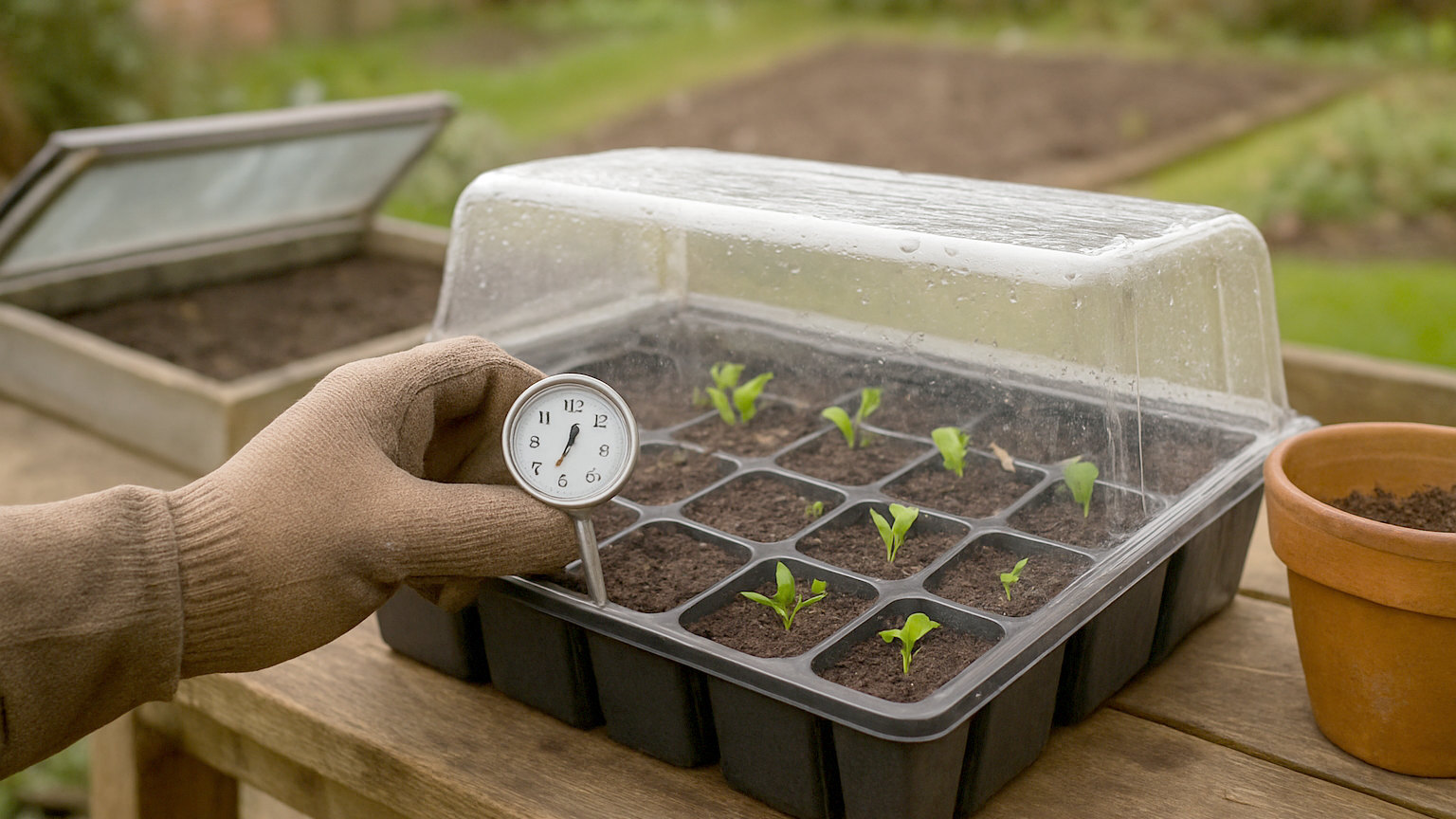
Temperature governs germination more directly than anything else, and it works in both directions. Some seed will not start until the soil is warm enough; some refuses once it becomes too warm. Both cause sowings that simply never appear.
Roughly what each crop wants
- Chillies and peppers - 25 to 28°C, and slow or unreliable below 20
- Aubergines, cucumbers, melons - 22 to 25°C
- Tomatoes - 18 to 22°C
- Courgettes, squash, sweetcorn, beans - 18 to 21°C
- Brassicas, beetroot, chard, most flowers - 15 to 20°C
- Peas, broad beans, spinach - 10 to 18°C, and they tolerate cool conditions well
- Lettuce - 10 to 18°C, and dormant above about 25
- Parsnips and carrots - above about 7°C, with parsnips needing steady moisture over several weeks
The lettuce problem
Lettuce seed goes dormant above about twenty-five degrees. This is thermodormancy, and it is why midsummer sowings frequently produce nothing while the same packet worked perfectly in April.
Sow in the evening so germination happens overnight when the soil is coolest. Water the drill thoroughly before sowing to cool it. Shade the row with a board or fleece for the first few days. Or start it in modules somewhere cool and transplant.
Some varieties tolerate more heat and are worth choosing for summer sowings.
Warmth to germinate, light to grow
These are two different needs and confusing them causes most windowsill failures.
A seed needs warmth and moisture to germinate and no light at all for most species. The moment the shoot appears, the requirement flips: it needs light more than warmth, and continued heat without light produces pale drawn seedlings.
Move trays out of the propagator or airing cupboard the day germination begins, and switch a heated propagator off at that point.
Propagators
A heated propagator with a thermostat is the reliable way to hit the higher temperatures, and it makes chillies and aubergines straightforward rather than hit and miss.
An unheated propagator lid still helps by holding humidity, which matters as much as warmth for even germination.
Improvised alternatives work for the germination stage: an airing cupboard, the top of a fridge, or a shelf above a radiator. All share the same danger, which is forgetting the tray for a day and finding pale stretched seedlings.
Soil temperature outdoors
For direct sowing, soil temperature matters more than air temperature and lags several weeks behind it.
Most vegetables need soil above about seven degrees. Warm-season crops need twelve or more. A soil thermometer costs very little, and measuring at about five centimetres depth in the morning gives a useful reading.
Covering a bed with clear polythene or a cloche for a fortnight before sowing raises soil temperature by several degrees and can bring a sowing forward by two or three weeks.
Cold treatment
Some seed needs the opposite: a period of cold before it will germinate at all, which is stratification. Many hardy perennials, trees and shrubs behave this way, along with a few vegetables.
Sowing in autumn and leaving the pots outside over winter provides it naturally. A month in a bag of damp vermiculite in the fridge achieves the same thing artificially.
Patience with the slow ones
Parsnips take three to six weeks, parsley four to six, and many perennials longer still. Provided the compost stays evenly moist, a slow sowing is not a failed one.
The commonest reason these fail is being allowed to dry out once during that long wait, or being given up on and disturbed.
Cover slow trays with a sheet of glass, a propagator lid or a plastic bag to hold moisture, checking every few days and removing it the moment anything appears.
Fluctuating temperatures
A few species germinate better with a daily swing between warmer and cooler rather than a constant temperature. A windowsill provides that naturally, which is one respect in which it beats a thermostatically controlled propagator.
Measuring it
A cheap digital thermometer with a probe tells you what a propagator or a windowsill is actually delivering, which is frequently not what you assume. An airing cupboard can be well above thirty degrees and a bright north sill barely above ten, and both explain failures that otherwise look inexplicable.
Check at seed level rather than in the air above the tray, since the two can differ by several degrees.


