
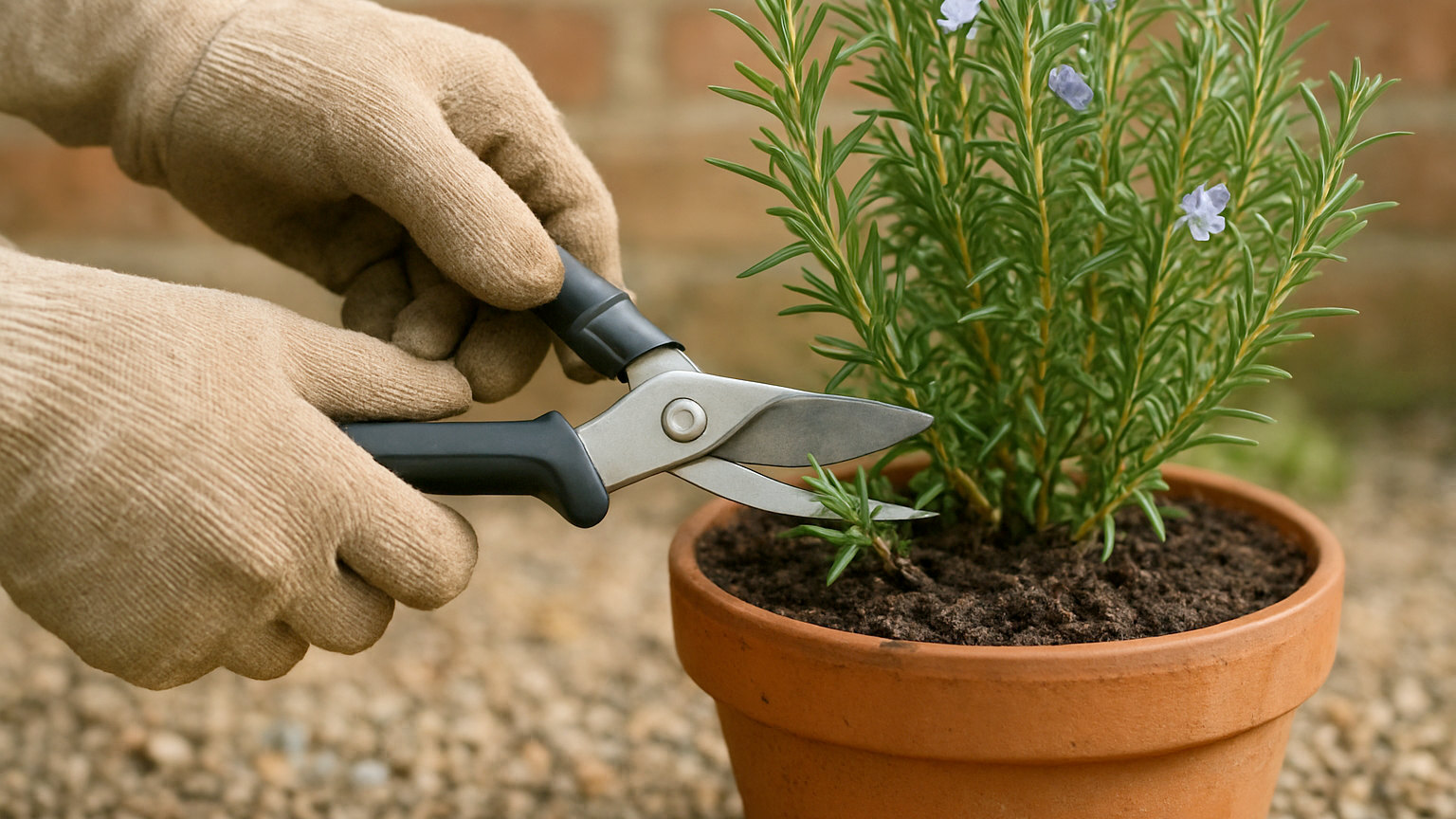
Rosemary comes from dry Mediterranean hillsides and it dies in British gardens far more often from winter wet than from cold. Get the drainage right and it is a long-lived, almost maintenance-free shrub.
Drainage above everything
Rosemary will survive hard frost and will not survive sitting in wet soil. Roots in cold saturated ground through January rot, and the plant dies in spring just as everything else starts growing.
Plant into free-draining soil, adding plenty of horticultural grit to the planting hole. Set it slightly proud of the surrounding ground and mulch with gravel rather than bark, so the base of the stem stays dry.
On clay, grow it in a pot or a raised bed instead of fighting the soil. A terracotta pot suits it, since terracotta dries faster than plastic, which in this case is an advantage.
Sun and position
Give it the sunniest, most sheltered spot you have. Against a south-facing wall is ideal, since the wall radiates warmth overnight and keeps the roots drier.
Six hours of direct sun is a reasonable minimum. In shade the plant becomes leggy, sparse and much more prone to disease, and the oils that give it its flavour never fully develop.
Do not feed it
Rosemary evolved on poor soil, and rich ground produces soft sappy growth with less flavour and less winter hardiness.
No feeding is needed in the ground. In a pot, a single light feed in spring is ample.
The cut that kills it
Never cut rosemary back into old bare wood. It will not reshoot from it, and a plant cut hard usually dies or is left permanently disfigured.
Trim lightly after flowering, taking only the current season's soft growth and always leaving green leaves below the cut. Little and often keeps a plant compact.
An old, sprawling, woody rosemary cannot be renovated. The answer is to take cuttings, root them, and replace the plant, which is why the next section matters.
Cuttings as insurance
Rosemary roots very easily, and taking a few cuttings each summer costs nothing and guarantees replacements.
Take semi-ripe cuttings about ten centimetres long in late summer, from non-flowering shoots. Strip the lower leaves, insert into gritty compost, and keep them in a sheltered spot or a cold frame.
Most will root within six to eight weeks. Cuttings will also root in a glass of water on a windowsill, which is less reliable and considerably easier.
Hardiness
Most rosemary is hardy through a normal British winter given good drainage, though prolonged severe cold combined with wet will kill it.
Upright varieties are generally hardier than prostrate and trailing forms, which are better in pots that can be moved to shelter. In a cold or exposed garden, keeping a rooted cutting under cover as insurance is sensible.
Rosemary beetle
A striking metallic beetle with green and purple stripes, about eight millimetres long, which has spread widely in recent decades. Both adults and larvae eat the foliage.
Damage shows as chewed leaves and general thinning. Hand picking is effective on a garden-sized plant, and shaking the branches over a sheet of paper or an upturned umbrella brings them down where you can collect them.
Check from late summer through autumn and winter, when they are most active. The same beetle attacks lavender, sage and thyme.
Harvesting
Growing it in a pot
A pot suits rosemary well, particularly on heavy soil. Use a soil-based compost with a third added grit, choose terracotta over plastic, and stand it on pot feet so water drains freely. Water only when the compost has dried out, and move it against a wall over winter rather than into a heated room, which produces soft growth and mildew.
Harvesting
Pick sprigs at any time of year, since rosemary is evergreen. Flavour is strongest just before flowering.
Take from different parts of the plant rather than repeatedly from one point, and never remove more than about a fifth at once. Dry surplus sprigs by hanging them somewhere warm and airy; rosemary is one of the herbs that dries well.
Leave the flowers on. They appear from spring, sometimes through mild winters, and are among the earliest nectar sources in the garden for bumblebees emerging in February.


