
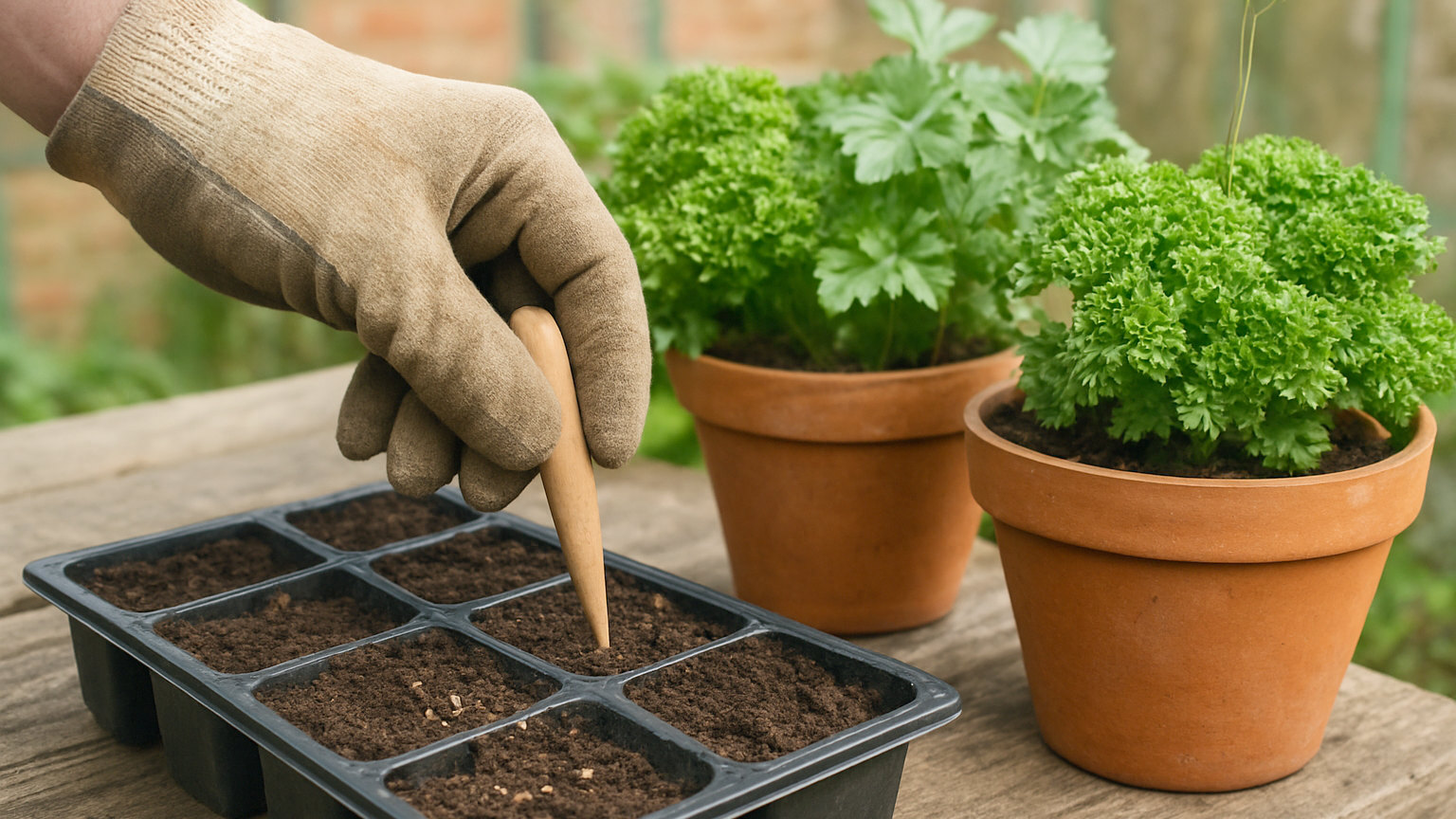
Parsley is easy to grow and slow to start, and the gap between those two facts accounts for most of the trouble people have with it. Seed can take four to six weeks to germinate, by which time many gardeners have concluded the sowing failed and dug it over.
It is a biennial
Parsley completes its life over two years. In the first it produces leaves, which is what you want. In the second it flowers, sets seed and dies, and the leaves become sparse and bitter as it does.
That means sowing every year rather than expecting a plant to last. A sowing in spring gives leaves from summer through winter and into the following spring, at which point it bolts and is replaced.
Germination takes weeks
Expect three to six weeks, and do not give up. Parsley seed contains germination inhibitors and needs steady moisture over a long period.
Soaking the seed in warm water overnight before sowing speeds it up noticeably. Sowing into warm soil, rather than cold ground in March, makes a considerable difference too.
Keep the drill damp throughout. A sowing that dries out once during those weeks will fail, which is the usual reason for a blank row.
Marking the row with a few radish seeds lets you hoe around it without guessing where it is.
Sowing
Sow from March to July, at about one centimetre deep, in rows thirty centimetres apart. Thin to twenty to twenty-five centimetres.
An August sowing gives plants that stand through winter and crop strongly in early spring, which is well worth doing.
Parsley can be started in modules, though like coriander it has a taproot and resents disturbance, so use deep cells and plant out small.
Flat leaf or curly
Flat leaf, sometimes called French or Italian parsley, has a stronger, cleaner flavour and is generally preferred for cooking. It also tends to be slightly more vigorous.
Curly parsley has a milder flavour and a tougher texture, holds up better as a garnish, and is marginally hardier in a cold winter.
Grow whichever you prefer to eat. There is no meaningful difference in how they are cultivated.
Position and watering
Parsley likes moisture-retentive soil with plenty of organic matter, in sun or light shade. Light shade suits it better in high summer.
Water regularly. Dry roots produce tough, bitter leaves and encourage early bolting.
A general feed in midsummer keeps a plant productive, and parsley is one of the few herbs that genuinely benefits from feeding.
Harvesting
Pick the outer stems from the base of the plant, leaving the centre to keep growing. Do not shear across the top, which removes the youngest growth and leaves the tough old stems behind.
Take no more than about a third at once. Regular picking keeps a plant producing tender growth for months.
Through winter
Parsley is hardy and stands outside through most winters, though growth almost stops in the darkest weeks.
A cloche or a cold frame keeps the leaves in far better condition and lets you keep picking. Plants in pots can be moved to a sheltered spot or into a greenhouse.
Growth resumes strongly in February and March, and that is often the most useful period from a plant sown the previous summer, arriving just before it bolts.
Containers
Parsley grows well in a deep pot, at least twenty-five centimetres, to accommodate the taproot. Keep it evenly moist, since containers dry out fast and dry parsley goes bitter, and feed every couple of weeks through the growing season.
A caution
Problems
Carrot fly attacks parsley, since the two are related, causing stunted plants with reddish foliage. The same barrier of fine mesh sixty centimetres high protects both. Leaf spot shows as brown blotches in wet seasons and is dealt with by removing affected leaves and improving airflow.
A caution
Parsley is closely related to several poisonous plants, including hemlock and fool's parsley, which look broadly similar. Grow it from labelled seed in a known position rather than gathering anything resembling it from the wild.
Label the row or the pot, and keep parsley away from any self-seeded umbellifer you have not identified. It is a small precaution and worth taking in a garden where children pick things.


