
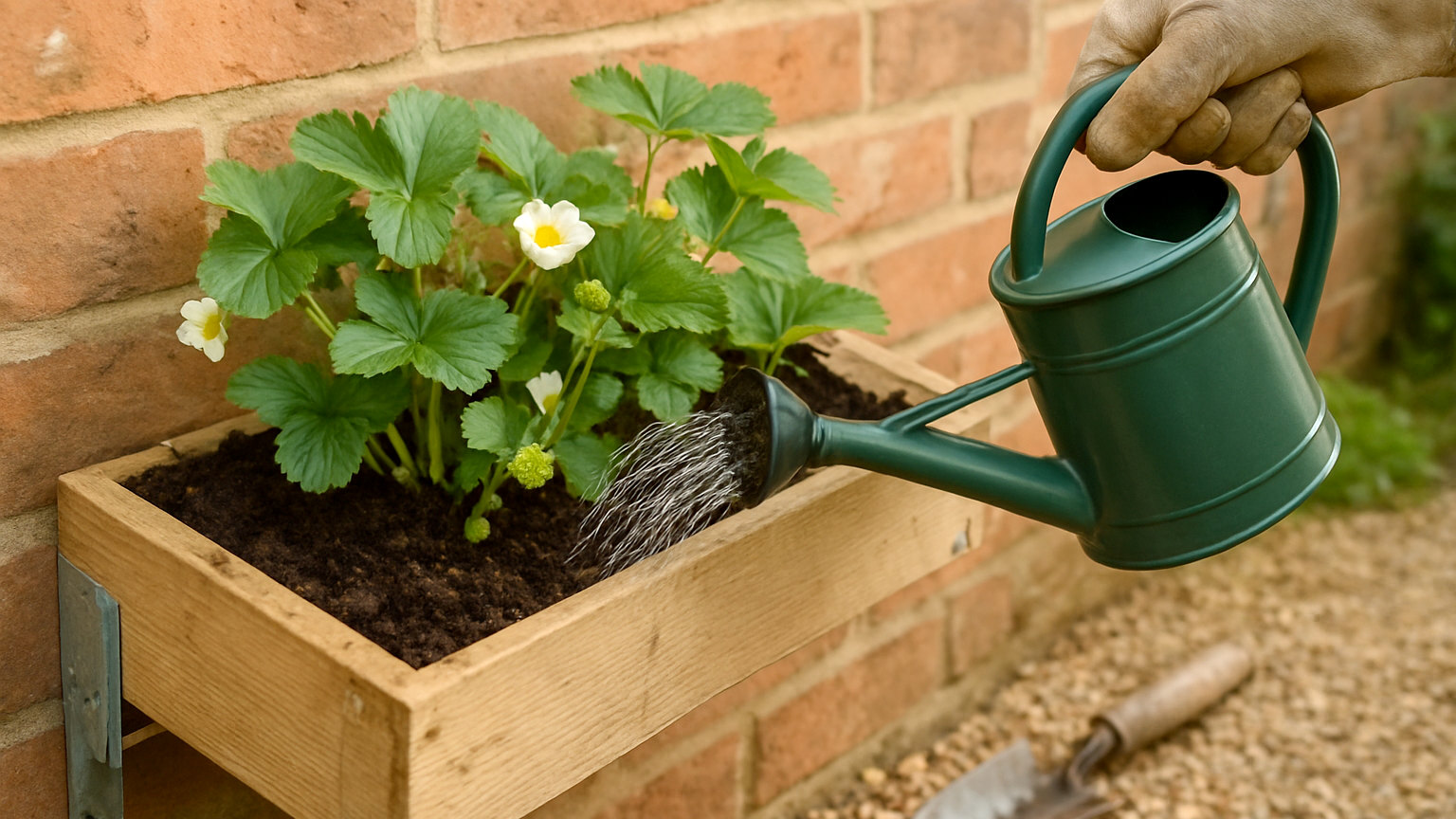
In a small garden, floor space is what you lack and wall space is usually going spare. Vertical planting takes advantage of that, and it works well provided two things are dealt with honestly: how it is fixed, and how it is watered.
Fixings and weight
Wet compost is heavy, and a wall planter that falls is dangerous. A modest wall system holding thirty litres of saturated compost weighs a considerable amount, and the load is entirely on the fixings.
Fix into masonry rather than mortar joints, using appropriate wall plugs or resin anchors, and never into rendered blockwork without checking what is behind it. On a fence, fix to the posts rather than the panels, which are not designed to carry weight.
Check fixings annually and after any gale. On a rented property, check before drilling, and on a boundary fence, remember you cannot fix anything to a fence you do not own without permission.
Keep systems away from anywhere a fall would cause injury, and be cautious about anything above a doorway or a seating area.
The watering problem
This is what defeats most vertical planting. The containers are small, exposed on all sides, often in full sun against a heat-reflecting wall, and water drains downwards through the system unevenly.
The top of a vertical planter dries out first and fastest, while the bottom stays wet from everything draining through it. Plants at the top die of drought while those at the bottom rot.
Daily watering is the minimum in summer, and twice daily on a hot wall. For anything beyond a couple of small planters, a drip irrigation system on a timer is close to essential, with emitters at each level.
Water-retaining granules in the compost and a mulch on each pocket both help.
Choosing a system
Individual wall-mounted pots and troughs are the simplest, easiest to water and easiest to replace when one plant fails.
Pocket systems in fabric or plastic hold more plants in less space and dry out fastest. Modular tray systems are more robust and considerably more expensive.
A pallet planter is the cheap homemade version. It works, provided it is fixed securely, lined with membrane and the timber is not treated with anything unsuitable for edibles.
Trellis with climbers is the simplest vertical planting of all, needing only one pot at ground level, and it covers far more wall than any pocket system.
What suits it
Shallow-rooted, compact and drought-tolerant plants do best.
Herbs are the obvious success: thyme, oregano, marjoram, chives and mint, though mint should have its own pocket. Salad leaves crop well and are picked at a convenient height.
Strawberries suit vertical systems particularly well, since the fruit hangs clear of the soil and slugs struggle to reach it.
Among ornamentals, sedums, sempervivums, heuchera, ferns for a shaded wall, trailing lobelia and small trailing pelargoniums all work.
What does not
Anything deep rooted, large or thirsty. Tomatoes, courgettes, brassicas, root vegetables and most shrubs need more compost than a wall pocket provides.
Anything requiring consistent moisture will suffer, since consistency is exactly what a vertical system finds hardest.
Aspect
A south-facing wall is hot and reflective, and compost temperatures against it can be extreme. Choose drought-tolerant planting and expect heavy watering.
A north-facing wall suits ferns, ivy, heuchera and shade-tolerant salads, and dries out far more slowly, which makes it easier to manage.
Protecting the wall
Leave an air gap between the planter and the wall so moisture does not sit against the brickwork, and make sure drainage water is directed away rather than running down the face of the building.
Damp problems caused by a wall planter are far more expensive to fix than the planting was to install.
Hanging baskets
The oldest vertical planting, and the same rules apply: use the largest basket you can hang, line it well, add water-retaining granules, and water daily. A basket dries faster than any other container in the garden.
Check the bracket as carefully as any other wall fixing, since a full basket is heavy and brackets rust through where they meet the wall.
A pulley system lets a basket be lowered for watering and picking, which makes a high one practical rather than an annual disappointment.


