
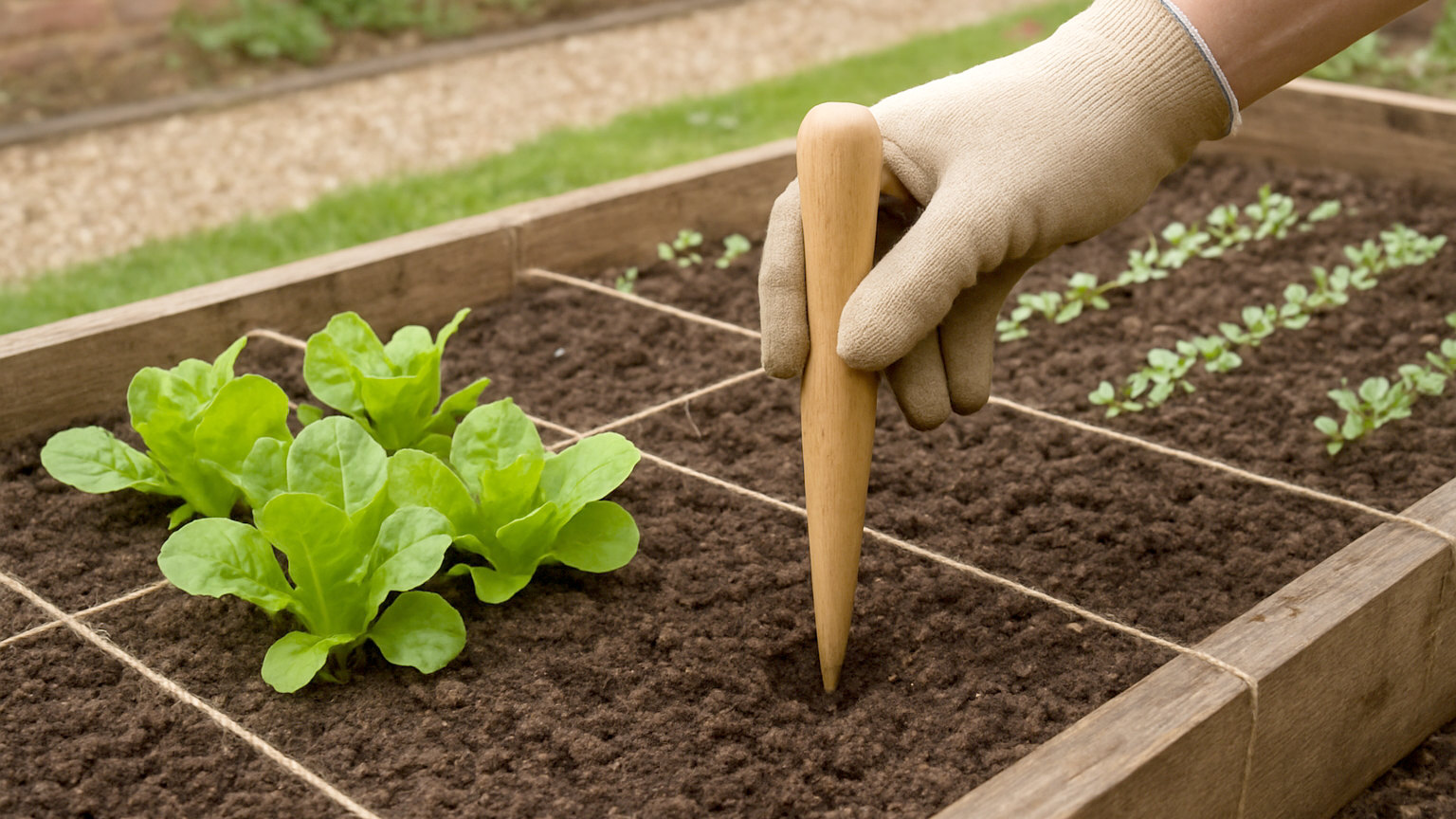
Square foot growing divides a raised bed into a grid of squares, each planted at its own density rather than in rows. In a small garden it produces considerably more than conventional row spacing, because it removes the paths that rows require.
The basic idea
A bed of 1.2 by 1.2 metres is divided into a grid of sixteen squares, each roughly 30 centimetres across. Each square holds one crop at the appropriate density.
Because you never walk on the bed, plants can be spaced at the distance they actually need rather than at the distance required to get a hoe between rows. That is where the gain comes from.
Mark the grid physically with string, thin battens or canes laid on the surface. It sounds unnecessary and it is what makes the method work in practice, since it turns planting into a series of small decisions rather than one large one.
How many per square
- 1 per square - cabbage, broccoli, cauliflower, courgette (which will spill over), pepper, aubergine, tomato
- 2 per square - cucumber trained upwards
- 4 per square - lettuce, chard, kohlrabi, garlic, strawberry, dwarf French beans
- 8 per square - peas, spinach, bush beans in some spacings
- 9 per square - beetroot, spring onions, turnips
- 16 per square - carrots, radishes
These are guides rather than rules, and it is worth checking the spacing on the seed packet and dividing the square accordingly.
What it is good at
Small plots, where the reduction in path space matters most. Beginners, because the grid makes planning concrete and prevents the common error of sowing far too much of one thing.
Succession, since a single square finishing can be replanted the same day without disturbing anything around it. A square of radishes cleared in May becomes a square of French beans in June.
Salad, quick crops and anything harvested a little at a time suit it particularly well.
Where it struggles
Crops that need room do not become smaller because you have drawn a grid. Courgettes, squash, sweetcorn, brassicas and maincrop potatoes all want more space than the method suggests, and squeezing them in produces disappointing plants.
Sweetcorn is a particular problem, since it is wind pollinated and needs a block of at least four by four plants to set properly, which uses most of a small bed on its own.
Intensive spacing also means intensive feeding and watering. The soil is working harder, so a generous annual mulch of compost is not optional.
Airflow is reduced at close spacing, which increases mildew and grey mould in a wet season.
Adapting it
Most gardeners end up using a modified version: grid squares for salad, roots and quick crops, and larger blocks of two, four or six squares for anything substantial.
Growing vertically frees up ground considerably. Climbing beans, cucumbers, and tomatoes trained up canes or netting at the north end of a bed take one square and produce a great deal.
Keeping it going
Have replacements ready in modules so a cleared square can be replanted immediately rather than sitting empty for a fortnight. This is what turns the method from tidy into genuinely productive.
Keep a simple plan on paper of what is in each square and when it was planted, which makes rotation possible and stops the same crop returning to the same square year after year without your noticing.
Rotation in a small grid
Strict four-year rotation is impractical at this scale. Moving crop families around the bed as far as possible from where they were last year captures most of the benefit.
Soil depth
The original method specified a shallow bed of around fifteen centimetres filled with a compost mix, on the basis that intensive spacing needs quality rather than depth. In practice, twenty to thirty centimetres over decent ground gives better results for roots and brassicas, and costs little more.
Rotation in a small grid
Strict four-year rotation is impractical at this scale. Moving crop families around the bed as far as possible from where they were last year captures most of the benefit.
Prioritise the crops where it matters most: never follow potatoes with tomatoes, and give brassicas the longest gap you can manage because clubroot persists in soil for many years.


