
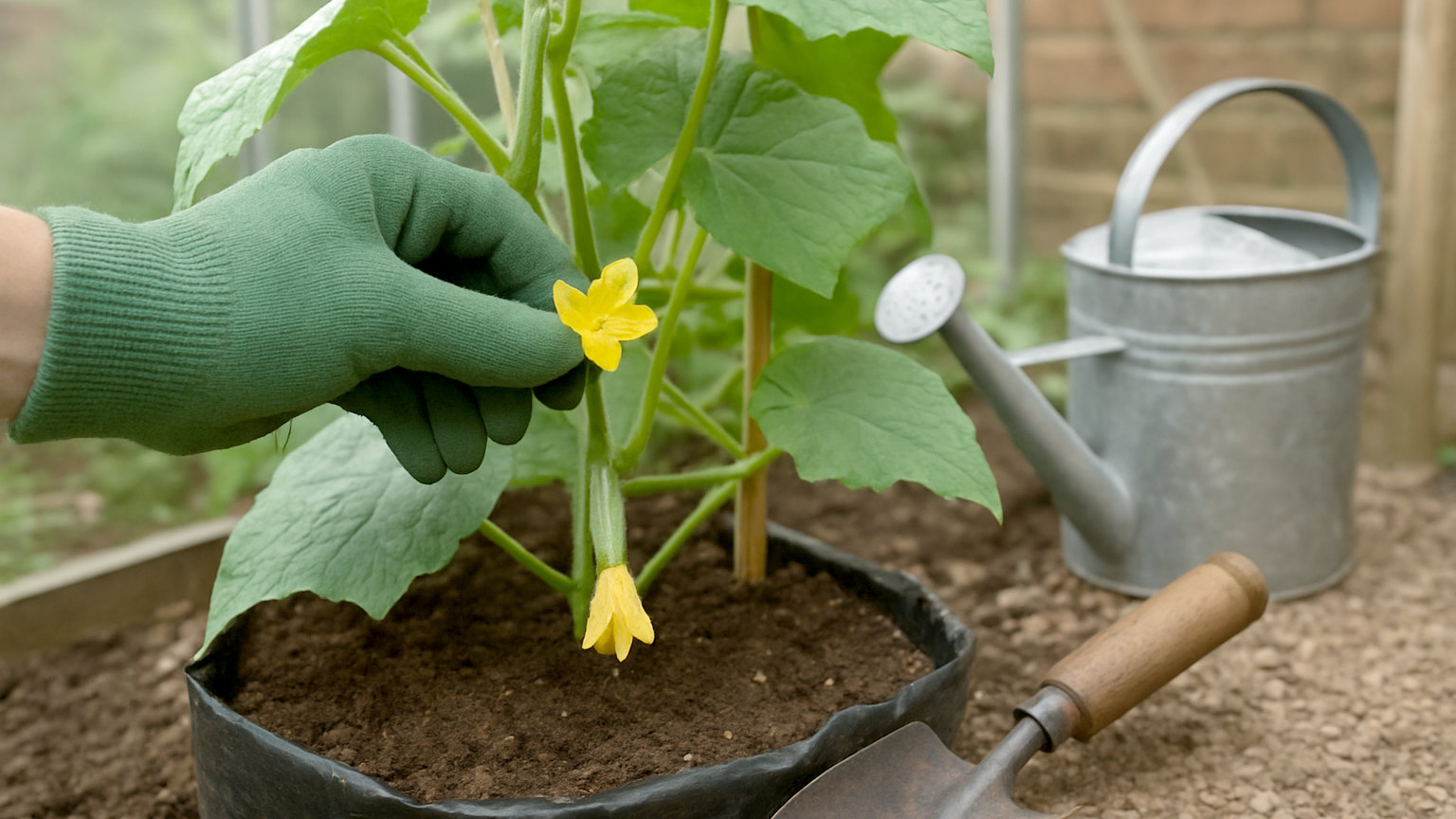
Greenhouse cucumbers crop heavily and quickly, and they want conditions that are almost the opposite of what tomatoes prefer: more humidity, more warmth and less ventilation. Growing the two in the same house is a compromise, and worth knowing before you plan the space.
Choose an all-female variety
Older greenhouse cucumbers produce both male and female flowers, and if a female flower is pollinated the fruit becomes bitter and swollen at one end.
With those varieties you must pick off every male flower, identifiable because it sits on a plain stem while a female has a tiny cucumber behind the bloom. Missing one spoils the fruit that follows.
All-female F1 varieties remove the problem entirely, producing no male flowers at all. For a greenhouse they are the sensible choice, and varieties such as Carmen and Femspot are widely available.
Ridge cucumbers, grown outdoors, are a different type and do need pollinating, so the rule does not transfer.
Sowing and planting
Sow from March to April, one seed per small pot, pushed in on its edge about two centimetres deep. Sowing on edge helps prevent the seed rotting.
They need warmth to germinate, around twenty to twenty-five degrees, and grow very fast afterwards, so there is nothing to gain from sowing early.
Plant into a large pot of at least thirty centimetres, a grow bag with two plants, or the border soil, once the roots fill the original pot. Plant slightly proud rather than deep, since cucumbers are prone to rotting at the collar.
Training
Grow them up a vertical string tied to a wire above and anchored below the rootball, twisting the stem around it weekly, or up a cane.
Pinch out the side shoots at two leaves beyond a developing fruit. Left alone the plant becomes an impenetrable mass of foliage carrying little.
When the main stem reaches the roof, pinch out the growing tip and let two side shoots take over, trained along the wire.
Humidity and heat
Cucumbers want humid air, which is why they suffer alongside tomatoes in a well-ventilated house.
Damp down the floor and staging on warm mornings, which raises humidity, cools the air and discourages red spider mite. Ventilate enough to prevent stagnant conditions but less than you would for tomatoes.
They want a minimum of about fifteen degrees at night and dislike cold draughts.
Watering and feeding
Water generously and consistently. Cucumbers are almost entirely water and a plant that dries out even briefly drops its fruit and turns bitter.
Water at the base, avoiding the crown of the plant. In hot weather a large plant may need water twice a day.
Feed weekly with a high-potassium tomato feed once the first fruits set, increasing to twice weekly at the height of cropping.
Picking
Pick regularly and young, cutting the stem with a knife rather than pulling. A cucumber left to grow large signals to the plant that it has done its job, and cropping slows sharply.
Expect fruit within eight to twelve weeks of sowing, and a well-managed plant will produce twenty or more cucumbers over a season.
Problems
Powdery mildew is almost inevitable by late summer, showing as a white dusty coating. It comes from dry roots and humid air, so consistent watering and airflow reduce it. Remove the worst leaves and accept the rest.
Red spider mite causes fine pale mottling and eventually webbing, and thrives in hot dry air. Damping down is the main defence, and the predatory mite Phytoseiulus works well as a biological control.
Whitefly gather under the leaves and are controlled effectively by the parasitic wasp Encarsia in an enclosed space.
Fruit aborting when small, turning yellow at the tip and shrivelling, is usually irregular watering or a check from cold.
Growing them alongside tomatoes
The two want different conditions, cucumbers preferring humidity and tomatoes preferring airflow. In a single greenhouse the usual compromise is to put cucumbers at the far end away from the door, where it is warmer and less draughty, and accept that neither is in ideal conditions.
If you grow both seriously, a partition of polythene down the middle lets you manage the two halves separately, and it costs almost nothing.


