
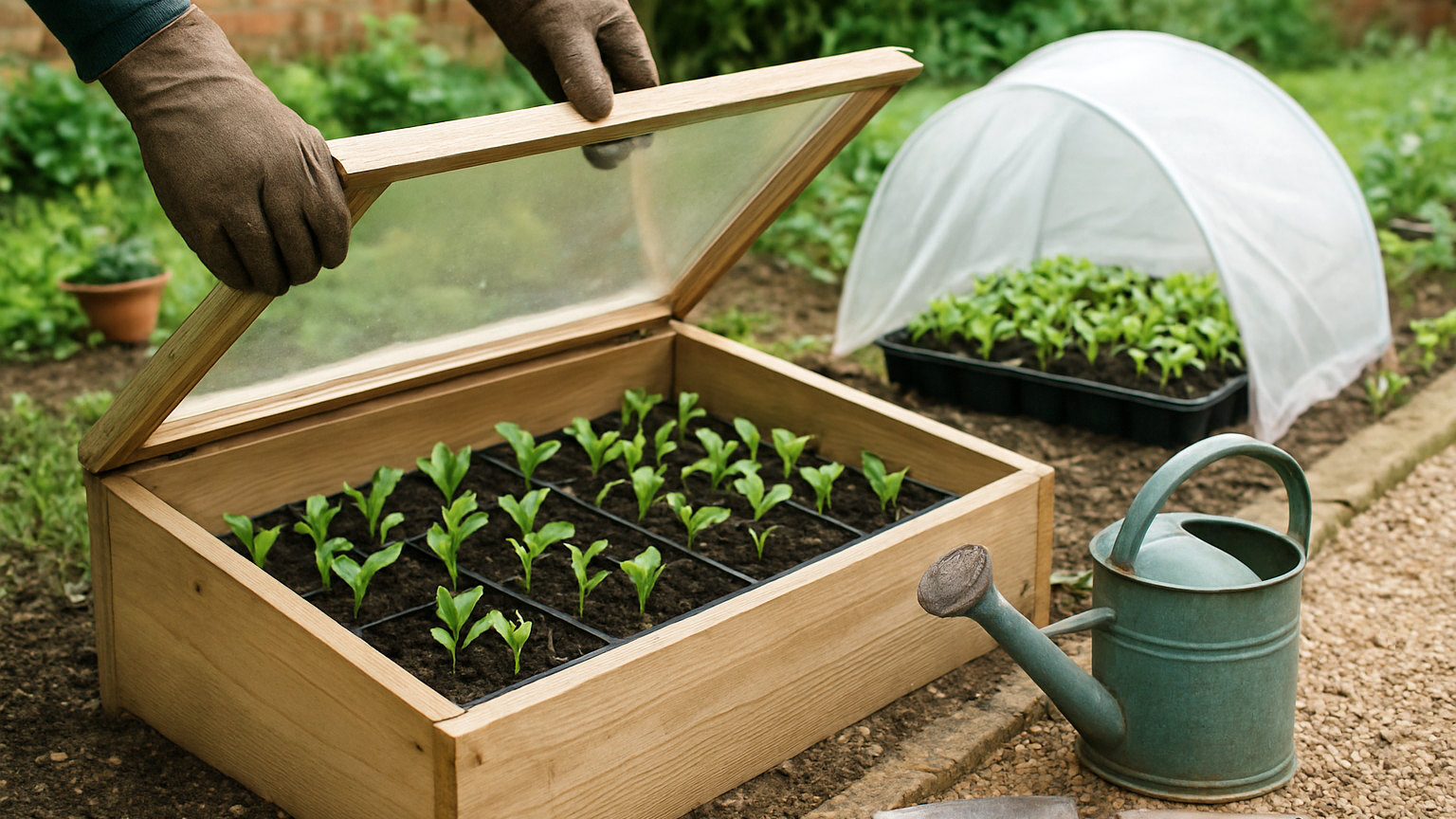
A greenhouse is not the only option, and for some purposes it is not the best one. A cold frame costs almost nothing and does several jobs better, while a polytunnel gives far more covered space for the money.
What a cold frame is for
A cold frame is a low box with a transparent sloping lid, unheated, sitting on the ground.
Its main use is hardening off, and it does this better than anything else, since the process becomes a matter of opening the lid progressively rather than carrying trays in and out twice a day.
Beyond that it overwinters hardy cuttings and autumn-sown seedlings, protects winter salads, brings on early sowings, provides a nursery bed for young plants, and hardens off shop-bought bedding.
For most gardeners a greenhouse plus a cold frame is a better combination than a slightly larger greenhouse.
Building one cheaply
A frame is easily made. Four sides of timber, higher at the back than the front so the lid slopes to shed rain and catch low sun, with an old window or a sheet of twin-wall polycarbonate as the lid.
Straw bales with a window laid on top work for a season. A stack of bricks does the same. The construction genuinely does not matter provided the lid can be propped open at varying heights.
Face it south, on a level site against a wall or a hedge for shelter, and make sure the lid is secured against wind, which will otherwise take it.
Using a frame
Ventilation is the whole skill. Prop the lid open on mild days and close it in the afternoon before the temperature drops, and shut it in frost.
Temperatures inside rise very quickly on a sunny day even in March, and plants scorch. A frame closed on a bright spring day can exceed thirty degrees.
Add insulation with fleece or bubble wrap inside on cold nights, and shade with mesh in high summer.
Polytunnels
A polytunnel gives several times the covered area of a greenhouse for the same money, which is its overwhelming advantage. For anyone growing quantity rather than a few specimen crops, it is the better value.
The trade-offs are real. The cover lasts perhaps five to ten years before it degrades and must be replaced. Light transmission is lower and more diffuse than glass. Condensation drips from the roof. Ventilation is harder, usually depending on doors at both ends and side vents.
They are also large and industrial in appearance, which suits an allotment better than a small garden.
Siting a tunnel
Align the length north to south for even light distribution, and site it out of the strongest wind, since a tunnel is essentially a sail and cover failure is usually wind related.
Anchor it properly according to the instructions, and keep the polythene taut, since a loose cover flaps and wears through at the hoops.
Doors at both ends allow through ventilation, which is close to essential in summer.
Cloches and low tunnels
The cheapest covered growing there is. Individual cloches, cut-off plastic bottles, or low tunnels of polythene or fleece over wire hoops.
They warm the soil ahead of sowing, protect early sowings from cold and pests, and extend the autumn season by several weeks. Fleece laid directly on a crop does much the same and lets rain through.
For many gardeners a few metres of low tunnel achieves more per pound spent than any other piece of equipment.
Choosing between them
A greenhouse suits raising plants, growing a few high-value crops well and overwintering tender specimens, with the best light and the longest life.
A polytunnel suits growing quantity, and an allotment or a large plot.
A cold frame suits hardening off, propagation and winter salads, and complements either of the others.
Cloches suit extending the season in open ground and cost very little.
Planning and permissions
Small domestic structures are normally permitted development, subject to limits on height and position. Polytunnels on allotments are often restricted by the site's own rules rather than by planning law, so check with the association before buying one.
Listed buildings and conservation areas have tighter requirements for anything visible, and it is worth a call to the local authority before spending.


