
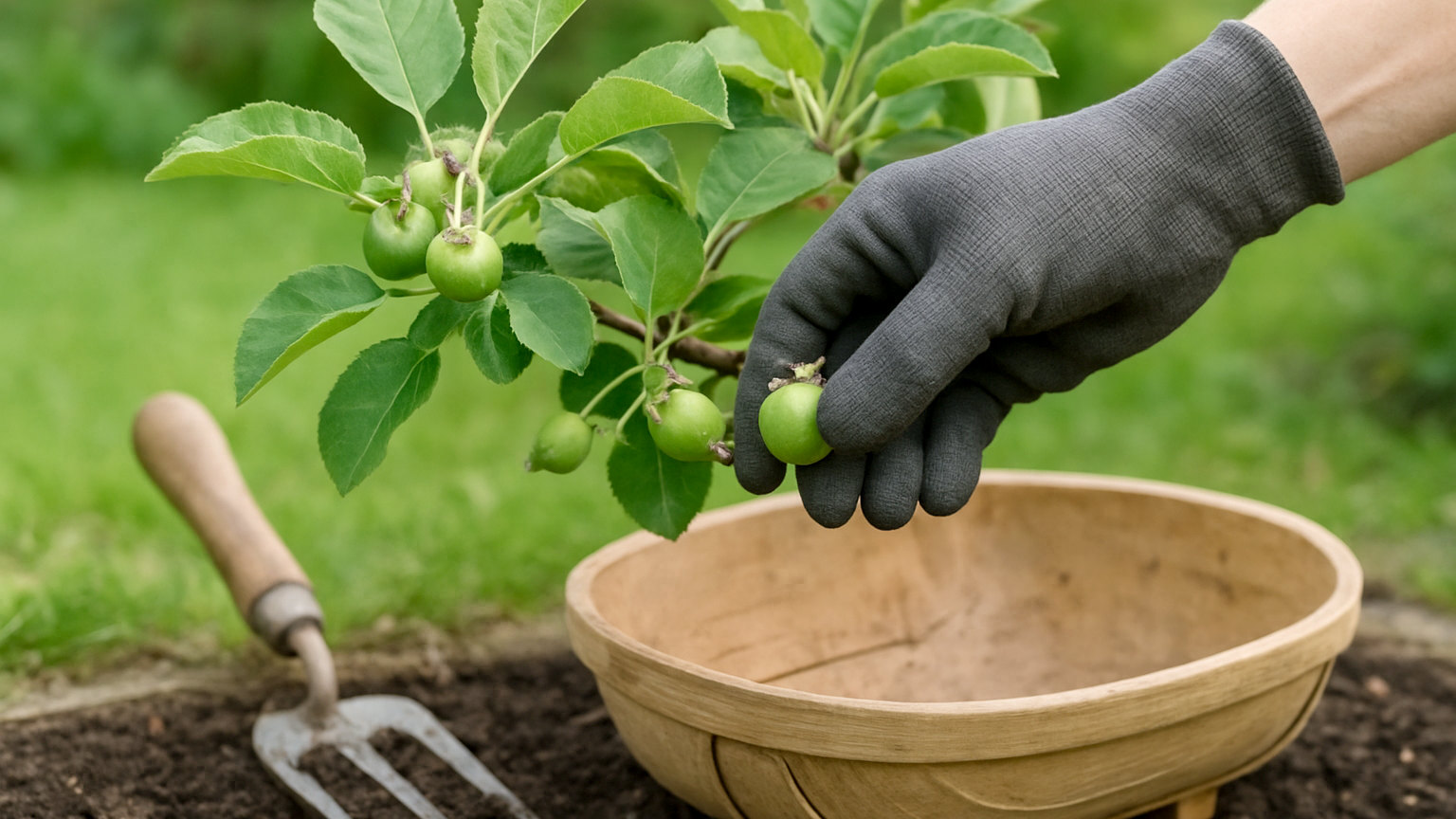
A fruit tree in early summer sheds a proportion of its immature fruit, sometimes a great deal of it, and every year gardeners assume something is wrong. It is normal, it has a name, and what you do afterwards matters more than the drop itself.
The June drop
In June, apples and pears in particular shed fruitlets that have not been properly pollinated or that the tree cannot support. It is a self-regulating mechanism and a sign of a tree behaving sensibly.
The scale can be alarming, with hundreds of small fruits on the ground under a mature tree. Provided plenty remain on the branches, nothing has gone wrong.
Drought, frost damage at blossom time and a heavy crop the previous year all increase it. Watering during dry spells in late spring reduces it noticeably.
Thin afterwards, not before
Wait until the June drop has finished, usually late June or early July, before thinning. Thinning beforehand means removing fruit the tree was going to shed anyway, and you may end up with too little.
How far apart
For apples, reduce each cluster to one or two fruits, spaced roughly ten to fifteen centimetres apart along the branch. Pears need less, and can be left at two per cluster about eight centimetres apart.
Plums are thinned to about five to eight centimetres apart, and this matters most of all, since plum branches are brittle and break under an unthinned crop.
Remove the king fruit, the largest central one in each apple cluster, which is often misshapen and produces poorly.
Take out anything small, damaged, marked or on the shaded inside of the tree first, keeping the best-placed fruit on the outside where it will colour properly.
Why bother
Thinning produces larger, better fruit and prevents the tree exhausting itself. A tree carrying a full crop puts everything into it and often produces almost nothing the following year.
It also protects the tree physically. Branches carrying too much weight bend, split at the join and tear, and those wounds admit canker and, on stone fruit, silver leaf.
Better airflow around thinned fruit reduces scab, brown rot and mildew, and thinned fruit stores considerably better.
Biennial bearing
Some varieties fall into a pattern of cropping heavily one year and hardly at all the next, which is biennial bearing. Once established it is self-perpetuating, because the heavy year uses up the reserves needed to form flower buds for the following one.
Thinning hard in the heavy year is the main way to break the cycle. Some growers thin very aggressively in an on year, removing up to half the fruit, which usually restores annual cropping within two seasons.
Consistent feeding and watering help, since a stressed tree is more likely to fall into the pattern.
How to do it
Use scissors or small snips rather than pulling, which can tear the spur off and cost you fruit in future years. Cut the stalk cleanly and leave the spur intact.
Work over the tree systematically, branch by branch, rather than dotting about. It takes an hour on a garden tree and is one of the more satisfying jobs of the year.
Trained forms
Cordons, espaliers and fans need thinning too, and arguably more, since they carry a lot of fruit on a small framework and crowded fruit stays small. The advantage is that everything is at eye level and the job is quick.
Fruit dropping at other times
Propping heavy branches
Even a thinned tree in a heavy year benefits from support. A forked stake under a laden branch, padded where it touches the bark, prevents the splitting that admits canker and silver leaf. Put props in before the branches are bending rather than after.
Fruit dropping at other times
Fruit falling in spring, shortly after blossom, usually indicates poor pollination or frost damage. Fruit falling in late summer as it approaches ripeness may be codling moth, wind, or simply that it is ready to pick.
Fruit falling steadily through a dry summer is nearly always drought, and the answer is a thorough weekly soak rather than a daily sprinkle. A mulch applied in spring reduces the problem considerably by holding moisture in the root zone.


