
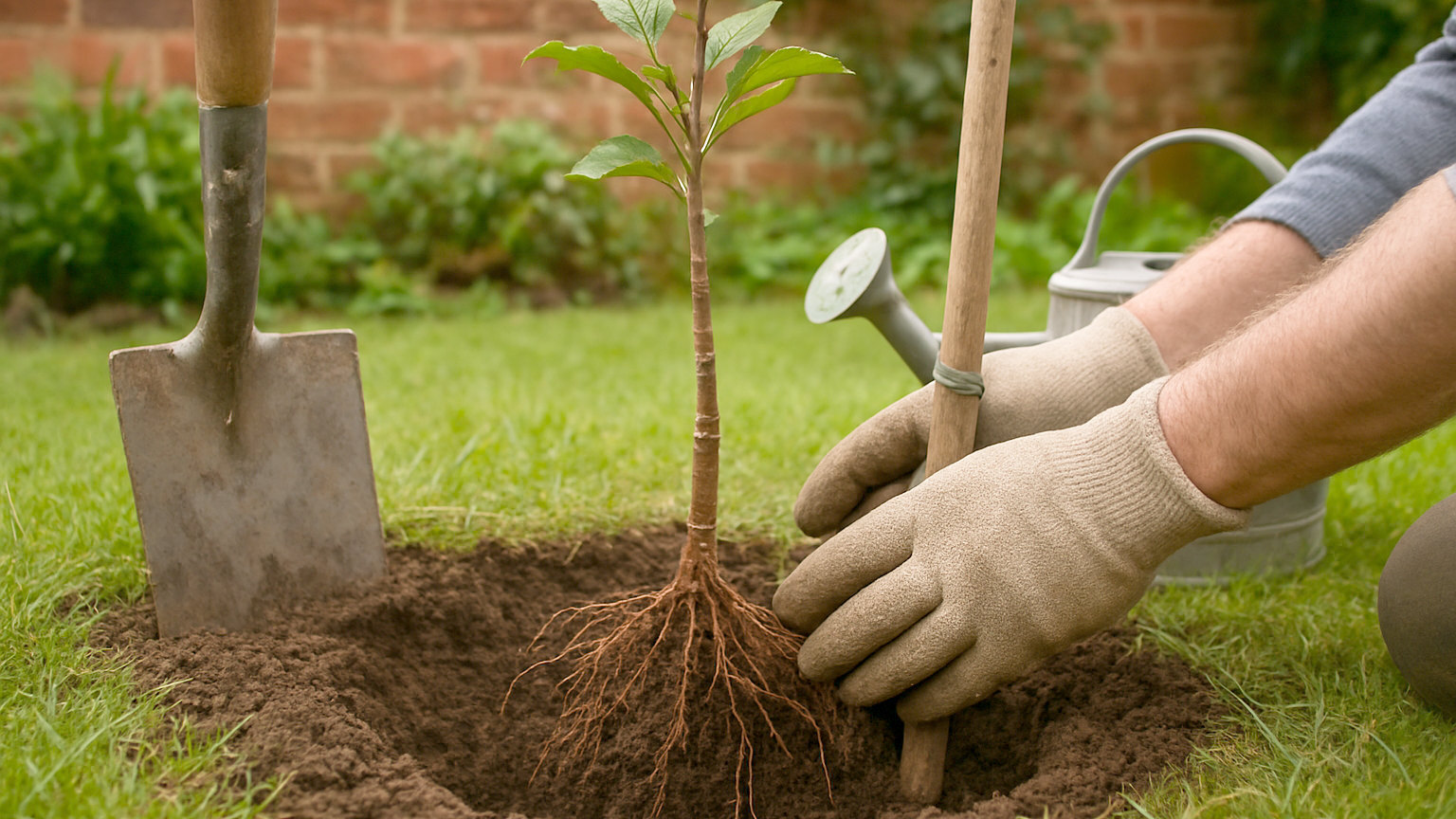
Nearly every fruit tree that dies, dies in its first two years, and the cause is almost always planting or the aftercare rather than the tree. The good news is that the whole business is straightforward and takes about half an hour.
When to plant
Bare-root trees are lifted and sold while dormant, from November to March, and this is the best time to plant. The tree has months to make roots before it needs to support leaves, and bare-root stock is cheaper and offers far more variety than potted trees.
Container-grown trees can go in at any time the ground is not frozen or waterlogged, but summer planting means watering diligently through the first season.
If a bare-root tree arrives and you cannot plant immediately, heel it into a spare patch of soil or a bucket of damp compost. Do not let the roots dry out at any point, even for an hour.
Digging the hole
Make it square rather than round, and wider than it is deep. Roots turning in a smooth circular hole tend to keep circling; the corners of a square hole encourage them out into the surrounding soil.
Width matters far more than depth. Aim for about three times the width of the root spread and only as deep as the roots need. Loosen the sides and base with a fork if the ground is compacted, particularly on clay, where a smooth-sided hole in wet soil acts as a sump.
Do not fill the hole with rich compost. A tree planted into a pocket of luxury never sends roots out into the surrounding soil, and it stays stunted and unstable. Backfill with the soil you removed, improved with a little compost at most.
Planting depth, and the graft union
The graft union must stay above soil level. This is the swollen kink low on the trunk where the variety was joined to the rootstock. If it is buried, the variety roots into the soil above the graft, the rootstock stops controlling size, and a tree bought as a three-metre garden apple grows into a six-metre orchard tree.
Plant so the old soil mark on the stem sits level with the surrounding ground, which usually leaves the graft five to ten centimetres clear. Lay a cane across the hole to check the level before backfilling.
Spread the roots out rather than cramming them in, backfill in stages, and firm gently with your heel as you go to remove air pockets without compacting the soil to concrete.
Staking
Stake low and short. A stake driven in at an angle of forty-five degrees, or a short vertical stake reaching only about a third of the way up the trunk, holds the roots steady while allowing the top to flex. That flexing is what makes the trunk thicken and strengthen.
A tall stake tied near the head produces a tree that leans on it permanently and snaps when it is removed. Use a proper adjustable tree tie with a spacer, check it every six months, and loosen it as the trunk thickens, because a forgotten tie will strangle a tree.
Most trees on semi-dwarfing rootstocks can have the stake removed after two or three years. Trees on M27 and M9 need staking permanently.
Watering, which decides everything
Water in thoroughly at planting, even in winter, to settle soil around the roots. Then water generously through the first two growing seasons, particularly in dry spells.
A full watering can or two once a week is far better than a daily sprinkle, which only wets the surface and encourages shallow rooting. A tree that has been allowed to dry out repeatedly in its first summer may survive and will never thrive.
Mulch, and keep the grass off
Mulch a circle at least a metre across with compost or bark, keeping it a few centimetres clear of the trunk itself, since mulch piled against bark causes rot.
Keep that circle free of grass for the first few years. Grass competes for water and nutrients aggressively and is one of the main reasons young trees grow slowly. Do not put a mower or a strimmer anywhere near the trunk, as bark damage at the base is frequently fatal.
The first two years
Remove any fruit that sets in the first year, and thin it hard in the second. Letting a young tree crop early diverts energy from root and branch growth, and a tree allowed to establish first will out-produce it within five years.


