
Picked at the right moment and stored properly, late apples will keep into the new year and sometimes to spring. Picked too early or stored badly, the same fruit is soft and useless by November.
The lift and twist test
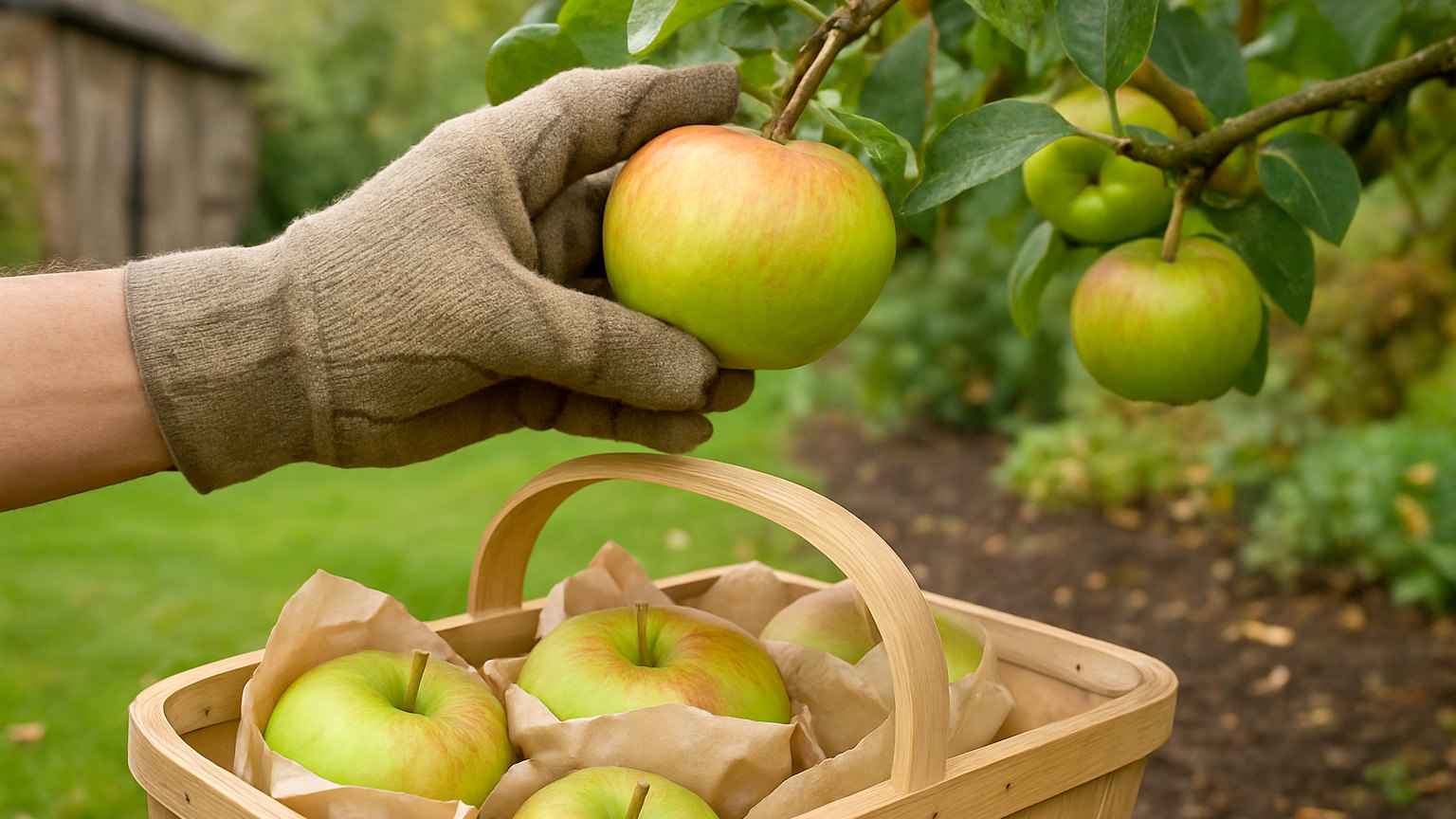
Cup the apple in your palm, lift it horizontally and twist very gently. If it is ready, the stalk parts from the spur without effort. If you have to tug, leave it another week.
This is far more reliable than colour, which varies enormously by variety and by how much sun that side of the fruit has had.
A second sign is the pips. Cut one apple open: if the pips have turned brown, the fruit is mature. White pips mean it needs longer.
Windfalls appearing in quantity often indicate the crop is approaching readiness, though they may also be codling moth or wind.
Not all apples store
Early varieties, picked in August and early September, do not keep at all. Discovery, Beauty of Bath and similar are ready when picked and go soft and mealy within days. Eat them straight off the tree.
Mid-season varieties picked in September keep for a few weeks.
Late varieties picked in October are the ones that store, and many improve in storage, developing flavour over weeks. Bramley, Egremont Russet and the later dessert varieties fall here.
Knowing which you have determines whether storage is worth attempting.
Pick carefully
Handle every apple as though it were an egg. Bruises are invisible for a few days and then rot, and one rotting apple will spoil everything around it.
Pick with the stalk attached, since a fruit that has lost its stalk has an open wound. Lay fruit into a padded box rather than dropping it, and never tip apples from one container into another.
Store only perfect fruit. Anything bruised, marked, holed by codling moth or lacking a stalk should be used within days or processed.
Storage conditions
Apples want cool, dark, slightly humid, well-ventilated and frost free. Somewhere between about three and seven degrees is ideal, which in practice means an unheated garage, shed, cellar or outbuilding.
A garden shed works if it does not freeze. A centrally heated house does not, since warmth ruins them within weeks.
Do not store apples with potatoes or onions. Apples give off ethylene, which makes potatoes sprout, and they absorb the smell of onions readily.
How to store them
Use slatted wooden trays or cardboard boxes with holes, laying fruit in a single layer without touching. Stacking trays lets air circulate between them.
Wrapping each apple in newspaper or greaseproof paper is worth the effort, since it slows moisture loss and stops rot spreading from one fruit to its neighbours.
Store varieties separately, since they keep for different lengths of time and you want to use the shortest keepers first. Label the trays.
Check them monthly
Go through the store every few weeks and remove anything soft, brown or shrivelled. A single rotting apple will take a whole tray with it, which is the usual reason a store fails.
Wrapping helps considerably here, since a wrapped rotten apple is contained.
Pears are different
Pears are picked underripe and stored unwrapped in single layers, then brought into room temperature a few at a time to ripen. Wrapping and warmth are exactly wrong for them, which is worth remembering if you grow both.
Dealing with a glut
Apples that will not store are best juiced, made into sauce and frozen, dried in rings, or turned into chutney. Bramleys freeze well as prepared slices or as cooked purée.
Checking a store you inherited
If fruit has been stored somewhere for the first time, check it weekly at first rather than monthly until you know how the space behaves. A garage that seemed cool in October may warm considerably on a mild spell, and a shed can freeze in January, which turns a whole crop to mush on thawing.
Dealing with a glut
Apples that will not store are best juiced, made into sauce and frozen, dried in rings, or turned into chutney. Bramleys freeze well as prepared slices or as cooked purée.
Community apple pressing days are common in autumn and are worth seeking out if you have more fruit than you can handle.


