
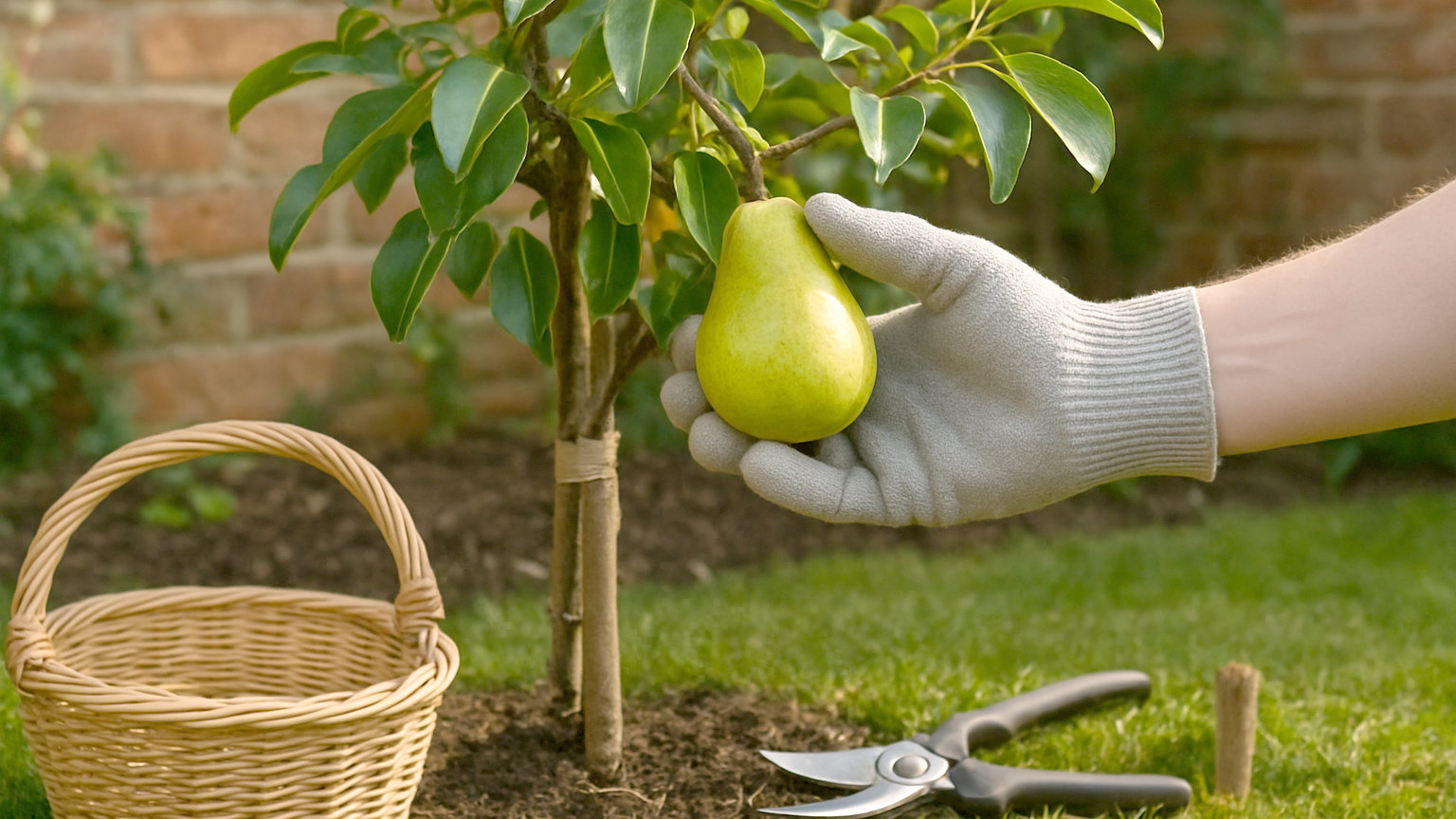
Pears need slightly more warmth and shelter than apples and reward it with a fruit that is difficult to buy in good condition. They also carry one rule that catches out almost everybody: a pear left to ripen on the tree is already past its best.
Position
Pears flower two or three weeks earlier than apples in terms of their own season but need a warmer, more sheltered site overall. A south or west-facing wall is ideal, and in colder or more exposed gardens a trained fan or espalier against a wall will crop when a free-standing tree struggles.
They want deep, moisture-retentive soil that does not dry out, and they are less tolerant of drought than apples. Avoid frost pockets, since the blossom is vulnerable.
Rootstocks
Pears are grafted onto quince rootstocks rather than pear ones, which control size effectively.
- Quince C - dwarfing, giving a tree around two and a half to three metres. Suits small gardens and trained forms
- Quince A - semi-vigorous, around three to four and a half metres. The general purpose choice
- Quince Eline - a newer dwarfing option, similar in effect to Quince C
Some varieties are incompatible with quince and are sold with an interstem, a short section of a compatible variety grafted between rootstock and top. A good nursery will tell you.
Varieties
Conference is the reliable one for British gardens: heavy cropping, tolerant of poorer conditions, and partially self-fertile so it will set some fruit alone. It remains the sensible first choice.
Doyenné du Comice has the best flavour of any pear grown here and is considerably fussier, wanting a warm sheltered site and a pollination partner. Beth and Concorde are both reliable and earlier.
Williams, sold as Bartlett in some places, is early and does not keep.
Pollination
Most pears crop far better with a partner flowering at the same time. Varieties are grouped by flowering period, and you need one in the same group or an adjacent one.
Conference will produce a crop alone, though the fruit is often narrow and misshapen without cross-pollination. If you have room for only one tree, Conference is the variety to choose.
Note that pears flower earlier than apples, so an apple will not pollinate a pear.
Picking, which is the part people get wrong
Pears must be picked before they are ripe and ripened indoors. Left on the tree they ripen from the inside outwards, and by the time the outside feels ready the core has gone soft, brown and gritty.
The test is to lift the fruit horizontally with the palm of your hand and twist gently. If the stalk parts from the spur easily, it is ready to pick, however hard it feels.
Early varieties are picked in August and September and eaten within days. Later varieties are picked in September and October and stored.
Ripening and storing
Store picked pears somewhere cool, dark and airy, in single layers on slatted trays, not touching each other. Do not wrap them, unlike apples.
Bring a few indoors to room temperature a few days before you want them. They ripen quickly at that point and go over within a day or two, so bring them in a handful at a time rather than all at once.
Test at the neck rather than the belly. A pear that yields slightly to gentle pressure just below the stalk is ready.
Pear rust
Bright orange spots on the upper leaf surface with corresponding growths beneath, increasingly common across the country.
The fungus alternates between pears and junipers, so removing nearby junipers helps if that is practical, though spores travel considerable distances. Rake up and bin affected leaves in autumn, and prune out any swellings on the branches.
It weakens a tree over years rather than killing it, and a healthy well-fed tree tolerates it reasonably well.
Other problems
Feeding and watering
Pears are hungrier and thirstier than apples. Mulch with well-rotted manure each spring, keeping it clear of the trunk, and apply sulphate of potash in late winter to support fruiting. Water thoroughly in dry spells while the fruit is swelling, since drought causes small hard fruit and premature drop.
Other problems
Pear midge causes fruitlets to blacken and drop in early summer; collect and destroy affected fruitlets rather than letting them fall to the soil. Scab produces dark blotches on leaves and fruit, and is reduced by good airflow and clearing fallen leaves.


